āϰāĻŦিāĻŦাāϰ, ā§§ā§Ļ āĻāĻĒ্āϰিāϞ, ⧍ā§Ļ⧍⧍

Allah

Allah


Allah
This article is about the Arabic word "Allah". For the Islamic view of God, see God in Islam. For other uses, see Allah (disambiguation).

The word 'Allah' in Arabic calligraphy

Allah (/ˈÃĻl.lə, ˈɑːl.lə, əˈl.lɑː/;[1][2] Arabic: Ø§Ų„Ų„Ų‡, romanized: Allāh, IPA: [ʔaÉĢ.ÉĢaːh] (listen)) is the common Arabic word for God. In the English language, the word generally refers to God in Islam.[3][4][5] The word is thought to be derived by contraction from al-ilāh, which means "the god", and is linguistically related to the Aramaic words Elah and ܐܲÜ ܵܗܵܐ (ĘŧAlÃĸhÃĸ) and the Hebrew word El (Elohim) for God.[6][7]

The word Allah has been used by Arabic people of different religions since pre-Islamic times.[8] The pre-Islamic Arabs worshipped a supreme deity whom they called Allah, alongside other lesser deities.[9] Muhammad used the word Allah to indicate the Islamic conception of God. Allah has been used as a term for God by Muslims (both Arab and non-Arab) and even Arab Christians[10] after the term "al-ilāh" and "Allah" were used interchangeably in Classical Arabic by the majority of Arabs who had become Muslims. It is also often, albeit not exclusively, used in this way by BÃĄbists, BahÃĄĘŧís, Mandaeans, Indonesian and Maltese Christians, and Sephardi Jews.[11][12][13][14] Similar usage by Christians and Sikhs in West Malaysia has recently led to political and legal controversies.[15][16][17][18]


Contents

1Etymology
2Usage
2.1Pre-Islamic Arabians
2.2Christianity
2.3Islam
3Pronunciation
4As a loanword
4.1English and other European languages
4.2Malaysian and Indonesian language
5National flags with "Allah" written on them
6Typography
6.1Unicode
7See also
8Further reading
8.1Online
9Citations
10General references
11External links
Etymology


The Arabic components that make up the word "Allah":

alif
hamzat waášŖl (Ų‡Ų…Ø˛ØŠ ؈ØĩŲ„)
lām
lām
shadda (شد؊)
dagger alif (ØŖŲ„Ų ØŽŲ†ØŦØąŲŠØŠ)
hāʞ

The etymology of the word Allāh has been discussed extensively by classical Arab philologists.[19] Grammarians of the Basra school regarded it as either formed "spontaneously" (murtajal) or as the definite form of lāh (from the verbal root lyh with the meaning of "lofty" or "hidden").[19] Others held that it was borrowed from Syriac or Hebrew, but most considered it to be derived from a contraction of the Arabic definite article al- "the" and ilāh "deity, god" to al-lāh meaning "the deity", or "the God".[19] The majority of modern scholars subscribe to the latter theory, and view the loanword hypothesis with skepticism.[20]

Cognates of the name "Allāh" exist in other Semitic languages, including Hebrew and Aramaic.[21] The corresponding Aramaic form is Elah (אלה), but its emphatic state is Elaha (אלהא). It is written as ܐܠܗܐ (ĘŧĔlāhā) in Biblical Aramaic and ܐܲÜ ܵܗܵܐ (ĘŧAlÃĸhÃĸ) in Syriac as used by the Assyrian Church, both meaning simply "God".[22] Biblical Hebrew mostly uses the plural (but functional singular) form Elohim (אלהים‎), but more rarely it also uses the singular form Eloah (אלוהּ‎).[citation needed]
Usage
Pre-Islamic Arabians
See also: Religion in pre-Islamic Arabia
Deities of the ancient Near East

hide
Ancient Egyptian

Amun
Anubis
Apis
Atum
Buchis
Geb
Horus
Isis
Montu
Nephthys
Nut
Osiris
Ptah
Qetesh
Ra
Set
Shu
Tefnut
Thoth


hide
Arabian

Allah
Aglibol
Abgal
al-Lat
al-Qaum
al-‘UzzÃĄ
Atarsamain
Athtar
Baalshamin
Bēl
Dhul Khalasa
Dushara
Gad
Hubal
Malakbel
Manaf
Manāt
Nasr
Nuha
Orotalt
Ruda
Suwa'
Theandrios
Wadd
Ya'uq
YaghÅĢth
Yarhibol
Yatha


hide
Eblaite and Syrian

Adamma
AÅĄtabil
Belet Ekallim
Belet Nagar
Dagan
Hadabal
Haddu of Halab
Hebat
Ishtar
Ishara
Kubaba
Kura
Ninkarrak
Saggar
Shalash
Wer


hide
Elamite

Humban
Inshushinak
Ishmekarab
Jabru
Kiririsha
Lagamar
Manzat
Nahundi
Narundi
Napir
Napirisha
Pinikir
Ruhurater
Simut


hide
Hurrian

Allani
AÅĄtabi
Hayya
Hepat
Hutena and Hutellura
Ishara
Kubaba
Kumarbi
KuÅĄuá¸Ģ
Lelluri
Mitanni deities (Indra, Mitra, Varuna)
Ninatta and Kulitta
Nupatik
Pirengir
Shalash
Å arruma
Å auÅĄka
Å imige
Å uwala
Teshub
Tilla


hide
Levantine (Canaanite and Ugaritic)

Adonis
Anat
Arsay
Arsu
Ashima
Ashtart/Astarte
Atargatis
Athirat
Attar
Azizos
Baalat Gebal
Baal
Baal Hammon
Chemosh
El
Eshmun
Kotharat
Kothar-wa-Khasis
Marqod
Melqart
Milcom
Misor
Mot
Nikkal
Qos
Resheph
Shadrafa
Shahar
Shalim
Shapash
Sydyk
Tanit
Yam
Yahweh
Yarikh


hide
Mesopotamian

Adad/Ishkur
Amurru
An/Anu
Asarluhi
Ashur
Aya
Dumuzi
Enki/Ea
Enlil
Ereshkigal
Gibil
Inanna/Ishtar
Ishtaran
Manungal
Marduk
Nabu
Nammu
Nanaya
Nisaba
Shala
Å umugan
Nanna/Sin
Nergal
Ninazu
Ninegal
Ningal
Ningishzida
Ninhursag
Ninisina
Ninlil
Ninshubur
Pabilsag
Papsukkal
Sarpanit
Sebitti
Tishpak
Utu/Shamash
Zababa

Religions of the ancient Near East


v
t
e


Regional variants of the word Allah occur in both pagan and Christian pre-Islamic inscriptions.[8][23] Different theories have been proposed regarding the role of Allah in pre-Islamic polytheistic cults. According to the Islamic scholar Ibn Kathir, Arab pagans considered Allah as an unseen God who created and controlled the Universe. Pagans believed worship of humans or animals who had lucky events in their life brought them closer to God. Pre-Islamic Meccans worshiped Allah alongside a host of lesser gods and those whom they called the “daughters of Allah.”[24] Islam forbade worship of anyone or thing other than God.[25] Some authors have suggested that polytheistic Arabs used the name as a reference to a creator god or a supreme deity of their pantheon.[26][27] The term may have been vague in the Meccan religion.[26][28] According to one hypothesis, which goes back to Julius Wellhausen, Allah (the supreme deity of the tribal federation around Quraysh) was a designation that consecrated the superiority of Hubal (the supreme deity of Quraysh) over the other gods.[8] However, there is also evidence that Allah and Hubal were two distinct deities.[8] According to that hypothesis, the Kaaba was first consecrated to a supreme deity named Allah and then hosted the pantheon of Quraysh after their conquest of Mecca, about a century before the time of Muhammad.[8] Some inscriptions seem to indicate the use of Allah as a name of a polytheist deity centuries earlier, but nothing precise is known about this use.[8] Some scholars have suggested that Allah may have represented a remote creator god who was gradually eclipsed by more particularized local deities.[29][30] There is disagreement on whether Allah played a major role in the Meccan religious cult.[29][31] No iconic representation of Allah is known to have existed.[31][32] Allah is the only god in Mecca that did not have an idol.[33] Muhammad's father's name was ĘŋAbd-Allāh meaning "the slave of Allāh".[28]
Christianity

Arabic-speakers of all Abrahamic faiths, including Christians and Jews, use the word "Allah" to mean "God".[11] The Christian Arabs of today have no other word for "God" than "Allah",[34] except Jehovah's Witnesses who add the biblical name "Jehovah" (ŲŠŲ‡ŲˆŲ‡) to the title "Allah".[35] Similarly, the Aramaic word for "God" in the language of Assyrian Christians is ĘŧĔlāhā, or Alaha. (Even the Arabic-descended Maltese language of Malta, whose population is almost entirely Catholic, uses Alla for "God".) Arab Christians, for example, use the terms Allāh al-ab (Ø§Ų„Ų„Ų‡ Ø§Ų„ØŖØ¨) for God the Father, Allāh al-ibn (Ø§Ų„Ų„Ų‡ Ø§Ų„Ø§Ø¨Ų†) for God the Son, and Allāh ar-rÅĢá¸Ĩ al-quds (Ø§Ų„Ų„Ų‡ Ø§Ų„ØąŲˆØ­ Ø§Ų„Ų‚Ø¯Øŗ) for God the Holy Spirit. (See God in Christianity for the Christian concept of God.)

Arab Christians have used two forms of invocations that were affixed to the beginning of their written works. They adopted the Muslim bismillāh, and also created their own Trinitized bismillāh as early as the 8th century.[36] The Muslim bismillāh reads: "In the name of God, the Compassionate, the Merciful." The Trinitized bismillāh reads: "In the name of Father and the Son and the Holy Spirit, One God." The Syriac, Latin and Greek invocations do not have the words "One God" at the end. This addition was made to emphasize the monotheistic aspect of Trinitarian belief and also to make it more palatable to Muslims.[36]

According to Marshall Hodgson, it seems that in the pre-Islamic times, some Arab Christians made pilgrimage to the Kaaba, a pagan temple at that time, honoring Allah there as God the Creator.[37]

Some archaeological excavation quests have led to the discovery of ancient pre-Islamic inscriptions and tombs made by Arab Christians in the ruins of a church at Umm el-Jimal in Northern Jordan, which initially, according to Enno Littman (1949), contained references to Allah as the proper name of God. However, on a second revision by Bellamy et al. (1985 & 1988) the 5-versed-inscription was re-translated as "(1)This [inscription] was set up by colleagues of ĘŋUlayh, (2) son of ĘŋUbaydah, secretary (3) of the cohort Augusta Secunda (4) Philadelphiana; may he go mad who (5) effaces it."[38][39][40]

The syriac word ܐܠܗܐ (ĘŧĔlāhā) can be found in the reports and the lists of names of Christian martyrs in South Arabia,[41][42] as reported by antique Syriac documents of the names of those martyrs from the era of the Himyarite and Aksumite kingdoms[43]

In Ibn Ishaq's biography there is a Christian leader named Abd Allah ibn Abu Bakr ibn Muhammad, who was martyred in Najran in 523, as he had worn a ring that said "Allah is my lord".[44]

In an inscription of Christian martyrion dated back to 512, references to 'l-ilah (Ø§Ų„Ø§Ų„Ų‡)[45] can be found in both Arabic and Aramaic. The inscription starts with the statement "By the Help of 'l-ilah".[46][47]

In pre-Islamic Gospels, the name used for God was "Allah", as evidenced by some discovered Arabic versions of the New Testament written by Arab Christians during the pre-Islamic era in Northern and Southern Arabia.[48] However most recent research in the field of Islamic Studies by Sydney Griffith et al. (2013), David D. Grafton (2014), Clair Wilde (2014) & ML Hjälm et al. (2016 & 2017) assert that "all one can say about the possibility of a pre-Islamic, Christian version of the Gospel in Arabic is that no sure sign of its actual existence has yet emerged."[49][50][51][52][53] Additionally ML Hjälm in her most recent research (2017) inserts that "manuscripts containing translations of the gospels are encountered no earlier than the year 873"[54]

Irfan ShahÃŽd quoting the 10th-century encyclopedic collection Kitab al-Aghani notes that pre-Islamic Arab Christians have been reported to have raised the battle cry "Ya La Ibad Allah" (O slaves of Allah) to invoke each other into battle.[55] According to Shahid, on the authority of 10th-century Muslim scholar Al-Marzubani, "Allah" was also mentioned in pre-Islamic Christian poems by some Ghassanid and Tanukhid poets in Syria and Northern Arabia.[56][57][58]
Islam
Main article: God in Islam
See also: Names of God in Islam

Medallion showing "Allah Jalla Jalaluhu" in the Hagia Sophia, Istanbul, Turkey

Allah script outside the Old Mosque in Edirne, Turkey

In Islam, Allah is the unique, omnipotent and only deity and creator of the universe and is equivalent to God in other Abrahamic religions.[12][13] Allah is usually seen as the personal name of God, a notion which became disputed in contemporary scholarship, including the question, whether or not the word Allah should be translated as God.[59]

According to Islamic belief, Allah is the most common word to represent God,[60] and humble submission to his will, divine ordinances and commandments is the pivot of the Muslim faith.[12] "He is the only God, creator of the universe, and the judge of humankind."[12][13] "He is unique (wāá¸Ĩid) and inherently one (aá¸Ĩad), all-merciful and omnipotent."[12] No human eyes can see Allah till the Day Of Judgement.[61] The Qur'an declares "the reality of Allah, His inaccessible mystery, His various names, and His actions on behalf of His creatures."[12] Allah doesn't depend on anything.[62] God is not a part of the Christian Trinity.[63] God has no parents and no children.[64]

The concept correlates to the Tawhid, where chapter 112 of the Qur'an (Al-'Ikhlās, The Sincerity) reads:
۝[65] SAY, God is one GOD;۝ the eternal GOD:۝ He begetteth not, neither is He begotten:۝ and there is not any one like unto Him.[66]

and in the Ayat ul-Kursi ("Verse of the Throne"), which is the 255th verse and the powerful verse in the longest chapter (the 2nd chapter) of the Qur'an, Al-Baqarah ("The Cow") states:

"Allah! There is no deity but Him, the Alive, the Eternal. Neither slumber nor sleep overtaketh Him.

Unto Him belongeth whatsoever is in the heavens and whatsoever is in the earth. Who could intercede in His presence without His permission?

He knoweth that which is in front of them and that which is behind them, while they encompass nothing of His knowledge except what He wills.

His throne includeth the heavens and the earth, and He is never weary of preserving them.

He is the Sublime, the Tremendous."

In Islamic tradition, there are 99 Names of God (al-asmā' al-á¸ĨusnÃĄ lit. meaning: 'the best names' or 'the most beautiful names'), each of which evoke a distinct characteristic of Allah.[13][67] All these names refer to Allah, the supreme and all-comprehensive divine name.[68] Among the 99 names of God, the most famous and most frequent of these names are "the Merciful" (ar-Raá¸Ĩmān) and "the Compassionate" (ar-Raá¸ĨÄĢm),[13][67] including the forementioned above al-Aá¸Ĩad ("the One, the Indivisible") and al-Wāá¸Ĩid ("the Unique, the Single").

Most Muslims use the untranslated Arabic phrase in shā’a llāh (meaning 'if God wills') after references to future events.[69] Muslim discursive piety encourages beginning things with the invocation of bi-smi llāh (meaning 'In the name of God').[70] There are certain phrases in praise of God that are favored by Muslims, including "Subá¸Ĩāna llāh" (Glory be to God), "al-á¸Ĩamdu li-llāh" (Praise be to God), "lā ilāha illā llāh" (There is no deity but God) or sometimes "lā ilāha illā inta/ huwa" (There is no deity but You/ Him) and "Allāhu Akbar" (God is the Most Great) as a devotional exercise of remembering God (dhikr).[71]

Silk textile panel repeating the name Allah, North Africa, 18th century

In a Sufi practice known as dhikr Allah (Arabic: Ø°ŲƒØą Ø§Ų„Ų„Ų‡, lit. "Remembrance of God"), the Sufi repeats and contemplates the name Allah or other associated divine names to Him while controlling his or her breath.[72] For example, in countless references in the context from the Qur'an forementioned above:

1) Allah is referred to in the second person pronoun in Arabic as "Inta (Arabic: َØĨِŲ†ْØĒ)" like the English "You", or commonly in the third person pronoun "Huwa (Arabic: َŲ‡ُ؈)" like the English "He" and uniquely in the case pronoun of the oblique form "Hu/ Huw (Arabic: Ų‡Ųˆ /-Ų‡ُ)" like the English "Him" which rhythmically resonates and is chanted as considered a sacred sound or echo referring Allah as the "Absolute Breath or Soul of Life" - Al-Nafs al-Hayyah (Arabic: Ø§Ų„Ų†ّŲØŗ Ø§Ų„Ø­ŲŠØ§ØŠ, an-Nafsu 'l-Ḥayyah) - notably among the 99 names of God, "the Giver of Life" (al-Muá¸ĨyÄĢ) and "the Bringer of Death" (al-Mumiyt);

2) Allah is neither male or female (who has no gender), but who is the essence of the "Omnipotent, Selfless, Absolute Soul (an-Nafs, Ø§Ų„Ų†ّŲØŗ) and Holy Spirit" (ar-RÅĢá¸Ĩ, Ø§Ų„ØąّŲˆØ­) - notably among the 99 names of God, "the All-Holy, All-Pure and All-Sacred" (al-Quddus);

3) Allah is the originator of both before and beyond the cycle of creation, destruction and time, - notably among the 99 names of God, "the First, Beginning-less" (al-Awwal), "the End/ Beyond ["the Final Abode"]/ Endless" (al-Akhir/ al-Ākhir) and "the Timeless" (aášŖ-ášĸabÅĢr).

According to Gerhard BÃļwering, in contrast with pre-Islamic Arabian polytheism, God in Islam does not have associates and companions, nor is there any kinship between God and jinn.[60] Pre-Islamic pagan Arabs believed in a blind, powerful, inexorable and insensible fate over which man had no control. This was replaced with the Islamic notion of a powerful but provident and merciful God.[12]

According to Francis Edward Peters, "The Qur’ān insists, Muslims believe, and historians affirm that Muhammad and his followers worship the same God as the Jews ( 29:46). The Qur’an's Allah is the same Creator God who covenanted with Abraham". Peters states that the Qur'an portrays Allah as both more powerful and more remote than Yahweh, and as a universal deity, unlike Yahweh who closely follows Israelites.[73]
Pronunciation

The word Allāh is generally pronounced [ɑÉĢˈÉĢɑː(h)], exhibiting a heavy lām, [ÉĢ], a velarized alveolar lateral approximant, a marginal phoneme in Modern Standard Arabic. Since the initial alef has no hamza, the initial [a] is elided when a preceding word ends in a vowel. If the preceding vowel is /i/, the lām is light, [l], as in, for instance, the Basmala.[74]
As a loanword
English and other European languages

The history of the name Allāh in English was probably influenced by the study of comparative religion in the 19th century; for example, Thomas Carlyle (1840) sometimes used the term Allah but without any implication that Allah was anything different from God. However, in his biography of Muá¸Ĩammad (1934), Tor AndrÃĻ always used the term Allah, though he allows that this "conception of God" seems to imply that it is different from that of the Jewish and Christian theologies.[75]

Languages which may not commonly use the term Allah to denote God may still contain popular expressions which use the word. For example, because of the centuries long Muslim presence in the Iberian Peninsula, the word ojalÃĄ in the Spanish language and oxalÃĄ in the Portuguese language exist today, borrowed from Arabic inshalla (Arabic: ØĨŲ† Ø´Ø§ØĄ Ø§Ų„Ų„Ų‡). This phrase literally means 'if God wills' (in the sense of "I hope so").[76] The German poet Mahlmann used the form "Allah" as the title of a poem about the ultimate deity, though it is unclear how much Islamic thought he intended to convey.

Some Muslims leave the name "Allāh" untranslated in English, rather than using the English translation "God".[77] The word has also been applied to certain living human beings as personifications of the term and concept.[78][79]
Malaysian and Indonesian language
Main articles: Titular Roman Catholic Archbishop of Kuala Lumpur v. Menteri Dalam Negeri and 2010 attacks against places of worship in Malaysia

The first dictionary of Dutch-Malay by A.C. Ruyl, Justus Heurnius, and Caspar Wiltens in 1650 recorded "Allah" as the translation of the Dutch word "Godt".

Gereja Kalam Kebangunan Allah (Word of God Revival Church) in Indonesia. Allah is the word for "God" in the Indonesian language - even in Alkitab (Christian Bible, from Ø§Ų„ŲƒØĒاب al-kitāb = the book) translations, while Tuhan is the word for "Lord".
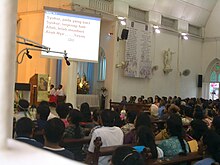
Christians in Malaysia also use the word Allah for "God".

Christians in Malaysia and Indonesia use Allah to refer to God in the Malaysian and Indonesian languages (both of them standardized forms of the Malay language). Mainstream Bible translations in the language use Allah as the translation of Hebrew Elohim (translated in English Bibles as "God").[80] This goes back to early translation work by Francis Xavier in the 16th century.[81][82] The first dictionary of Dutch-Malay by Albert Cornelius Ruyl, Justus Heurnius, and Caspar Wiltens in 1650 (revised edition from 1623 edition and 1631 Latin edition) recorded "Allah" as the translation of the Dutch word "Godt".[83] Ruyl also translated the Gospel of Matthew in 1612 into the Malay language (an early Bible translation into a non-European language,[84] made a year after the publication of the King James Version[85][86]), which was printed in the Netherlands in 1629. Then he translated the Gospel of Mark, published in 1638.[87][88]

The government of Malaysia in 2007 outlawed usage of the term Allah in any other but Muslim contexts, but the Malayan High Court in 2009 revoked the law, ruling it unconstitutional. While Allah had been used for the Christian God in Malay for more than four centuries, the contemporary controversy was triggered by usage of Allah by the Roman Catholic newspaper The Herald. The government appealed the court ruling, and the High Court suspended implementation of its verdict until the hearing of the appeal. In October 2013 the court ruled in favor of the government's ban.[89] In early 2014 the Malaysian government confiscated more than 300 bibles for using the word to refer to the Christian God in Peninsular Malaysia.[90] However, the use of Allah is not prohibited in the two Malaysian states of Sabah and Sarawak.[91][92] The main reason it is not prohibited in these two states is that usage has been long-established and local Alkitab (Bibles) have been widely distributed freely in East Malaysia without restrictions for years.[91] Both states also do not have similar Islamic state laws as those in West Malaysia.[18]

In reaction to some media criticism, the Malaysian government has introduced a "10-point solution" to avoid confusion and misleading information.[93][94] The 10-point solution is in line with the spirit of the 18- and 20-point agreements of Sarawak and Sabah.[18]
National flags with "Allah" written on them



Flag of Iraq with the Takbir written on it


Flag of Saudi Arabia with the Islamic holy creed written on it


Flag of Afghanistan with the Shahadah written on it



Flag of Iran with "Allah" written on it

Typography

The word Allah written in different writing systems

The word Allāh is always written without an alif to spell the ā vowel. This is because the spelling was settled before Arabic spelling started habitually using alif to spell ā. However, in vocalized spelling, a small diacritic alif is added on top of the shaddah to indicate the pronunciation.

In the pre-Islamic Zabad inscription,[95] God is referred to by the term Ø§Ų„Ø§Ų„Ų‡, that is, alif-lam-alif-lam-ha.[45] This presumably indicates Al-'ilāh = "the god", without alif for ā.

Many Arabic type fonts feature special ligatures for Allah.[96]

Since Arabic script is used to write other texts rather than Koran only, rendering lām + lām + hā’ as the previous ligature is considered faulty which is the case with most common Arabic typefaces.


This simplified style is often preferred for clarity, especially in non-Arabic languages, but may not be considered appropriate in situations where a more elaborate style of calligraphy is preferred. –SIL International[97]
Unicode

Unicode has a code point reserved for Allāh, ‎ = U+FDF2, in the Arabic Presentation Forms-A block, which exists solely for "compatibility with some older, legacy character sets that encoded presentation forms directly";[98][99] this is discouraged for new text. Instead, the word Allāh should be represented by its individual Arabic letters, while modern font technologies will render the desired ligature.

The calligraphic variant of the word used as the Coat of arms of Iran is encoded in Unicode, in the Miscellaneous Symbols range, at code point U+262B (☫).
See also
Abdullah (name)
Allah as a lunar deity
Emblem of Iran
Ismul Azam
Names of God
Further reading
Online
Allah Qur'ān, in EncyclopÃĻdia Britannica Online, by Asma Afsaruddin, Brian Duignan, Thinley Kalsang Bhutia, Gloria Lotha, Marco Sampaolo, Matt StefonTesc, Noah Tesch and Adam Zeidan
Citations

^ "Allah". Random House Webster's Unabridged Dictionary.
^ "Allah". Oxford Learner's Dictionaries.
^ "God". Islam: Empire of Faith. PBS. Archived from the original on 27 March 2014. Retrieved 18 December 2010.
^ "Islam and Christianity", Encyclopedia of Christianity (2001): Arabic-speaking Christians and Jews also refer to God as Allāh.
^ Gardet, L. "Allah". In Bearman, P.; Bianquis, Th.; Bosworth, C.E.; van Donzel, E.; Heinrichs, W.P. (eds.). Encyclopaedia of Islam Online. Brill Online. Retrieved 2 May 2007.
^ Zeki Saritoprak (2006). "Allah". In Oliver Leaman (ed.). The Qur'an: An Encyclopedia. Routledge. p. 34. ISBN 978-0-415-32639-1.
^ Vincent J. Cornell (2005). "God: God in Islam". In Lindsay Jones (ed.). Encyclopedia of Religion. Vol. 5 (2nd ed.). MacMillan Reference USA. p. 724.
^ Jump up to:a b c d e f Christian Julien Robin (2012). Arabia and Ethiopia. In The Oxford Handbook of Late Antiquity. OUP USA. pp. 304–305. ISBN 978-0-19-533693-1.
^ Anthony S. Mercatante & James R. Dow (2004). "Allah". The Facts on File Encyclopedia of World Mythology and Legend. Facts on File. p. 53. ISBN 978-1-4381-2685-2.
^ Merriam-Webster. "Allah". Merriam-Webster. Archived from the original on 20 April 2014. Retrieved 25 February 2012.
^ Jump up to:a b Columbia Encyclopedia, Allah
^ Jump up to:a b c d e f g "Allah." EncyclopÃĻdia Britannica. 2007. EncyclopÃĻdia Britannica
^ Jump up to:a b c d e Encyclopedia of the Modern Middle East and North Africa, Allah
^ Willis Barnstone, Marvin Meyer The Gnostic Bible: Revised and Expanded Edition Shambhala Publications 2009 ISBN 978-0-8348-2414-0 page 531
^ Sikhs target of 'Allah' attack, Julia Zappei, 14 January 2010, The New Zealand Herald. Accessed on line 15 January 2014.
^ Malaysia court rules non-Muslims can't use 'Allah', 14 October 2013, The New Zealand Herald. Accessed on line 15 January 2014.
^ Malaysia's Islamic authorities seize Bibles as Allah row deepens, Niluksi Koswanage, 2 January 2014, Reuters. Accessed on line 15 January 2014. [1]
^ Jump up to:a b c Idris Jala (24 February 2014). "The 'Allah'/Bible issue, 10-point solution is key to managing the polarity". The Star. Retrieved 25 June 2014.
^ Jump up to:a b c D.B. Macdonald. Encyclopedia of Islam, 2nd ed, Brill. "Ilah", Vol. 3, p. 1093.
^ Gerhard BÃļwering. Encyclopedia of the Quran, Brill, 2002. Vol. 2, p. 318
^ Columbia Encyclopaedia says: Derived from an old Semitic root referring to the Divine and used in the Canaanite El, the Mesopotamian ilu, and the biblical Elohim and Eloah, the word Allah is used by all Arabic-speaking Muslims, Christians, Jews, and other monotheists.
^ The Comprehensive Aramaic Lexicon – Entry for Ęŧlh Archived 18 October 2013 at the Wayback Machine
^ Hitti, Philip Khouri (1970). History of the Arabs. Palgrave Macmillan. pp. 100–101.
^ Anthony S. Mercatante & James R. Dow (2004). "Allah". The Facts on File Encyclopedia of World Mythology and Legend. Facts on File. p. 53. ISBN 978-1-4381-2685-2.
^ IslamKotob. Tafsir Ibn Kathir all 10 volumes. IslamKotob.
^ Jump up to:a b L. Gardet, Allah, Encyclopaedia of Islam, ed. by Sir H.A.R. Gibb
^ Zeki Saritopak, Allah, The Qu'ran: An Encyclopedia, ed. by Oliver Leaman, p. 34
^ Jump up to:a b Gerhard BÃļwering, God and his Attributes, Encyclopedia of the Qur'an, ed. by Jane Dammen McAuliffe
^ Jump up to:a b Jonathan Porter Berkey (2003). The Formation of Islam: Religion and Society in the Near East, 600-1800. Cambridge University Press. p. 42. ISBN 978-0-521-58813-3.
^ Daniel C. Peterson (26 February 2007). Muhammad, Prophet of God. Wm. B. Eerdmans Publishing. p. 21. ISBN 978-0-8028-0754-0.
^ Jump up to:a b Francis E. Peters (1994). Muhammad and the Origins of Islam. SUNY Press. p. 107. ISBN 978-0-7914-1875-8.
^ Irving M. Zeitlin (19 March 2007). The Historical Muhammad. Polity. p. 33. ISBN 978-0-7456-3999-4.
^ "Allah." In The Oxford Dictionary of Islam. Ed. John L. Esposito. Oxford Islamic Studies Online. 1 January 2019. <http://www.oxfordislamicstudies.com/article/opr/t125/e128>.
^ Lewis, Bernard; Holt, P. M.; Holt, Peter R.; Lambton, Ann Katherine Swynford (1977). The Cambridge history of Islam. Cambridge, Eng: University Press. p. 32. ISBN 978-0-521-29135-4.
^ "ØŗØ¨ِّØ­ŲˆØ§ ØĨِŲ„Ų‡َŲ†Ø§ ŲŠŲ‡ŲˆŲ‡! (Praise our God Jehovah!)". jw.org. Retrieved 15 September 2021.
^ Jump up to:a b Thomas E. Burman, Religious Polemic and the Intellectual History of the Mozarabs, Brill, 1994, p. 103
^ Marshall G. S. Hodgson, The Venture of Islam: Conscience and History in a World Civilization, University of Chicago Press, p. 156
^ James Bellamy, "Two Pre-Islamic Arabic Inscriptions Revised: Jabal Ramm and Umm al-Jimal", Journal of the American Oriental Society, 108/3 (1988) pp. 372–378 (translation of the inscription) "This was set up by colleagues/friends of ĘŋUlayh, the son of ĘŋUbaydah, secretary/adviser of the cohort Augusta Secunda Philadelphiana; may he go mad/crazy who effaces it."
^ Enno Littmann, Arabic Inscriptions (Leiden, 1949)
^ Daniels, Peter T. (2014). The Type and Spread of Arabic Script.
^ "The Himyarite Martyrs (text) —".
^ James of Edessa the hymns of Severus of Antioch and others." Ernest Walter Brooks (ed.), Patrologia Orientalis VII.5 (1911)., vol: 2, p. 613. pp. ܐܠܗܐ (Elaha).
^ Ignatius Ya`qub III, The Arab Himyarite Martyrs in the Syriac Documents (1966), Pages: 9-65-66-89
^ Alfred Guillaume& Muhammad Ibn Ishaq, (2002 [1955]). The Life of Muhammad: A Translation of Isá¸Ĩāq's SÄĢrat RasÅĢl Allāh with Introduction and Notes. Karachi and New York: Oxford University Press, page 18.
^ Jump up to:a b M. A. Kugener, "Nouvelle Note Sur L'Inscription Trilingue De ZÊbed", Rivista Degli Studi Orientali, pp. 577-586.
^ Adolf Grohmann, Arabische Paläographie II: Das Schriftwesen und die Lapidarschrift (1971), Wien: Hermann BÃļhlaus Nochfolger, Page: 6-8
^ Beatrice Gruendler, The Development of the Arabic Scripts: From the Nabatean Era to the First Islamic Century according to Dated Texts (1993), Atlanta: Scholars Press, Page:
^ Frederick Winnett V, Allah before Islam-The Moslem World (1938), Pages: 239–248
^ Sidney H Griffith, "The Gospel in Arabic: An Enquiry into Its Appearance in the First Abbasid Century", Oriens Christianus, Volume 69, p. 166. "All one can say about the possibility of a pre-Islamic, Christian version of the Gospel in Arabic is that no sure sign of its actual existence has yet emerged.
^ Grafton, David D (2014). The identity and witness of Arab pre-Islamic Arab Christianity: The Arabic language and the Bible. Christianity [...] did not penetrate into the lives of the Arabs primarily because the monks did not translate the Bible into the vernacular and inculcate Arab culture with biblical values and tradition. Trimingham's argument serves as an example of the Western Protestant assumptions outlined in the introduction of this article. It is clear that the earliest Arabic biblical texts can only be dated to the 9th century at the earliest, that is after the coming of Islam.
^ Sidney H. Griffith, The Bible in Arabic: The Scriptures of the 'People of the Book' in the Language of Islam. Jews, Christians and Muslims from the Ancient to the Modern World, Princeton University Press, 2013, pp242- 247 ff.
^ The Arabic Bible before Islam – Clare Wilde on Sidney H. Griffith's The Bible in Arabic. June 2014.
^ Hjälm, ML (2017). Senses of Scripture, Treasures of Tradition: The Bible in Arabic Among Jews, Christians and Muslims. Brill. ISBN 978-90-04-34716-8.
^ Hjälm, ML (2017). Senses of Scripture, Treasures of Tradition, The Bible in Arabic among Jews, Christians and Muslims (Biblia Arabica) (English and Arabic ed.). Brill. ISBN 978-90-04-34716-8. By contrast, manuscripts containing translations of the gospels are encountered no earlier then the year 873 (Ms. Sinai. N.F. parch. 14 & 16)
^ Irfan ShahÃŽd, Byzantium and the Arabs in the Fourth Century, Dumbarton Oaks Trustees for Harvard University-Washington DC, page 418.
^ Irfan ShahÃŽd, Byzantium and the Arabs in the Fourth Century, Dumbarton Oaks Trustees for Harvard University-Washington DC, Page: 452
^ A. Amin and A. Harun, Sharh Diwan Al-Hamasa (Cairo, 1951), Vol. 1, Pages: 478-480
^ Al-Marzubani, Mu'jam Ash-Shu'araa, Page: 302
^ Andreas GÃļrke and Johanna Pink Tafsir and Islamic Intellectual History Exploring the Boundaries of a Genre Oxford University Press in association with The Institute of Ismaili Studies London ISBN 978-0-19-870206-1 p. 478
^ Jump up to:a b BÃļwering, Gerhard, God and His Attributes, Encyclopaedia of the QurĘŧān, Brill, 2007.
^ "The Quranic Arabic Corpus - Translation". corpus.quran.com. Retrieved 11 April 2021.
^ "112. Surah Al-Ikhlaas or At-Tauhid – NobleQuran.com". Retrieved 11 April 2021.
^ "The Quranic Arabic Corpus - Translation". corpus.quran.com. Retrieved 30 March 2021.
^ Arabic script in Unicode symbol for a Quran verse, U+06DD, page 3, Proposal for additional Unicode characters
^ Sale, G AlKoran
^ Jump up to:a b Bentley, David (September 1999). The 99 Beautiful Names for God for All the People of the Book. William Carey Library. ISBN 978-0-87808-299-5.
^ Murata, Sachiko (1992). The Tao of Islam : a sourcebook on gender relationships in Islamic thought. Albany NY USA: SUNY. ISBN 978-0-7914-0914-5.
^ Gary S. Gregg, The Middle East: A Cultural Psychology, Oxford University Press, p.30
^ Carolyn Fluehr-Lobban, Islamic Society in Practice, University Press of Florida, p. 24
^ M. Mukarram Ahmed, Muzaffar Husain Syed, Encyclopaedia of Islam, Anmol Publications PVT. LTD, p. 144
^ Carl W. Ernst, Bruce B. Lawrence, Sufi Martyrs of Love: The Chishti Order in South Asia and Beyond, Macmillan, p. 29
^ F.E. Peters, Islam, p.4, Princeton University Press, 2003
^ "How do you pronounce "Allah" (Ø§Ų„Ų„Ų‡) correctly?". ARABIC for NERDS. 16 June 2018. Archived from the original on 17 June 2018. Retrieved 16 June 2018.
^ William Montgomery Watt, Islam and Christianity today: A Contribution to Dialogue, Routledge, 1983, p.45
^ Islam in Luce LÃŗpez Baralt, Spanish Literature: From the Middle Ages to the Present, Brill, 1992, p.25
^ F. E. Peters, The Monotheists: Jews, Christians, and Muslims in Conflict and Competition, Princeton University Press, p.12
^ "Nation of Islam". www.bible.ca. Archived from the original on 13 August 2013.
^ "A history of Clarence 13X and the Five Percenters, referring to Clarence Smith as Allah". Finalcall.com. Archived from the original on 22 October 2013. Retrieved 14 January 2014.
^ Example: Usage of the word "Allah" from Matthew 22:32 in Indonesian bible versions (parallel view) as old as 1733 Archived 19 October 2013 at the Wayback Machine
^ The Indonesian Language: Its History and Role in Modern Society Sneddon, James M.; University of New South Wales Press; 2004
^ The History of Christianity in India from the Commencement of the Christian Era: Hough, James; Adamant Media Corporation; 2001
^ Wiltens, Caspar; Heurnius, Justus (1650). Justus Heurnius, Albert Ruyl, Caspar Wiltens. "Vocabularium ofte Woordenboeck nae ordre van den alphabeth, in 't Duytsch en Maleys". 1650:65. Archived from the original on 22 October 2013. Retrieved 14 January 2014.
^ But compare: Milkias, Paulos (2011). "Ge'ez Literature (Religious)". Ethiopia. Africa in Focus. Santa Barbara, California: ABC-CLIO. p. 299. ISBN 978-1-59884-257-9. Retrieved 15 February 2018. Monasticism played a key role in the Ethiopian literary movement. The Bible was translated during the time of the Nine Saints in the early sixth century [...].
^ Barton, John (2002–12). The Biblical World, Oxford, UK: Routledge. ISBN 978-0-415-27574-3.
^ North, Eric McCoy; Eugene Albert Nida ((2nd Edition) 1972). The Book of a Thousand Tongues, London: United Bible Societies.
^ "Sejarah Alkitab Indonesia / Albert Conelisz Ruyl". sejarah.sabda.org.
^ "EncyclopÃĻdia Britannica: Albert Cornelius Ruyl". Britannica.com. Archived from the original on 19 October 2013. Retrieved 14 January 2014.
^ Roughneen, Simon (14 October 2013). "No more 'Allah' for Christians, Malaysian court says". The Christian Science Monitor. Retrieved 14 October 2013.
^ "BBC News - More than 300 Bibles are confiscated in Malaysia". BBC. 2 January 2014. Archived from the original on 25 January 2014. Retrieved 14 January 2014.
^ Jump up to:a b "Catholic priest should respect court: Mahathir". Daily Express. 9 January 2014. Archived from the original on 10 January 2014. Retrieved 10 January 2014.
^ Jane Moh; Peter Sibon (29 March 2014). "Worship without hindrance". The Borneo Post. Archived from the original on 29 March 2014. Retrieved 29 March 2014.
^ "Bahasa Malaysia Bibles: The Cabinet's 10-point solution". 25 January 2014.
^ "Najib: 10-point resolution on Allah issue subject to Federal, state laws". The Star. 24 January 2014. Retrieved 25 June 2014.
^ "Zebed Inscription: A Pre-Islamic Trilingual Inscription In Greek, Syriac & Arabic From 512 CE". Islamic Awareness. 17 March 2005.
^
Arabic fonts and Mac OS X Archived 10 March 2008 at the Wayback Machine
Programs for Arabic in Mac OS X Archived 6 October 2013 at the Wayback Machine

^ "Scheherazade New". SIL International. Retrieved 4 February 2022.
^ The Unicode Consortium. FAQ - Middle East Scripts Archived 1 October 2013 at the Wayback Machine
^ "Unicode Standard 5.0, p.479, 492" (PDF). Archived from the original (PDF) on 28 April 2014. Retrieved 14 January 2014.
From Wikipedia, the free encyclopedia
Playlist

Playlist

wekftion logo Animation


 āϚāĻŸā§āϟāĻ—ā§āϰāĻžāĻŽ āĻŦāĻŋāĻļā§āĻŦāĻŦāĻŋāĻĻā§āϝāĻžāϞāϝāĻŧ āϚāĻŸā§āϟāĻ—ā§āϰāĻžāĻŽā§‡ āĻ…āĻŦāĻ¸ā§āĻĨāĻŋāϤ āĻŦāĻžāĻ‚āϞāĻžāĻĻ⧇āĻļ⧇āϰ āĻāĻ•āϟāĻŋ āĻĒāĻžāĻŦāϞāĻŋāĻ• āĻŦāĻŋāĻļā§āĻŦāĻŦāĻŋāĻĻā§āϝāĻžāϞāϝāĻŧ

āϚāϟ্āϟāĻ—্āϰাāĻŽ āĻŦিāĻļ্āĻŦāĻŦিāĻĻ্āϝাāϞāϝ় āϚāϟ্āϟāĻ—্āϰাāĻŽে āĻ…āĻŦāϏ্āĻĨিāϤ āĻŦাংāϞাāĻĻেāĻļেāϰ āĻāĻ•āϟি āĻĒাāĻŦāϞিāĻ• āĻŦিāĻļ্āĻŦāĻŦিāĻĻ্āϝাāϞāϝ়

 āϚāϟ্āϟāĻ—্āϰাāĻŽ āĻŦিāĻļ্āĻŦāĻŦিāĻĻ্āϝাāϞāϝ় āϚāϟ্āϟāĻ—্āϰাāĻŽে āĻ…āĻŦāϏ্āĻĨিāϤ āĻŦাংāϞাāĻĻেāĻļেāϰ āĻāĻ•āϟি āĻĒাāĻŦāϞিāĻ• āĻŦিāĻļ্āĻŦāĻŦিāĻĻ্āϝাāϞāϝ় 

āϚāϟ্āϟāĻ—্āϰাāĻŽ āĻŦিāĻļ্āĻŦāĻŦিāĻĻ্āϝাāϞāϝ় (āϏংāĻ•্āώেāĻĒে āϚāĻŦি) āϚāϟ্āϟāĻ—্āϰাāĻŽে āĻ…āĻŦāϏ্āĻĨিāϤ āĻŦাংāϞাāĻĻেāĻļেāϰ āϏāϰāĻ•াāϰি āĻŦāĻšু-āĻ…āύুāώāĻĻāĻ­িāϤ্āϤিāĻ• āĻ—āĻŦেāώāĻŖা āĻŦিāĻļ্āĻŦāĻŦিāĻĻ্āϝাāϞāϝ়। āĻāϟি ⧧⧝ā§Ŧā§Ŧ āϏাāϞে āϚāϟ্āϟāĻ—্āϰাāĻŽ āϜেāϞাāϰ āĻšাāϟāĻšাāϜাāϰী āωāĻĒāϜেāϞাāϝ় āϏ্āĻĨাāĻĒিāϤ āĻšāϝ়। āĻāϟি āĻĻেāĻļেāϰ āϤৃāϤীāϝ় āĻāĻŦং āĻļিāĻ•্āώাāĻ™্āĻ—āĻŖ āφāϝ়āϤāύেāϰ āĻĻিāĻ• āĻĨেāĻ•ে āĻĻেāĻļেāϰ āϏāϰ্āĻŦāĻŦৃāĻšā§Ž āĻŦিāĻļ্āĻŦāĻŦিāĻĻ্āϝাāϞāϝ়। ⧍ā§Ļ⧧⧝ āϏাāϞেāϰ āĻšিāϏাāĻŦে, āĻāχ āĻŦিāĻļ্āĻŦāĻŦিāĻĻ্āϝাāϞāϝ়ে āĻĒ্āϰাāϝ় ⧍⧭,ā§Ģā§Ļā§Ļ āĻļিāĻ•্āώাāϰ্āĻĨী āĻāĻŦং ā§Žā§­ā§¨ āϜāύ āĻļিāĻ•্āώāĻ• āϰāϝ়েāĻ›েāύ।

āϚāϟ্āϟāĻ—্āϰাāĻŽ āĻŦিāĻļ্āĻŦāĻŦিāĻĻ্āϝাāϞāϝ়
āϚāϟ্āϟāĻ—্āϰাāĻŽ āĻŦিāĻļ্āĻŦāĻŦিāĻĻ্āϝাāϞāϝ়েāϰ āϞোāĻ—ো
āĻ…āύ্āϝাāύ্āϝ āύাāĻŽ
āϚāĻŦি
āϧāϰāύāĻĒাāĻŦāϞিāĻ• āĻŦিāĻļ্āĻŦāĻŦিāĻĻ্āϝাāϞāϝ়, āϏāĻš-āĻļিāĻ•্āώা
āϏ্āĻĨাāĻĒিāĻ¤ā§§ā§Ž āύāĻ­েāĻŽ্āĻŦāϰ ā§§ā§¯ā§Ŧā§Ŧ
āĻ…āϧিāĻ­ুāĻ•্āϤিāĻŦিāĻļ্āĻŦāĻŦিāĻĻ্āϝাāϞāϝ় āĻŽāĻž্āϜুāϰী āĻ•āĻŽিāĻļāύ
āφāϚাāϰ্āϝāϰাāώ্āϟ্āϰāĻĒāϤি āφāĻŦ্āĻĻুāϞ āĻšাāĻŽিāĻĻ
āωāĻĒাāϚাāϰ্āϝāĻļিāϰীāĻŖ āφāĻ–āϤাāϰ
āĻļিāĻ•্āώাāϝ়āϤāύিāĻ• āĻŦ্āϝāĻ•্āϤিāĻŦāϰ্āĻ—
ā§Žā§­ā§¨[ā§§]
āĻĒ্āϰāĻļাāϏāύিāĻ• āĻŦ্āϝāĻ•্āϤিāĻŦāϰ্āĻ—
ā§Šā§§ā§§
(āĻĒুāϰুāώ ⧍⧭⧭, āύাāϰী ā§Šā§Ē)
āĻļিāĻ•্āώাāϰ্āĻĨী⧍⧭,ā§Ģā§Ļā§Ļ
(āĻ›াāϤ্āϰ ā§§ā§Žā§Ļā§Ļā§Ļ, āĻ›াāϤ্āϰী ⧝,ā§Ģā§Ļā§Ļ)[ā§§]
āĻ িāĻ•াāύা, ,
ā§Ēā§Šā§Šā§§[ā§§]
,
āĻŦাংāϞাāĻĻেāĻļ

⧍⧍.ā§Ēā§­ā§§ā§Ļā§Ļ⧍⧧° āωāϤ্āϤāϰ ⧝⧧.ā§­ā§Žā§Žā§Ēā§Ŧā§¯ā§Š° āĻĒূāϰ্āĻŦ
āĻļিāĻ•্āώাāĻ™্āĻ—āύ⧍,ā§§ā§Ļā§Ļ āĻāĻ•āϰ (ā§Žā§Ģā§Ļ āĻšেāĻ•্āϟāϰ)
āĻ­াāώাāĻŦāĻšুāĻ­াāώিāĻ•
āĻ“āϝ়েāĻŦāϏাāχāϟwww.cu.ac.bd
āϚāϟ্āϟāĻ—্āϰাāĻŽ āĻŦিāĻļ্āĻŦāĻŦিāĻĻ্āϝাāϞāϝ়েāϰ āϜāϞāĻ›াāĻĒ āϞোāĻ—ো

āĻŦাংāϞাāĻĻেāĻļেāϰ āϏ্āĻŦাāϧীāύāϤা āĻ…āϰ্āϜāύেāϰ āĻĒূāϰ্āĻŦে āĻāχ āĻŦিāĻļ্āĻŦāĻŦিāĻĻ্āϝাāϞāϝ় āĻ¤ā§ŽāĻ•াāϞীāύ āĻĒূāϰ্āĻŦ āĻĒাāĻ•িāϏ্āϤাāύেāϰ āĻĒ্āϰāĻ—āϤিāĻļীāϞ āĻ“ āĻ—āĻŖāϤাāύ্āϤ্āϰিāĻ• āφāύ্āĻĻোāϞāύেāϰ āĻ•েāύ্āĻĻ্āϰāĻŦিāύ্āĻĻু āĻšāϝ়ে āĻ“āĻ েāĻ›িāϞ। āϏে āϏāĻŽāϝ়ে āĻŦিāĻļ্āĻŦāĻŦিāĻĻ্āϝাāϞāϝ়েāϰ āĻļিāĻ•্āώāĻ• āĻ“ āĻļিāĻ•্āώাāϰ্āĻĨীāϰা āĻŦাāĻ™াāϞি āϜাāϤীāϝ়āϤাāĻŦাāĻĻেāϰ āωāϤ্āĻĨাāύ āĻāĻŦং āĻŦাংāϞাāĻĻেāĻļেāϰ āϏ্āĻŦাāϧীāύāϤা āĻ…āϰ্āϜāύে āĻ•েāύ্āĻĻ্āϰীāϝ় āĻ­ূāĻŽিāĻ•া āĻĒাāϞāύ āĻ•āϰেāĻ›িāϞ।

āĻŦāϰ্āϤāĻŽাāύে āϚāϟ্āϟāĻ—্āϰাāĻŽ āĻŦিāĻļ্āĻŦāĻŦিāĻĻ্āϝাāϞāϝ়েāϰ āĻ…āϧীāύে ⧍⧧āϟি āĻļিāĻ•্āώাāĻĒ্āϰāϤিāώ্āĻ াāύ āĻ…āϰ্āύ্āϤāĻ­ূāĻ•্āϤ āϰāϝ়েāĻ›ে। āϚāϟ্āϟāĻ—্āϰাāĻŽেāϰ āĻĒাāĻšাāĻĄ়ি āĻāϞাāĻ•াāϝ় āĻ…āĻŦāϏ্āĻĨিāϤ āĻŦিāĻļ্āĻŦāĻŦিāĻĻ্āϝাāϞāϝ়āϟি āĻĒ্āϰাāĻ•ৃāϤিāĻ• āϏৌāύ্āĻĻāϰ্āϝেāϰ āφāϧাāϰ। āĻāĻ–াāύে āϰāϝ়েāĻ›ে āϚāϟ্āϟāĻ—্āϰাāĻŽেāϰ āϏāϰ্āĻŦāĻŦৃāĻšāϤ āĻŦিāĻļ্āĻŦāĻŦিāĻĻ্āϝাāϞāϝ় āĻ—্āϰāύ্āĻĨাāĻ—াāϰ। āĻāχ āĻŦিāĻļ্āĻŦāĻŦিāĻĻ্āϝাāϞāϝ়ে āĻ…āύেāĻ• āωāϞ্āϞেāĻ–āϝোāĻ—্āϝ āĻĒ্āϰাāĻ•্āϤāύ āĻļিāĻ•্āώāĻ•-āĻļিāĻ•্āώাāϰ্āĻĨী āĻļিāĻ•্āώাāĻ—্āϰāĻšāĻŖ āĻ“ āĻ…āϧ্āϝাāĻĒāύা āĻ•āϰেāĻ›েāύ āϝাāϰ āĻŽāϧ্āϝে ā§§ āϜāύ āύোāĻŦেāϞ āĻŦিāϜāϝ়ী āĻāĻŦং āĻāĻ•াāϧিāĻ• āĻāĻ•ুāĻļে āĻĒāĻĻāĻ• āĻŦিāϜāϝ়ী āĻ…āϰ্āύ্āϤāĻ­ূāĻ•্āϤ āϰāϝ়েāĻ›েāύ। ⧍ā§Ļ⧍ā§Ļ āϏাāϞেāϰ āĻšিāϏেāĻŦে, āĻĻেāĻļে āĻāχ āĻŦিāĻļ্āĻŦāĻŦিāĻĻ্āϝাāϞāϝ়েāϰ āĻ…āĻŦāϏ্āĻĨাāύ ⧝āĻŽ āĻāĻŦং āĻŦৈāĻļ্āĻŦিāĻ• āĻ…āĻŦāϏ্āĻĨাāύ ā§Šā§§ā§Ļā§§ āϤāĻŽ।[⧍]

DU

DU

āĻĸাāĻ•া āĻŦিāĻļ্āĻŦāĻŦিāĻĻ্āϝাāϞāϝ় (āϏংāĻ•্āώেāĻĒে āĻĸাāĻŦি) āĻĸাāĻ•াāϰ āĻļাāĻšāĻŦাāĻ—ে āĻ…āĻŦāϏ্āĻĨিāϤ āĻŦাংāϞাāĻĻেāĻļেāϰ āĻāĻ•āϟি āϏ্āĻŦাāϝ়āϤ্āϤāĻļাāϏিāϤ āϏāϰāĻ•াāϰি āĻ—āĻŦেāώāĻŖাāϧāϰ্āĻŽী āĻŦিāĻļ্āĻŦāĻŦিāĻĻ্āϝাāϞāϝ়। ⧧⧝⧍⧧ āϏাāϞে āϤāĻĻাāύীāύ্āϤāύ āĻŦ্āϰিāϟিāĻļ āĻ­াāϰāϤে āĻ…āĻ•্āϏāĻŦ্āϰিāϜ āĻļিāĻ•্āώা āĻŦ্āϝāĻŦāϏ্āĻĨা āĻ…āύুāϏāϰāĻŖে āĻāϟি āϏ্āĻĨাāĻĒিāϤ āĻšāϝ়। āĻāϰ āĻļিāĻ•্āώা āĻ•াāϰ্āϝāĻ•্āϰāĻŽ āĻļুāϰু āĻšāϝ় ⧧⧝⧍⧧ āϏাāϞেāϰ ā§§ āϜুāϞাāχ।[ā§Š] āϏূāϚāύাāϞāĻ—্āύে āĻŦিāĻ­িāύ্āύ āĻĒ্āϰāĻĨিāϤāϝāĻļা āĻŦৃāϤ্āϤিāϧাāϰী āĻ“ āĻŦিāϜ্āĻžাāύীāĻĻেāϰ āĻĻ্āĻŦাāϰা āĻ•āĻ োāϰāĻ­াāĻŦে āĻŽাāύ āύিāϝ়āύ্āϤ্āϰিāϤ āĻšāĻŦাāϰ āĻĒ্āϰেāĻ•্āώাāĻĒāϟে āĻāϟি āĻĒ্āϰাāϚ্āϝেāϰ āĻ…āĻ•্āϏāĻĢোāϰ্āĻĄ āύাāĻŽে āϏ্āĻŦীāĻ•ৃāϤি āĻĒাāϝ়।[ā§Ē][ā§Ģ]

āĻĸাāĻ•া āĻŦিāĻļ্āĻŦāĻŦিāĻĻ্āϝাāϞāϝ়
āĻĸাāĻ•া āĻŦিāĻļ্āĻŦāĻŦিāĻĻ্āϝাāϞāϝ়েāϰ āϞোāĻ—ো.svg
āύীāϤিāĻŦাāĻ•্āϝāϏāϤ্āϝেāϰ āϜāϝ় āϏুāύিāĻļ্āϚিāϤ
āϏ্āϞোāĻ—াāύāĻļিāĻ•্āώাāχ āφāϞো
āϧāϰāύāϏāϰāĻ•াāϰি āĻŦিāĻļ্āĻŦāĻŦিāĻĻ্āϝাāϞāϝ়
āϏ্āĻĨাāĻĒিāϤ⧧⧝⧍⧧; ā§§ā§Ļā§§ āĻŦāĻ›āϰ āφāĻ—ে
āĻ…āϧিāĻ­ুāĻ•্āϤিāĻŦিāĻļ্āĻŦāĻŦিāĻĻ্āϝাāϞāϝ় āĻŽāĻž্āϜুāϰী āĻ•āĻŽিāĻļāύ
āφāϚাāϰ্āϝāϰাāώ্āϟ্āϰāĻĒāϤি āφāĻŦ্āĻĻুāϞ āĻšাāĻŽিāĻĻ
āωāĻĒাāϚাāϰ্āϝāĻŽোāĻšাāĻŽ্āĻŽāĻĻ āφāĻ–āϤাāϰুāϜ্āϜাāĻŽাāύ
āĻĄিāύā§Ŧ
⧧⧝⧝⧍[⧧]
ā§Ē,ā§Ēā§§ā§­
āĻļিāĻ•্āώাāϰ্āĻĨীā§Ēā§Ŧ,ā§§ā§Ģā§Ļ (⧍ā§Ļā§§ā§Ž-⧍ā§Ļ⧧⧝)[⧍]
āĻ িāĻ•াāύা, , ,
ā§¨ā§Š°ā§Ēā§Š′ā§Ģ⧝″ āωāϤ্āϤāϰ ⧝ā§Ļ°ā§¨ā§Š′ā§¨ā§Ž″ āĻĒূāϰ্āĻŦ
āĻļিāĻ•্āώাāĻ™্āĻ—āύāύāĻ—āϰ, ā§Žā§§ āĻšেāĻ•্āϟāϰ (⧍ā§Ļā§Ļ āĻāĻ•āϰ) (āχāύāϏ্āϟিāϟিāωāϟ āĻ…āĻŦ āϞেāĻĻাāϰ āχāĻž্āϜিāύিāϝ়াāϰিং āĻŦ্āϝāϤীāϤ)
āϏংāĻ•্āώিāĻĒ্āϤ āύাāĻŽāĻĸাāĻŦি
āĻ“āϝ়েāĻŦāϏাāχāϟwww.du.ac.bd

āĻŦিāĻļ্āĻŦāĻŦিāĻĻ্āϝাāϞāϝ়āϟিāϤে āĻŦāϰ্āϤāĻŽাāύে ā§§ā§Šāϟি āĻ…āύুāώāĻĻ, ā§Žā§Šāϟি āĻŦিāĻ­াāĻ—, ā§§ā§Šāϟি āχāύāϏ্āϟিāϟিāωāϟ, ā§Ģā§Ŧāϟি āĻ—āĻŦেāώāĻŖা āĻŦ্āϝুāϰো āĻ“ āĻ•েāύ্āĻĻ্āϰ, ⧍ā§Ļāϟি āφāĻŦাāϏিāĻ• āĻšāϞ āĻ“ ā§Šāϟি āĻ›াāϤ্āϰাāĻŦাāϏ, āĻāĻŦং ā§­āϟি āϏ্āύাāϤāĻ• āĻĒāϰ্āϝাāϝ়েāϰ āĻ…āϧিāĻ­ুāĻ•্āϤ āϏāϰāĻ•াāϰি āĻ•āϞেāϜāϏāĻš āĻŽোāϟ ā§§ā§Ļā§Ģāϟি āĻ…āϧিāĻ­ুāĻ•্āϤ āĻ•āϞেāϜ āϰāϝ়েāĻ›ে।[ā§§] āĻ…āϧিāĻ­ুāĻ•্āϤ āĻ•āϞেāϜāĻ—ুāϞোāϰ āĻ­িāύ্āύ āĻ…āĻŦāĻ•াāĻ াāĻŽো āĻ“ āĻ•āϰ্āĻŽāĻ•াāĻŖ্āĻĄ āϰāϝ়েāĻ›ে। āĻĸাāĻ•া āĻŦিāĻļ্āĻŦāĻŦিāĻĻ্āϝাāϞāϝ়েāϰ āĻ•েāύ্āĻĻ্āϰীāϝ় āĻ—্āϰāύ্āĻĨাāĻ—াāϰ āĻŦাংāϞাāĻĻেāĻļেāϰ āϏāϰ্āĻŦāĻŦৃāĻšā§Ž āĻ—্āϰāύ্āĻĨাāĻ—াāϰ।[ā§Ŧ]

āĻĸাāĻ•া āĻŦিāĻļ্āĻŦāĻŦিāĻĻ্āϝাāϞāϝ়ে āĻ…āϏংāĻ–্āϝ āĻ•ৃāϤি āĻļিāĻ•্āώাāϰ্āĻĨী āĻ…āϧ্āϝāϝ়āύ āĻ•āϰেāĻ›েāύ, āϤāύ্āĻŽāϧ্āϝে āϰāϝ়েāĻ›েāύ ā§§ā§Š āϜāύ āϰাāώ্āϟ্āϰāĻĒāϤি, ā§­ āϜāύ āĻĒ্āϰāϧাāύāĻŽāύ্āϤ্āϰী āĻāĻŦং āĻāĻ•āϜāύ āύোāĻŦেāϞ āĻĒুāϰāϏ্āĻ•াāϰ āĻŦিāϜāϝ়ী। āĻŦাংāϞাāĻĻেāĻļেāϰ āϜাāϤিāϰ āϜāύāĻ• āĻļেāĻ– āĻŽুāϜিāĻŦুāϰ āϰāĻšāĻŽাāύ āĻāĻ–াāύে āĻĒāĻĄ়াāĻļোāύা āĻ•āϰেāĻ›েāύ āĻāĻŦং āĻŦাংāϞাāĻĻেāĻļ āϏ্āĻŦাāϧীāύ āĻ•āϰāϤে āĻāχ āĻŦিāĻļ্āĻŦāĻŦিāĻĻ্āϝাāϞāϝ়েāϰ āĻļিāĻ•্āώাāϰ্āĻĨীāĻĻেāϰ āĻŦিāĻļেāώ āĻ…āĻŦāĻĻাāύ āĻ›িāϞ।[ā§Ē] āĻāχ āĻŦিāĻļ্āĻŦāĻŦিāĻĻ্āϝাāϞāϝ়েāϰ āĻļিāĻ•্āώāĻ•āĻŦৃāύ্āĻĻ āϏāĻŦāϚেāϝ়ে āĻŦেāĻļি āϏংāĻ–্āϝāĻ• āĻŦাংāϞাāĻĻেāĻļ āĻŦিāϜ্āĻžাāύ āĻāĻ•াāĻĄেāĻŽি āĻĒāĻĻāĻ• āϞাāĻ­ āĻ•āϰেāĻ›েāύ।[ā§­][ā§Ž] āĻāĻ›াāĻĄ়া āĻāϟি āĻŦাংāϞাāĻĻেāĻļেāϰ āĻāĻ•āĻŽাāϤ্āϰ āĻŦিāĻļ্āĻŦāĻŦিāĻĻ্āϝাāϞāϝ় āĻšিāϏেāĻŦে āĻāĻļিāϝ়া āωāχāĻ•েāϰ āĻļীāϰ্āώ ā§§ā§Ļā§Ļ āĻŦিāĻļ্āĻŦāĻŦিāĻĻ্āϝাāϞāϝ়েāϰ āϤাāϞিāĻ•াāϝ় āϜাāϝ়āĻ—া āĻ•āϰে āύেāϝ়।[⧝]

āχāϤিāĻšাāϏāϏāĻŽ্āĻĒাāĻĻāύা

āύāĻŦাāĻŦ āϏৈāϝ়āĻĻ āύāĻ“āϝ়াāĻŦ āφāϞী āϚৌāϧুāϰী, āĻĸাāĻ•া āĻŦিāĻļ্āĻŦāĻŦিāĻĻ্āϝাāϞāϝ় āĻĒ্āϰāϤিāώ্āĻ াāϰ āĻ…āύ্āϝāϤāĻŽ āĻĒ্āϰāϧাāύ āĻĒ্āϰāϏ্āϤাāĻŦāĻ•

āĻŦ্āϰিāϟিāĻļ āĻ”āĻĒāύিāĻŦেāĻļিāĻ• āĻļাāϏāύāĻ•াāϞে āϏ্āĻŦাāϧীāύ āϜাāϤিāϏāϤ্āϤ্āĻŦাāϰ āĻŦিāĻ•াāĻļেāϰ āϞāĻ•্āώ্āϝে āĻŦিāĻļ āĻļāϤāĻ•েāϰ āĻĻ্āĻŦিāϤীāϝ় āĻĻāĻļāĻ•ে āĻĸাāĻ•া āĻŦিāĻļ্āĻŦāĻŦিāĻĻ্āϝাāϞāϝ় āĻĒ্āϰāϤিāώ্āĻ াāϰ āĻĒ্āϰāĻ•্āϰিāϝ়া āĻļুāϰু āĻšāϝ়। āĻŦ্āϰিāϟিāĻļ āĻ­াāϰāϤে āĻ¤ā§ŽāĻ•াāϞীāύ āĻļাāϏāĻ•āĻĻেāϰ āĻ…āύ্āϝাāϝ্āϝ āϏিāĻĻ্āϧাāύ্āϤে āĻĒূāϰ্āĻŦāĻŦāĻ™্āĻ—েāϰ āĻŽাāύুāώেāϰ āĻĒ্āϰāϤিāĻŦাāĻĻেāϰ āĻĢāϏāϞ āĻšāϚ্āĻ›ে āĻāχ āĻĸাāĻ•া āĻŦিāĻļ্āĻŦāĻŦিāĻĻ্āϝাāϞāϝ়। āĻ āϏāĻŽ্āĻĒāϰ্āĻ•ে āĻĒ্āϰāĻ–্āϝাāϤ āχāϤিāĻšাāϏāĻŦিāĻĻ āĻŽুāύāϤাāϏীāϰ āĻŽাāĻŽুāύ āĻĸাāĻ•া āϏ্āĻŽৃāϤি āĻŦিāϏ্āĻŽৃāϤিāϰ āύāĻ—āϰী āĻ—্āϰāύ্āĻĨে āϞিāĻ–েāĻ›েāύ,

āĻŦāĻ™্āĻ—āĻ­āĻ™্āĻ— āϰāĻĻেāϰ āĻ•্āώāϤিāĻĒূāϰāĻŖ āĻšিāϏেāĻŦে āĻĒ্āϰāϤিāώ্āĻ া āĻ•āϰা āĻšāϝ়েāĻ›িāϞ āĻĸাāĻ•া āĻŦিāĻļ্āĻŦāĻŦিāĻĻ্āϝাāϞāϝ়। āϞāϰ্āĻĄ āϞিāϟāύ āϝাāĻ•ে āĻŦāϞেāĻ›িāϞেāύ āϏ্āĻĒ্āϞেāύāĻĄিāĻĄ āχāĻŽ্āĻĒিāϰিāϝ়াāϞ āĻ•āĻŽāĻĒেāύāϏেāĻļāύ। āĻĒূāϰ্āĻŦāĻŦāĻ™্āĻ— āĻļিāĻ•্āώাāĻĻীāĻ•্āώা, āĻ…āϰ্āĻĨāύীāϤি āϏāĻŦ āĻ•্āώেāϤ্āϰেāχ āĻĒিāĻ›িāϝ়ে āĻ›িāϞ। āĻŦāĻ™্āĻ—āĻ­āĻ™্āĻ— āĻšāĻ“āϝ়াāϰ āĻĒāϰ āĻ āĻ…āĻŦāϏ্āĻĨাāϰ āĻ–াāύিāĻ•āϟা āĻĒāϰিāĻŦāϰ্āϤāύ āĻšāϝ়েāĻ›িāϞ, āĻŦিāĻļেāώ āĻ•āϰে āĻļিāĻ•্āώাāϰ āĻ•্āώেāϤ্āϰে।[ā§§ā§Ļ]

⧧⧝⧧⧍ āϏাāϞেāϰ ⧍ āĻĢেāĻŦ্āϰুāϝ়াāϰি āĻĸাāĻ•াāϝ় āĻŦিāĻļ্āĻŦāĻŦিāĻĻ্āϝাāϞāϝ় āĻĒ্āϰāϤিāώ্āĻ াāϰ āĻĒ্āϰāϤিāĻļ্āϰুāϤি āĻĻেāύ āĻ¤ā§ŽāĻ•াāϞীāύ āĻŦ্āϰিāϟিāĻļ āĻ­াāϰāϤেāϰ āĻ­াāχāϏāϰāϝ় āϞāϰ্āĻĄ āĻšাāϰ্āĻĄিāĻž্āϜ। āĻāϰ āĻŽাāϤ্āϰ āϤিāύ āĻĻিāύ āĻĒূāϰ্āĻŦে āĻ­াāχāϏāϰāϝ় āĻāϰ āϏাāĻĨে āϏাāĻ•্āώাā§Ž āĻ•āϰে āĻŦিāĻļ্āĻŦāĻŦিāĻĻ্āϝাāϞāϝ় āĻĒ্āϰāϤিāώ্āĻ াāϰ āφāĻŦেāĻĻāύ āϜাāύিāϝ়ে āĻ›িāϞেāύ āĻĸাāĻ•াāϰ āύāĻŦাāĻŦ āϏ্āϝাāϰ āϏāϞিāĻŽুāϞ্āϞাāĻš, āϧāύāĻŦাāĻĄ়ীāϰ āύāĻŦাāĻŦ āϏৈāϝ়āĻĻ āύāĻ“āϝ়াāĻŦ āφāϞী āϚৌāϧুāϰী, āĻļেāϰে āĻŦাংāϞা āĻ. āĻ•ে. āĻĢāϜāϞুāϞ āĻšāĻ• āĻāĻŦং āĻ…āύ্āϝাāύ্āϝ āύেāϤৃāĻŦৃāύ্āĻĻ। ⧍⧭ āĻŽে āĻŦিāĻļ্āĻŦāĻŦিāĻĻ্āϝাāϞāϝ় āĻĒ্āϰāϤিāώ্āĻ াāϰ āϜāύ্āϝ āĻĒ্āϰāϏ্āϤাāĻŦ āĻ•āϰেāύ āĻŦ্āϝাāϰিāϏ্āϟাāϰ āφāϰ. āύাāĻĨাāύেāϰ āύেāϤৃāϤ্āĻŦে āĻĄি āφāϰ āĻ•ুāϞāϚাāϰ, āύāĻŦাāĻŦ āϏৈāϝ়āĻĻ āύāĻ“āϝ়াāĻŦ āφāϞী āϚৌāϧুāϰী, āύāĻ“āϝ়াāĻŦ āϏিāϰাāϜুāϞ āχāϏāϞাāĻŽ, āĻĸাāĻ•াāϰ āĻĒ্āϰāĻ­াāĻŦāĻļাāϞী āύাāĻ—āϰিāĻ• āφāύāύ্āĻĻāϚāύ্āĻĻ্āϰ āϰাāϝ়, āϜāĻ—āύ্āύাāĻĨ āĻ•āϞেāϜ (āĻŦāϰ্āϤāĻŽাāύে āϜāĻ—āύ্āύাāĻĨ āĻŦিāĻļ্āĻŦāĻŦিāĻĻ্āϝাāϞāϝ়)-āĻāϰ āĻ…āϧ্āϝāĻ•্āώ āϞāϞিāϤ āĻŽোāĻšāύ āϚāϟ্āϟোāĻĒাāϧ্āϝাāϝ়, āĻĸাāĻ•া āĻ•āϞেāϜেāϰ āĻ…āϧ্āϝāĻ•্āώ āĻĄāĻŦ্āϞিāω.āĻ.āϟি. āφāϚিāϰ্āĻŦāϞ্āĻĄ, āĻĸাāĻ•া āĻŽাāĻĻ্āϰাāϏাāϰ (āĻŦāϰ্āϤāĻŽাāύ āĻ•āĻŦি āύāϜāϰুāϞ āϏāϰāĻ•াāϰি āĻ•āϞেāϜ) āϤāϤ্āϤ্āĻŦাāĻŦāϧাāϝ়āĻ• āĻļাāĻŽāϏুāϞ āωāϞাāĻŽা āφāĻŦু āύāϏāϰ āĻŽুāĻšāĻŽ্āĻŽāĻĻ āĻ“āϝ়াāĻšেāĻĻ, āĻŽোāĻšাāĻŽ্āĻŽāĻĻ āφāϞী (āφāϞীāĻ—āĻĄ়), āĻĒ্āϰেāϏিāĻĄেāύ্āϏি āĻ•āϞেāϜেāϰ āĻ…āϧ্āϝāĻ•্āώ āĻāχāϚ. āĻāχāϚ. āφāϰ. āϜেāĻŽāϏ, āĻĒ্āϰেāϏিāĻĄেāύ্āϏি āĻ•āϞেāϜেāϰ āĻ…āϧ্āϝাāĻĒāĻ• āϏি.āĻĄāĻŦ্āϞিāω. āĻĒিāĻ•, āĻāĻŦং āϏংāϏ্āĻ•ৃāϤ āĻ•āϞেāϜেāϰ āĻ…āϧ্āϝāĻ•্āώ āϏāϤীāĻļāϚāύ্āĻĻ্āϰ āφāϚাāϰ্āϝ। ā§§ā§¯ā§§ā§Š āϏাāϞে āĻĒ্āϰāĻ•াāĻļিāϤ āĻšāϝ় āύাāĻĨাāύ āĻ•āĻŽিāϟিāϰ āχāϤিāĻŦাāϚāĻ• āϰিāĻĒোāϰ্āϟ āĻāĻŦং āϏে āĻŦāĻ›āϰāχ āĻĄিāϏেāĻŽ্āĻŦāϰ āĻŽাāϏে āϏেāϟি āĻ…āύুāĻŽোāĻĻিāϤ āĻšāϝ়। ⧧⧝⧧⧭ āϏাāϞে āĻ—āĻ িāϤ āϏ্āϝাāĻĄāϞাāϰ āĻ•āĻŽিāĻļāύāĻ“ āχāϤিāĻŦাāϚāĻ• āĻĒ্āϰāϏ্āϤাāĻŦ āĻĻিāϞে ⧧⧝⧍ā§Ļ āϏাāϞেāϰ ā§§ā§Š āĻŽাāϰ্āϚ āĻ­াāϰāϤীāϝ় āφāχāύ āϏāĻ­া āĻĒাāĻļ āĻ•āϰে 'āĻĻি āĻĸাāĻ•া āχāωāύিāĻ­াāϰ্āϏিāϟি āĻ…্āϝাāĻ•্āϟ (āĻ…্āϝাāĻ•্āϟ āύং-ā§§ā§Š) ⧧⧝⧍ā§Ļ'। āϞāϰ্āĻĄ āϰোāύাāϞ্āĻĄāϏে ⧧⧝⧧⧭ āĻšāϤে ⧧⧝⧍⧍ āϏাāϞ āĻĒāϰ্āϝāύ্āϤ āĻŦাংāϞাāϰ āĻ—āĻ­āϰ্āύāϰ āĻĨাāĻ•া āĻ•াāϞে āύāĻŦাāĻŦ āϏৈāϝ়āĻĻ āĻļাāĻŽāϏুāϞ āĻšুāĻĻা āĻ•ে āĻŦিāĻļ্āĻŦāĻŦিāĻĻ্āϝাāϞāϝ়েāϰ āφāϜীāĻŦāύ āϏāĻĻāϏ্āϝ āϘোāώāĻŖা āĻ•āϰেāύ। āϏৈāϝ়āĻĻ āĻļাāĻŽāϏুāϞ āĻšুāĻĻাāϰ āϏুāĻĒাāϰিāĻļে āϏ্āϝাāϰ āĻ. āĻāĻĢ. āϰাāĻšāĻŽাāύ āĻ•ে āĻĸাāĻ•া āĻŦিāĻļ্āĻŦāĻŦিāĻĻ্āϝাāϞāϝ়েāϰ āĻĒ্āϰāĻ­োāϏ্āϟ āĻŽāύোāύীāϤ āĻ•āϰা āĻšāϝ়, āϤিāύি āχāϤঃāĻĒূāϰ্āĻŦে āφāϞীāĻ—āĻĄ় āĻŽুāϏāϞিāĻŽ āĻŦিāĻļ্āĻŦāĻŦিāĻĻ্āϝাāϞāϝ়ে āĻ•াāϰ্āϝāϰāϤ āĻ›িāϞেāύ।[ā§§ā§§] āĻĒāϰāĻŦāϰ্āϤী āϘāϟāύাāĻĒ্āϰāĻŦাāĻš āϏāĻŽ্āĻĒāϰ্āĻ•ে āϰāĻĢিāĻ•ুāϞ āχāϏāϞাāĻŽেāϰ āĻĸাāĻ•া āĻŦিāĻļ্āĻŦāĻŦিāĻĻ্āϝাāϞāϝ়েāϰ ā§Žā§Ļ āĻŦāĻ›āϰ āĻ—্āϰāύ্āĻĨ āĻĨেāĻ•ে āϜাāύা āϝাāϝ়, āύাāĻĨাāύ āĻ•āĻŽিāϟি āϰāĻŽāύা āĻ…āĻž্āϚāϞে ā§Ēā§Ģā§Ļ āĻāĻ•āϰ āϜাāϝ়āĻ—াāϝ় āĻĸাāĻ•া āĻŦিāĻļ্āĻŦāĻŦিāĻĻ্āϝাāϞāϝ় āϏ্āĻĨাāĻĒāύেāϰ āĻĒ্āϰāϏ্āϤাāĻŦ āĻĻেāϝ়। āĻāχ āϜাāϝ়āĻ—াāϝ় āϤāĻ–āύ āĻ›িāϞ āĻĸাāĻ•া āĻ•āϞেāϜ, āĻ—āĻ­āϰ্āύāĻŽেāύ্āϟ āĻšাāωāϏ, āϏেāĻ•্āϰেāϟাāϰিāϝ়েāϟ āĻ“ āĻ—āĻ­āϰ্āύāĻŽেāύ্āϟ āĻĒ্āϰেāϏāϏāĻŽূāĻš।

āϏৃāώ্āϟিāϰ āĻļুāϰুāϤেāχ āĻĸাāĻ•া āĻŦিāĻļ্āĻŦāĻŦিāĻĻ্āϝাāϞāϝ় āύাāύা āĻĒ্āϰāϤিāĻ•ূāϞāϤাāϰ āĻŽুāĻ–ে āĻĒāĻĄ়ে। āĻ āĻ›াāĻĄ়া ⧧⧝⧧ā§Ē āϏাāϞে āĻĒ্āϰāĻĨāĻŽ āĻŦিāĻļ্āĻŦāϝুāĻĻ্āϧ āĻļুāϰু āĻšāĻ“āϝ়াāϝ় āĻŦিāĻļ্āĻŦāĻŦিāĻĻ্āϝাāϞāϝ় āĻĒ্āϰāϤিāώ্āĻ া āύিāϝ়ে āĻ…āύিāĻļ্āϚāϝ়āϤা āĻĻেāĻ–া āĻĻেāϝ়। āĻāϰ āĻĢāϞে āĻĒূāϰ্āĻŦ āĻŦাংāϞাāϰ āĻŽাāύুāώ āĻšāϤাāĻļা āĻĒ্āϰāĻ•াāĻļ āĻ•āϰে। ⧧⧝⧧⧭ āϏাāϞেāϰ āĻŽাāϰ্āϚ āĻŽাāϏে āχāĻŽ্āĻĒেāϰিāϝ়াāϞ āϞেāϜিāϏāϞেāϟিāĻ­ āĻ•াāωāύ্āϏিāϞে āϏৈāϝ়āĻĻ āύāĻ“āϝ়াāĻŦ āφāϞী āϚৌāϧুāϰী āϏāϰāĻ•াāϰেāϰ āĻ•াāĻ›ে āĻ…āĻŦিāϞāĻŽ্āĻŦে āĻĸাāĻ•া āĻŦিāĻļ্āĻŦāĻŦিāĻĻ্āϝাāϞāϝ় āĻŦিāϞ āĻĒেāĻļেāϰ āφāĻš্āĻŦাāύ āϜাāύাāύ। ⧧⧝⧍ā§Ļ āϏাāϞেāϰ ā§¨ā§Š āĻŽাāϰ্āϚ āĻ—āĻ­āϰ্āύāϰ āϜেāύাāϰেāϞ āĻ āĻŦিāϞে āϏāĻŽ্āĻŽāϤি āĻĻেāύ। āĻ āφāχāύāϟি āĻĸাāĻ•া āĻŦিāĻļ্āĻŦāĻŦিāĻĻ্āϝাāϞāϝ়েāϰ āĻĒ্āϰāϤিāώ্āĻ াāϰ āĻ­িāϤ্āϤি। āĻ āφāχāύেāϰ āĻŦাāϏ্āϤāĻŦাāϝ়āύেāϰ āĻĢāϞাāĻĢāϞ āĻšিāϏেāĻŦে ⧧⧝⧍⧧ āϏাāϞেāϰ ā§§ āϜুāϞাāχ ā§Žā§Ēā§­ āϜāύ āĻļিāĻ•্āώাāϰ্āĻĨী āύিāϝ়ে āĻĸাāĻ•া āĻŦিāĻļ্āĻŦāĻŦিāĻĻ্āϝাāϞāϝ় āϝাāϤ্āϰা āĻļুāϰু āĻ•āϰে। āĻ ā§Žā§Ēā§­ āϜāύেāϰ āĻŽāϧ্āϝে āύাāϰী āĻ›িāϞেāύ āĻāĻ•āϜāύ।[⧧⧍]

āĻ›াāϤ্āϰ-āĻ›াāϤ্āϰীāĻĻেāϰ āϜāύ্āϝ āĻŦিāĻļ্āĻŦāĻŦিāĻĻ্āϝাāϞāϝ়েāϰ āĻĻ্āĻŦাāϰ āωāύ্āĻŽুāĻ•্āϤ āĻšāϝ় ⧧⧝⧍⧧ āϏাāϞেāϰ ā§§ āϜুāϞাāχ। āϏে āϏāĻŽāϝ়েāϰ āĻĸাāĻ•াāϰ āϏāĻŦāϚেāϝ়ে āĻ…āĻ­িāϜাāϤ āĻ“ āϏৌāύ্āĻĻāϰ্āϝāĻŽāĻŖ্āĻĄিāϤ āϰāĻŽāύা āĻāϞাāĻ•াāϝ় āĻĒ্āϰাāϝ় ā§Ŧā§Ļā§Ļ āĻāĻ•āϰ āϜāĻŽিāϰ āωāĻĒāϰ āĻĒূāϰ্āĻŦāĻŦāĻ™্āĻ— āĻāĻŦং āφāϏাāĻŽ āĻĒ্āϰāĻĻেāĻļেāϰ āĻĒāϰিāϤ্āϝāĻ•্āϤ āĻ­āĻŦāύাāĻĻি āĻāĻŦং āĻĸাāĻ•া āĻ•āϞেāϜেāϰ (āĻŦāϰ্āϤāĻŽাāύ āĻ•াāϰ্āϜāύ āĻšāϞ) āĻ­āĻŦāύāϏāĻŽূāĻšেāϰ āϏāĻŽāύ্āĻŦāϝ়ে āĻŽāύোāϰāĻŽ āĻĒāϰিāĻŦেāĻļে āĻ—āĻĄ়ে āωāĻ ে āĻĸাāĻ•া āĻŦিāĻļ্āĻŦāĻŦিāĻĻ্āϝাāϞāϝ়। āĻĒ্āϰāϤিāώ্āĻ াāϰ āĻāχ āĻĻিāύāϟি āĻĒ্āϰāϤিāĻŦāĻ›āϰ "āĻĸাāĻ•া āĻŦিāĻļ্āĻŦāĻŦিāĻĻ্āϝাāϞāϝ় āĻĻিāĻŦāϏ" āĻšিāϏেāĻŦে āĻĒাāϞāύ āĻ•āϰা āĻšāϝ়।

āϤিāύāϟি āĻ…āύুāώāĻĻ āĻ“ ⧧⧍āϟি āĻŦিāĻ­াāĻ— āύিāϝ়ে āĻāĻ•āϟি āφāĻŦাāϏিāĻ• āĻŦিāĻļ্āĻŦāĻŦিāĻĻ্āϝাāϞāϝ় āĻšিāϏেāĻŦে āĻāϰ āϝাāϤ্āϰা āĻļুāϰু āĻšāϝ়। āĻĸাāĻ•া āĻ•āϞেāϜ āĻ“ āϜāĻ—āύ্āύাāĻĨ āĻ•āϞেāϜেāϰ (āĻŦāϰ্āϤāĻŽাāύ āϜāĻ—āύ্āύাāĻĨ āĻŦিāĻļ্āĻŦāĻŦিāĻĻ্āϝাāϞāϝ়) āĻĄিāĻ—্āϰি āĻ•্āϞাāϏে āĻ…āϧ্āϝāϝ়āύāϰāϤ āĻ›াāϤ্āϰāĻĻেāϰ āύিāϝ়ে āĻĸাāĻ•া āĻŦিāĻļ্āĻŦāĻŦিāĻĻ্āϝাāϞāϝ় āϝাāϤ্āϰা āĻļুāϰু āĻ•āϰে। āĻļুāϧু āĻ›াāϤ্āϰ āύāϝ়, āĻļিāĻ•্āώāĻ• āĻāĻŦং āϞাāχāĻŦ্āϰেāϰিāϰ āĻŦāχ āĻ“ āĻ…āύ্āϝাāύ্āϝ āωāĻĒāĻ•āϰāĻŖ āĻĻিāϝ়েāĻ“ āĻāχ āĻĻুāϟি āĻ•āϞেāϜ āĻĸাāĻ•া āĻŦিāĻļ্āĻŦāĻŦিāĻĻ্āϝাāϞāϝ়েāϰ āĻĒ্āϰāϤিāώ্āĻ াāϝ় āϏāĻšāϝোāĻ—িāϤা āĻ•āϰে। āĻāχ āϏāĻšāϝোāĻ—িāϤা āĻĻাāύেāϰ āĻ•ৃāϤāϜ্āĻžāϤা āĻšিāϏেāĻŦে āĻāχ āĻŦিāĻļ্āĻŦāĻŦিāĻĻ্āϝাāϞāϝ়েāϰ āĻĻু’āϟি āĻšāϞেāϰ āύাāĻŽāĻ•āϰāĻŖ āĻ•āϰা āĻšāϝ় āĻĸাāĻ•া āĻšāϞ (āĻŦāϰ্āϤāĻŽাāύে āĻĄ. āĻŽুāĻšāĻŽ্āĻŽāĻĻ āĻļāĻšীāĻĻুāϞ্āϞাāĻš āĻšāϞ) āĻ“ āϜāĻ—āύ্āύাāĻĨ āĻšāϞ[ā§§ā§Š]

āĻ•āϞা, āĻŦিāϜ্āĻžাāύ āĻ“ āφāχāύ āĻ…āύুāώāĻĻেāϰ āĻ…āύ্āϤāϰ্āĻ­ুāĻ•্āϤ āĻ›িāϞ āϏংāϏ্āĻ•ৃāϤ āĻ“ āĻŦাংāϞা, āχংāϰেāϜি, āĻļিāĻ•্āώা, āχāϤিāĻšাāϏ, āφāϰāĻŦি, āχāϏāϞাāĻŽি āĻ…āϧ্āϝāϝ়āύ, āĻĢাāϰ্āϏি āĻ“ āωāϰ্āĻĻু, āĻĻāϰ্āĻļāύ, āĻ…āϰ্āĻĨāύীāϤি āĻ“ āϰাāϜāύীāϤি, āĻĒāĻĻাāϰ্āĻĨāĻŦিāĻĻ্āϝা, āϰāϏাāϝ়āύ, āĻ—āĻŖিāϤ āĻāĻŦং āφāχāύ

āĻĒ্āϰāĻĨāĻŽ āĻļিāĻ•্āώাāĻŦāϰ্āώে āĻŦিāĻ­িāύ্āύ āĻŦিāĻ­াāĻ—ে āĻŽোāϟ āĻ›াāϤ্āϰāĻ›াāϤ্āϰীāϰ āϏংāĻ–্āϝা āĻ›িāϞ ā§Žā§­ā§­ āϜāύ āĻāĻŦং āĻļিāĻ•্āώāĻ• āϏংāĻ–্āϝা āĻ›িāϞ āĻŽাāϤ্āϰ ā§Ŧā§Ļ āϜāύ। āĻāχ āĻŦিāĻļ্āĻŦāĻŦিāĻĻ্āϝাāϞāϝ়েāϰ āĻĒ্āϰāĻĨāĻŽ āĻ›াāϤ্āϰী āϞীāϞা āύাāĻ— (āχংāϰেāϜি āĻŦিāĻ­াāĻ—; āĻāĻŽāĻ-ā§§ā§¯ā§¨ā§Š)। āϝে āϏāĻŦ āĻĒ্āϰāĻĨীāϤāϝāĻļা āĻļিāĻ•্āώাāĻŦিāĻĻ āĻŦিāĻļ্āĻŦāĻŦিāĻĻ্āϝাāϞāϝ়েāϰ āĻĒ্āϰāϤিāώ্āĻ াāϞāĻ—্āύে āĻļিāĻ•্āώāĻ•āϤাāϰ āϏাāĻĨে āϜāĻĄ়িāϤ āĻ›িāϞেāύ āϤাāϰা āĻšāϞেāύঃ āĻšāϰāĻĒ্āϰāϏাāĻĻ āĻļাāϏ্āϤ্āϰী, āĻāĻĢ.āϏি. āϟাāϰ্āύাāϰ, āĻŽুāĻšāĻŽ্āĻŽāĻĻ āĻļāĻšীāĻĻুāϞ্āϞাāĻš, āϜি.āĻāχāϚ. āϞ্āϝাংāϞি, āĻšāϰিāĻĻাāϏ āĻ­āϟ্āϟাāϚাāϰ্āϝ, āĻĄāĻŦ্āϞিāω.āĻ.āϜেāύāĻ•িāύ্āϏ, āϰāĻŽেāĻļāϚāύ্āĻĻ্āϰ āĻŽāϜুāĻŽāĻĻাāϰ, āϏ্āϝাāϰ āĻ. āĻāĻĢ. āϰাāĻšāĻŽাāύ, āϏāϤ্āϝেāύ্āĻĻ্āϰāύাāĻĨ āĻŦāϏু, āύāϰেāĻļāϚāύ্āĻĻ্āϰ āϏেāύāĻ—ুāĻĒ্āϤ, āϜ্āĻžাāύāϚāύ্āĻĻ্āϰ āϘোāώ āĻĒ্āϰāĻŽুāĻ–। āĻĻ্āĻŦিāϤীāϝ় āĻŦিāĻļ্āĻŦāϝুāĻĻ্āϧāĻ•াāϞীāύ āĻ…āϏ্āĻĨিāϰāϤা āĻ“ āĻ­াāϰāϤ āĻŦিāĻ­āĻ•্āϤি āφāύ্āĻĻোāϞāύেāϰ āĻ•াāϰāĻŖে āĻĸাāĻ•া āĻŦিāĻļ্āĻŦāĻŦিāĻĻ্āϝাāϞāϝ়েāϰ āĻ…āĻ—্āϰāϝাāϤ্āϰা āĻ•িāĻ›ুāϟা āĻŦ্āϝাāĻšāϤ āĻšāϝ়। ⧧⧝ā§Ēā§­ āϏাāϞে āĻ­াāϰāϤ āĻ“ āĻĒাāĻ•িāϏ্āϤাāύ āύাāĻŽāĻ• āĻĻুāχāϟি āϏ্āĻŦাāϧীāύ āϰাāώ্āϟ্āϰ āĻĒ্āϰāϤিāώ্āĻ িāϤ āĻšāϝ়। āĻ¤ā§ŽāĻ•াāϞীāύ āĻĒূāϰ্āĻŦāĻŦāĻ™্āĻ— āϤāĻĨা āĻĒূāϰ্āĻŦ āĻĒাāĻ•িāϏ্āϤাāύেāϰ āϰাāϜāϧাāύী āĻĸাāĻ•াāϝ় āĻ…āĻŦāϏ্āĻĨিāϤ āĻĒ্āϰāĻĻেāĻļেāϰ āĻāĻ•āĻŽাāϤ্āϰ āĻŦিāĻļ্āĻŦāĻŦিāĻĻ্āϝাāϞāϝ়-āĻĸাāĻ•া āĻŦিāĻļ্āĻŦāĻŦিāĻĻ্āϝাāϞāϝ়āĻ•ে āĻ•েāύ্āĻĻ্āϰ āĻ•āϰে āĻ āĻĻেāĻļেāϰ āĻŽাāύুāώেāϰ āφāĻļা-āφāĻ•াāĻ™্āĻ•্āώা āωāϜ্āϜীāĻŦিāϤ āĻšāϝ়। āύāϤুāύ āωāĻĻ্āϝāĻŽে āĻĸাāĻ•া āĻŦিāĻļ্āĻŦāĻŦিāĻĻ্āϝাāϞāϝ়েāϰ āĻ•āϰ্āĻŽāĻ•াāĻŖ্āĻĄ āĻļুāϰু āĻšāϝ়। āĻ¤ā§ŽāĻ•াāϞীāύ āĻĒূāϰ্āĻŦāĻŦাংāϞাāϰ ā§Ģā§Ģ āϟি āĻ•āϞেāϜ āĻ āĻŦিāĻļ্āĻŦāĻŦিāĻĻ্āϝাāϞāϝ়েāϰ āĻ…āϧিāĻ­ুāĻ•্āϤ āĻšāϝ়। ⧧⧝ā§Ēā§­-ā§­ā§§ āϏāĻŽāϝ়েāϰ āĻŽāϧ্āϝে ā§Ģāϟি āύāϤুāύ āĻ…āύুāώāĻĻ, ā§§ā§Ŧāϟি āύāϤুāύ āĻŦিāĻ­াāĻ— āĻ“ ā§Ēāϟি āχāύ্āϏāϟিāϟিāωāϟ āĻĒ্āϰāϤিāώ্āĻ িāϤ āĻšāϝ়।

⧧⧝ā§Ģ⧍ āϏাāϞেāϰ āĻ­াāώা āφāύ্āĻĻোāϞāύ āĻĨেāĻ•ে āĻļুāϰু āĻ•āϰে ⧧⧝⧭⧧ āĻāϰ āϏ্āĻŦাāϧীāύāϤা āϝুāĻĻ্āϧ āĻĒāϰ্āϝāύ্āϤ āĻŦিāĻļ্āĻŦāĻŦিāĻĻ্āϝাāϞāϝ়েāϰ āϰāϝ়েāĻ›ে āĻ—ৌāϰāĻŦāĻŽāϝ় āĻ­ূāĻŽিāĻ•া। āϏ্āĻŦাāϧীāύāϤা āϝুāĻĻ্āϧে āĻ āĻŦিāĻļ্āĻŦāĻŦিāĻĻ্āϝাāϞāϝ় āĻĒাāĻ•িāϏ্āϤাāύি āĻšাāύাāĻĻাāϰ āĻŦাāĻšিāύীāϰ āφāĻ•্āϰāĻŽāĻŖেāϰ āĻļিāĻ•াāϰ āĻšāϝ়। āĻāϤে āĻ āĻŦিāĻļ্āĻŦāĻŦিāĻĻ্āϝাāϞāϝ়েāϰ āĻļিāĻ•্āώāĻ•-āĻ•āϰ্āĻŽāĻ•āϰ্āϤা-āĻ•āϰ্āĻŽāϚাāϰী āĻāĻŦং āĻ›াāϤ্āϰ-āĻ›াāϤ্āϰী āϏāĻš āĻ…āύেāĻ•ে āĻļāĻšীāĻĻ āĻšāϝ়েāĻ›েāύ। āĻŦিāĻļ্āĻŦāĻŦিāĻĻ্āϝাāϞāϝ়েāϰ āĻļিāĻ•্āώāĻ• āĻ“ āĻ›াāϤ্āϰāĻ›াāϤ্āϰীāĻĻেāϰ āĻ•āĻ োāϰ āύিāϝ়āύ্āϤ্āϰāĻŖে āϰাāĻ–াāϰ āϞāĻ•্āώ্āϝে ⧧⧝ā§Ŧā§§ āϏাāϞে āϏ্āĻŦৈāϰাāϚাāϰী āφāχāϝ়ুāĻŦ āĻ–াāύেāϰ āϏāϰāĻ•াāϰ āĻĒ্āϰāĻŦāϰ্āϤিāϤ āĻ…āϧ্āϝাāĻĻেāĻļ āĻŦাāϤিāϞেāϰ āϜāύ্āϝ āώাāϟেāϰ āĻĻāĻļāĻ• āĻĨেāĻ•ে āĻļিāĻ•্āώāĻ•āĻĻেāϰ āĻĻাāĻŦিāϰ āĻĒāϰিāĻĒ্āϰেāĻ•্āώিāϤে āϏ্āĻŦাāϧীāύāϤাāϰ āĻĒāϰ āĻ—āĻŖāĻĒ্āϰāϜাāϤāύ্āϤ্āϰী āĻŦাংāϞাāĻĻেāĻļেāϰ āϜাāϤীāϝ় āϏংāϏāĻĻ āωāĻ•্āϤ āĻ…āϧ্āϝাāĻĻেāĻļ āĻŦাāϤিāϞ āĻ•āϰে āĻĸাāĻ•া āĻŦিāĻļ্āĻŦāĻŦিāĻĻ্āϝাāϞāϝ় āĻ…āϰ্āĻĄাāϰ-ā§§ā§¯ā§­ā§Š āϜাāϰি āĻ•āϰে। āĻŦāϰ্āϤāĻŽাāύে āĻŦিāĻļ্āĻŦāĻŦিāĻĻ্āϝাāϞāϝ় āĻāχ āĻ…āϰ্āĻĄাāϰ āĻĻ্āĻŦাāϰা āĻĒāϰিāϚাāϞিāϤ āĻšāϝ়ে āφāϏāĻ›ে।[ā§§ā§Ē]

āĻĒ্āϰাāĻ™্āĻ—āĻŖ āĻ“ āĻ…āĻŦāĻ•াāĻ াāĻŽোāϏāĻŽ্āĻĒাāĻĻāύা

āĻŽূāϞ āĻĒ্āϰাāĻ™্āĻ—āĻŖāϏāĻŽ্āĻĒাāĻĻāύা

Dhaka University Building.jpg

ā§Ŧā§Ļā§Ļ āĻāĻ•āϰ āύāĻ—āϰ āĻāϞাāĻ•াāϰ āωāĻĒāϰ āĻāχ āĻŦিāĻļ্āĻŦāĻŦিāĻĻ্āϝাāϞāϝ়েāϰ āĻŽূāϞ āĻĒ্āϰাāĻ™্āĻ—āĻŖ āĻ…āĻŦāϏ্āĻĨিāϤ। āĻāχ āĻāϞাāĻ•াāϰ āĻŽāϧ্āϝে āĻŦিāĻ­িāύ্āύ āĻ…āύুāώāĻĻ, āĻŦিāĻ­াāĻ—, āφāĻŦাāϏিāĻ• āĻšāϞ āĻ“ āĻ…āύ্āϝাāύ্āϝ āĻ…āĻŦāĻ•াāĻ াāĻŽো āĻ…āĻŦāϏ্āĻĨিāϤ। āĻ•াāϰ্āϜāύ āĻšāϞ āĻ“ āĻ•āϞা āĻ­āĻŦāύ āĻāχ āĻŦিāĻļ্āĻŦāĻŦিāĻĻ্āϝাāϞāϝ়েāϰ āϐāϤিāĻšাāϏিāĻ• āĻ“ āĻ…āύ্āϝāϤāĻŽ āĻĒ্āϰāϤীāĻ•ী āĻ­āĻŦāύ।[ā§§ā§Ģ][ā§§ā§Ŧ] āĻ•াāϰ্āϜāύ āĻšāϞে āĻŦিāϜ্āĻžাāύ āĻ“ āϜীāĻŦāĻŦিāϜ্āĻžাāύ āĻŦিāĻ­াāĻ—āϏāĻŽূāĻš, āĻāĻŦং āĻ•āϞা āĻ­āĻŦāύে āĻ•āϞা āĻŦিāĻ­াāĻ—āϏāĻŽূāĻšেāϰ āĻ“ āϏāĻŽাāϜāĻŦিāϜ্āĻžাāύেāϰ āĻ•āϝ়েāĻ•āϟি āĻŦিāĻ­াāĻ—েāϰ āĻĒাāĻ āĻĻাāύ āĻ“ āĻĒāϰীāĻ•্āώা āĻ…āύুāώ্āĻ িāϤ āĻšāϝ়। āϏাāĻŽাāϜিāĻ• āĻŦিāϜ্āĻžাāύ āĻ­āĻŦāύে āϏাāĻŽাāϜিāĻ• āĻŦিāϜ্āĻžাāύ āĻŦিāĻ­াāĻ—āϏāĻŽূāĻš, āĻŦ্āϝāĻŦāϏাāϝ় āĻļিāĻ•্āώা āĻ­āĻŦāύ āĻ“ āĻāĻŽāĻŦিāĻ āĻ­āĻŦāύে āĻŦ্āϝāĻŦāϏাāϝ় āĻļিāĻ•্āώা āĻŦিāĻ­াāĻ—āϏāĻŽূāĻš, āĻāĻŦং āϚাāϰুāĻ•āϞা āχāύāϏ্āϟিāϟিāωāĻļāύে āϚাāϰুāĻ•āϞা āĻŦিāĻ­াāĻ—āϏāĻŽূāĻšেāϰ āĻĒাāĻ āĻĻাāύ āĻ“ āĻĒāϰীāĻ•্āώা āĻ…āύুāώ্āĻ িāϤ āĻšāϝ়।

āϏ্āĻŽৃāϤিāϏ্āϤāĻŽ্āĻ­ āĻ“ āĻ­াāϏ্āĻ•āϰ্āϝāϏāĻŽ্āĻĒাāĻĻāύা

⧧⧝ā§Ģ⧍ āϏাāϞেāϰ āĻŦাংāϞা āĻ­াāώা āφāύ্āĻĻোāϞāύেāϰ āϏ্āĻŽৃāϤিāϏৌāϧ āĻ•েāύ্āĻĻ্āϰীāϝ় āĻļāĻšীāĻĻ āĻŽিāύাāϰ āĻĸাāĻ•া āĻŦিāĻļ্āĻŦāĻŦিāĻĻ্āϝাāϞāϝ়āϏ্āĻĨ āĻĸাāĻ•া āĻŽেāĻĄিāĻ•েāϞ āĻ•āϞেāϜেāϰ āĻĒাāĻļে āĻ…āĻŦāϏ্āĻĨিāϤ।[ā§§ā§­] āĻŦাংāϞাāĻĻেāĻļেāϰ āϏ্āĻŦাāϧীāύāϤা āϝুāĻĻ্āϧেāϰ āϏ্āĻŽাāϰāĻ• āĻšিāϏেāĻŦে āϰāϝ়েāĻ›ে āĻāĻ•াāϧিāĻ• āĻ­াāϏ্āĻ•āϰ্āϝ। āĻ•āϞাāĻ­āĻŦāύেāϰ āϏাāĻŽāύে āĻ…āĻŦāϏ্āĻĨিāϤ āĻ…āĻĒāϰাāϜেāϝ় āĻŦাংāϞা āĻ­াāϏ্āĻ•āϰ্āϝāϟি āĻŦাংāϞাāĻĻেāĻļেāϰ āϏ্āĻŦাāϧীāύāϤা āϝুāĻĻ্āϧেāϰ āĻ…āύ্āϝāϤāĻŽ āϏ্āĻŽাāϰāĻ• āĻ­াāϰ্āϏ্āĻ•āϰ্āϝ। ā§Ŧ āĻĢুāϟ āĻŦেāĻĻিāϰ āĻ“āĻĒāϰ āύিāϰ্āĻŽিāϤ ⧧⧍ āĻĢুāϟ āωāϚ্āϚāϤা, ā§Ž āĻĢুāϟ āĻĒ্āϰāϏ্āĻĨ āĻ“ ā§Ŧ āĻĢুāϟ āĻŦ্āϝাāϏāĻŦিāĻļিāώ্āϟ āĻ­াāϏ্āĻ•āϰ্āϝāϟিāϰ āύিāϰ্āĻŽাāĻŖ āĻ•াāϜ āĻļুāϰু āĻšāϝ় ā§§ā§¯ā§­ā§Š āϏাāϞে āĻāĻŦং āωāύ্āĻŽোāϚāύ āĻ•āϰা āĻšāϝ় ⧧⧝⧭⧝ āϏাāϞে।[ā§§ā§Ž] āĻ›াāϤ্āϰ āĻļিāĻ•্āώāĻ• āĻ•েāύ্āĻĻ্āϰেāϰ āϏāĻĄ়āĻ•āĻĻ্āĻŦীāĻĒে āĻŽুāĻ•্āϤিāϝুāĻĻ্āϧ āĻ“ āĻŽুāĻ•্āϤিāϝোāĻĻ্āϧাāĻĻেāϰ āϏ্āĻŽāϰāĻŖে āύিāϰ্āĻŽিāϤ āĻšāϝ়েāĻ›ে āϏ্āĻŦোāĻĒাāϰ্āϜিāϤ āϏ্āĻŦাāϧীāύāϤা। ā§§ā§¯ā§Žā§Ž āϏাāϞেāϰ ⧍ā§ĢāĻļে āĻŽাāϰ্āϚ āĻāϰ āύিāϰ্āĻŽাāĻŖāĻ•াāϜ āϏāĻŽাāĻĒ্āϤ āĻšāϝ় āĻ“ āωāύ্āĻŽোāϚāύ āĻ•āϰা āĻšāϝ়।[⧧⧝] āĻĢুāϞাāϰ āϰোāĻĄে āϏāϞিāĻŽুāϞ্āϞাāĻš āĻšāϞ, āϜāĻ—āύ্āύাāĻĨ āĻšāϞ āĻ“ āĻŦুāϝ়েāϟ āϏংāϞāĻ—্āύ āϏāĻĄ়āĻ• āĻĻ্āĻŦীāĻĒে āĻ…āĻŦāϏ্āĻĨিāϤ āϏ্āĻŦাāϧীāύāϤা āϏংāĻ—্āϰাāĻŽ āĻ­াāϏ্āĻ•āϰ্āϝāϟি āĻŦাংāϞাāĻĻেāĻļেāϰ āϏāϰ্āĻŦāĻŦৃāĻšā§Ž āĻ­াāϏ্āĻ•āϰ্āϝ। āĻ­াāώা āφāύ্āĻĻোāϞāύ āĻĨেāĻ•ে āϏ্āĻŦাāϧীāύāϤা āĻ…āϰ্āϜāύ āĻĒāϰ্āϝāύ্āϤ āĻŦাāĻ™াāϞিāϰ āχāϤিāĻšাāϏেāϰ āϏāĻŽāϏ্āϤ āĻŦীāϰāϤ্āĻŦāĻ—াāĻĨাāĻ•ে āϧাāϰāĻŖ āĻ•āϰে āύিāϰ্āĻŽিāϤ āĻ­াāϏ্āĻ•āϰ্āϝāϟি ⧧⧝⧝⧝ āϏাāϞে āωāύ্āĻŽোāϚāύ āĻ•āϰা āĻšāϝ়।[⧍ā§Ļ] āĻĢুāϞাāϰ āϰোāĻĄেāϰ āϏāĻĄ়āĻ•āĻĻ্āĻŦীāĻĒে āωāĻĒাāϚাāϰ্āϝেāϰ āĻ­āĻŦāύেāϰ āĻĒাāĻļে āϰāϝ়েāĻ›ে āϏ্āĻŽৃāϤি āϚিāϰāύ্āϤāύ। āĻāϰ āύাāĻŽāĻĢāϞāĻ•ে āĻĸাāĻ•া āĻŦিāĻļ্āĻŦāĻŦিāĻĻ্āϝাāϞāϝ়েāϰ ⧧⧝ā§Ē āϜāύ āĻļāĻšীāĻĻেāϰ āύাāĻŽ āϰāϝ়েāĻ›ে। āϜāĻ—āύ্āύাāĻĨ āĻšāϞে ⧧⧝⧭⧧ āϏাāϞেāϰ ⧍ā§Ģ āĻŽাāϰ্āϚ āϰাāϤে āĻ—āĻŖāĻšāϤ্āϝাāϰ āĻļিāĻ•াāϰ āĻšāĻ“āϝ়া ā§Ē āϜāύ āĻļিāĻ•্āώāĻ•, ā§Šā§Ŧ āϜāύ āĻ›াāϤ্āϰ āĻāĻŦং ⧍⧧ āϜāύ āĻ•āϰ্āĻŽāϚাāϰী āĻ“ āĻ…āϤিāĻĨি āϏ্āĻŽāϰāĻŖে āύিāϰ্āĻŽিāϤ āĻšāϝ়েāĻ›ে āĻ—āĻŖāĻšāϤ্āϝা āĻĢāϞāĻ•। āĻ•āϞাāĻ­āĻŦāύেāϰ āϏাāĻŽāύেāϰ āϚāϤ্āϤ্āĻŦāϰে āĻĸাāĻ•া āĻŦিāĻļ্āĻŦāĻŦিāĻĻ্āϝাāϞāϝ়েāϰ āĻļāĻšীāĻĻāĻĻেāϰ āύাāĻŽāĻĢāϞāĻ• āϰāϝ়েāĻ›ে।[⧍⧧]

āĻ•াāϰ্āϜāύ āĻšāϞেāϰ āϏাāĻŽāύে āĻ…āĻŦāϏ্āĻĨিāϤ āĻĻোāϝ়েāϞ āϚāϤ্āĻŦāϰ āĻŦাংāϞাāĻĻেāĻļেāϰ āϜাāϤীāϝ় āĻĒাāĻ–ি āĻĻোāϝ়েāϞেāϰ āĻāĻ•āϟি āϏ্āĻŽাāϰāĻ• āĻ­াāϏ্āĻ•āϰ্āϝ। āĻāϟি āĻŦাংāϞাāĻĻেāĻļেāϰ āϜাāϤীāϝ় āĻŦৈāĻļিāώ্āϟ্āϝেāϰ āϧাāϰāĻ• āĻ“ āĻŦাāĻšāĻ•, āĻāĻŦং āĻŦাāĻ™াāϞি āϏংāϏ্āĻ•ৃāϤিāϰ āĻĒāϰিāϚাāϝ়āĻ•।[⧍⧍] āĻĻোāϝ়েāϞ āϚāϤ্āĻŦāϰেāϰ āωāϤ্āϤāϰ āĻĒাāĻļে āĻ…āĻŦāϏ্āĻĨিāϤ āϤিāύ āύেāϤাāϰ āĻŽাāϜাāϰ āĻĸাāĻ•াāϰ āĻ…āύ্āϝāϤāĻŽ āϏ্āĻĨাāĻĒāϤ্āϝ āύিāĻĻāϰ্āĻļāύ। āĻāϟি āϏ্āĻŦাāϧীāύāϤা-āĻĒূāϰ্āĻŦ āĻŦাংāϞাāϰ āϤিāύ āϰাāϜāύৈāϤিāĻ• āύেāϤা - āĻšোāϏেāύ āĻļāĻšীāĻĻ āϏোāĻšāϰাāĻ“āϝ়াāϰ্āĻĻী, āĻ–াāϜা āύাāϜিāĻŽুāĻĻ্āĻĻিāύ āĻ“ āĻļেāϰেāĻŦাংāϞা āĻ.āĻ•ে. āĻĢāϜāϞুāϞ āĻšāĻ•েāϰ āϏāĻŽাāϧি। āϤিāύāϟি āωঁāϚু āĻ•āϞাāĻŽ āĻĻ্āĻŦাāϰা āύিāϰ্āĻŽিāϤ āĻ āϏāĻŽাāϧিāϰ āύিāϰ্āĻŽাāĻŖ āĻ•াāϜ āĻļুāϰু āĻšāϝ় ⧧⧝⧭⧝ āϏাāϞে āĻāĻŦং āϏāĻŽাāĻĒ্āϤ āĻšāϝ় ā§§ā§¯ā§Žā§Ģ āϏাāϞে।[ā§¨ā§Š] āϤিāύ āύেāϤা āĻŽাāϜাāϰেāϰ āĻĒাāĻļেāχ āĻ…āĻŦāϏ্āĻĨিāϤ āĻĸাāĻ•া āĻ—েāχāϟ āĻŦিāĻļ্āĻŦāĻŦিāĻĻ্āϝাāϞāϝ় āĻāϞাāĻ•াāϰ āĻāĻ•āϟি āϐāϤিāĻšাāϏিāĻ• āĻŽোāϘāϞ āϏ্āĻĨাāĻĒāύা।[⧍ā§Ē]

āĻ›াāϤ্āϰ āĻļিāĻ•্āώāĻ• āĻ•েāύ্āĻĻ্āϰেāϰ āϏাāĻŽāύে āĻ…āĻŦāϏ্āĻĨিāϤ āϏāύ্āϤ্āϰাāϏ āĻŦিāϰোāϧী āϰাāϜু āϏ্āĻŽাāϰāĻ• āĻ­াāϏ্āĻ•āϰ্āϝ āĻŦিāĻļ্āĻŦāĻŦিāĻĻ্āϝাāϞāϝ়েāϰ āφāϰেāĻ•āϟি āĻĒ্āϰāϧাāύ āĻ­াāϏ্āĻ•āϰ্āϝ। āϏāύ্āϤ্āϰাāϏীāĻĻেāϰ āĻ—ুāϞিāϤে āύিāĻšāϤ āĻŦাংāϞাāĻĻেāĻļ āĻ›াāϤ্āϰ āχāωāύিāϝ়āύেāϰ āĻ•েāύ্āĻĻ্āϰীāϝ় āύেāϤা āĻŽāψāύ āĻšোāϏেāύ āϰাāϜুāϰ āϏ্āĻŽāϰāĻŖে āĻāĻŦং āϏāύ্āϤ্āϰাāϏāĻŦিāϰোāϧী āϚেāϤāύা āϧāϰে āϰাāĻ–াāϰ āĻĒ্āϰāϤ্āϝāϝ়ে ⧧⧝⧝⧭ āϏাāϞেāϰ ā§§ā§­ āϏেāĻĒ্āϟেāĻŽ্āĻŦāϰ āĻ­াāϏ্āĻ•āϰ্āϝāϟি āωāύ্āĻŽোāϚāύ āĻ•āϰা āĻšāϝ়।[⧍ā§Ģ] āĻ›াāϤ্āϰ āĻļিāĻ•্āώāĻ• āĻ•েāύ্āĻĻ্āϰেāϰ āϚāϤ্āĻŦāϰে āϰāϝ়েāĻ›ে āĻļাāύ্āϤিāϰ āĻĒাāϝ়āϰা āĻ­াāϏ্āĻ•āϰ্āϝ। āĻāĻ›াāĻĄ়া āĻĸাāĻ•া āĻŦিāĻļ্āĻŦāĻŦিāĻĻ্āϝাāϞāϝ়ে āĻ…āĻŦāϏ্āĻĨিāϤ āĻ…āύ্āϝাāύ্āϝ āĻ­াāϏ্āĻ•āϰ্āϝāϏāĻŽূāĻš āĻšāϞ āϏ্āĻŦাāĻŽী āĻŦিāĻŦেāĻ•াāύāύ্āĻĻ āĻ­াāϏ্āĻ•āϰ্āϝ, āϘৃāĻŖাāϏ্āϤāĻŽ্āĻ­, āĻŽāϧুāĻĻাāϰ āĻ­াāϏ্āĻ•āϰ্āϝ, āϏāĻĒ্āϤāĻļāĻšীāĻĻ āϏ্āĻŽৃāϤিāϏ্āϤāĻŽ্āĻ­, āĻŦৌāĻĻ্āϧ āĻ­াāϏ্āĻ•āϰ্āϝ āĻ“ āĻļāĻšীāĻĻ āĻĄা. āĻŽিāϞāύ āĻ­াāϏ্āĻ•āϰ্āϝ।

āĻ•েāύ্āĻĻ্āϰীāϝ় āĻŦ্āϝāĻŦāϏ্āĻĨাāĻĒāύাāϏāĻŽ্āĻĒাāĻĻāύা

āĻĒ্āϰāϤিāώ্āĻ াāϰ āĻĒāϰ āĻĨেāĻ•ে āĻ āϝাāĻŦā§Ž āĻŽোāϟ ā§¨ā§Ž āϜāύ āωāĻĒাāϚাāϰ্āϝ āĻĻাāϝ়িāϤ্āĻŦ āĻĒাāϞāύ āĻ•āϰেāĻ›েāύ। āĻĸাāĻ•া āĻŦিāĻļ্āĻŦāĻŦিāĻĻ্āϝাāϞāϝ়েāϰ āĻŦāϰ্āϤāĻŽাāύ āĻ“ ā§¨ā§Ž āϤāĻŽ āωāĻĒাāϚাāϰ্āϝ āĻŦিāĻļিāώ্āϟ āĻļিāĻ•্āώাāĻŦিāĻĻ āĻ…āϧ্āϝাāĻĒāĻ• āĻŽোāĻšাāĻŽ্āĻŽāĻĻ āφāĻ–āϤাāϰুāϜ্āϜাāĻŽাāύ। āϤিāύি āĻĒ্āϰāĻĨāĻŽে āĻ­াāϰāĻĒ্āϰাāĻĒ্āϤ āωāĻĒাāϚাāϰ্āϝেāϰ āĻĻাāϝ়িāϤ্āĻŦ āĻĒাāϞāύ āĻ•āϰāϞেāĻ“ āĻŦāϰ্āϤāĻŽাāύে āĻĒূāϰ্āĻŖāĻ•াāϞীāύ āωāĻĒাāϚাāϰ্āϝ āĻšিāϏেāĻŦে āĻĻাāϝ়িāϤ্āĻŦ āĻĒাāϞāύ āĻ•āϰāĻ›েāύ।[⧍ā§Ŧ]

āĻ…āύুāώāĻĻāϏāĻŽূāĻšāϏāĻŽ্āĻĒাāĻĻāύা

āχāύāϏ্āϟিāϟিāωāϟ āĻ“ āĻ…āϧিāĻ­ুāĻ•্āϤ āϏāϰāĻ•াāϰি āĻ•āϞেāϜāϏāĻŽ্āĻĒাāĻĻāύা

  1. āĻļিāĻ•্āώা āĻ“ āĻ—āĻŦেāώāĻŖা āχāύ্āϏāϟিāϟিāωāϟ: āĻĻেāĻļেāϰ āĻļিāĻ•্āώা āĻ•্āώেāϤ্āϰেāϰ āωāύ্āύāϝ়āύ āĻ“ āφāϧুāύিāĻ•াāϝ়āύেāϰ āϜāύ্āϝ āϝোāĻ—্āϝ āĻļিāĻ•্āώāĻ•, āĻļিāĻ•্āώাāĻŦিāĻĻ āĻ“ āĻļিāĻ•্āώাāĻŦিāϜ্āĻžাāύী āĻ—āĻĄ়ে āϤোāϞাāϰ āϞāĻ•্āώ্āϝ āύিāϝ়ে āχāύ্āϏāϟিāϟিāωāϟāϟি āĻĸাāĻ•া āĻŦিāĻļ্āĻŦāĻŦিāĻĻ্āϝাāϞāϝ়েāϰ āĻĒ্āϰāĻĨāĻŽ āχāύ্āϏāϟিāϟিāωāϟ āĻšিāϏেāĻŦে āχāωāĻāϏāĻāχāĻĄ-āĻāϰ āĻ…āϰ্āĻĨাāϝ়āύে āĻ•āϞোāϰাāĻĄো āϏ্āϟেāϟ āĻ•āϞেāϜেāϰ (āĻŦāϰ্āϤāĻŽাāύে āχāωāύিāĻ­াāϰ্āϏিāϟি āĻ…āĻŦ āύāϰ্āĻĻাāϰ্āύ āĻ•āϞোāϰাāĻĄো) āϟেāĻ•āύিāĻ•াāϞ āϏāĻšাāϝ়āϤাāϝ় ⧧⧝ā§Ģ⧝ āϏাāϞে āĻĒ্āϰāϤিāώ্āĻ া āĻ•āϰা āĻšāϝ়। āĻāχ āχāύ্āϏāϟিāϟিāωāϟেāϰ āĻŦিāĻ­িāύ্āύ āĻ•োāϰ্āϏেāϰ āĻŽāϧ্āϝে āϰāϝ়েāĻ›ে āϚাāϰ āĻŦāĻ›āϰেāϰ āĻŦি.āĻāĻĄ (āϏāĻŽ্āĻŽাāύ), āĻāĻ• āĻŦāĻ›āϰেāϰ āĻāĻŽ. āĻāĻĄ (āύিāϝ়āĻŽিāϤ), āĻĻুāχ āĻŦāĻ›āϰেāϰ āĻāĻŽ. āĻāĻĄ āϏাāύ্āϧ্āϝāĻ•াāϞীāύ āĻ•োāϰ্āϏ, āĻāĻŽ. āĻĢিāϞ. āĻ“ āĻĒিāĻāχāϚ.āĻĄি.
  2. āĻĒāϰিāϏংāĻ–্āϝাāύ āĻ—āĻŦেāώāĻŖা āĻ“ āĻļিāĻ•্āώāĻŖ āχāύāϏ্āϟিāϟিāωāϟ: āχāϏ্āϟিāϟিāωāϟāϟি āϏাāϧাāϰāĻŖāϤ āφāχ. āĻāϏ. āφāϰ. āϟি āύাāĻŽে āĻĒāϰিāϚিāϤ। ⧧⧝ā§Ŧā§Ē āϏাāϞে āĻāχ āχāϏ্āϟিāϟিāωāϟāϟি āĻĒ্āϰāϤিāώ্āĻ িāϤ āĻšāϝ়। āĻĒāϰিāϏংāĻ–্āϝাāύāĻŦিāĻĻ āĻĄঃ āĻ•াāϜী āĻŽোāϤাāĻšাāϰ āĻšোāϏেāύ āĻ›িāϞেāύ āĻāχ āχāύ্āϏāϟিāϟিāωāϟেāϰ āĻĒ্āϰāϤিāώ্āĻ াāϤা āĻĒāϰিāϚাāϞāĻ•, āĻŦāϰ্āϤāĻŽাāύে āĻāϰ āĻĒāϰিāϚাāϞāĻ• āĻšāϞেāύ āĻŽোāĻšাāĻŽ্āĻŽāĻĻ āϏোāϝ়াāχāĻŦ। āĻāχ āχāύ্āϏāϟিāϟিāωāϟে āĻĢāϞিāϤ āĻĒāϰিāϏংāĻ–্āϝাāύ āĻŦিāώāϝ়ে āϚাāϰ āĻŦāĻ›āϰ āĻŽেāϝ়াāĻĻি āĻŦি.āĻāϏ(āϏāĻŽ্āĻŽাāύ) āĻ“ āĻāĻ• āĻŦāĻ›āϰ āĻŽেāϝ়াāĻĻি āĻāĻŽ. āĻāϏ āĻ•োāϰ্āϏে āĻĒাāĻ āĻĻাāύ āĻ•āϰা āĻšāϝ়।
  3. āĻŦ্āϝāĻŦāϏাāϝ় āĻĒ্āϰāĻļাāϏāύ āχāύ্āϏāϟিāϟিāωāϟ
  4. āĻĒুāώ্āϟি āĻ“ āĻ–াāĻĻ্āϝ āĻŦিāϜ্āĻžাāύ āχāύ্āϏāϟিāϟিāωāϟ
  5. āϏāĻŽাāϜāĻ•āϞ্āϝাāĻŖ āĻ“ āĻ—āĻŦেāώāĻŖা āχāύ্āϏāϟিāϟিāωāϟ
  6. āφāϧুāύিāĻ• āĻ­াāώা āχāύāϏ্āϟিāϟিāωāϟ
  7. āϤāĻĨ্āϝ āĻĒ্āϰāϝুāĻ•্āϤি āχāύ্āϏāϟিāϟিāωāϟ
  8. āϞেāĻĻাāϰ āĻĒ্āϰāĻ•ৌāĻļāϞ āĻ“ āĻĒ্āϰāϝুāĻ•্āϤি āχāύ্āϏāϟিāϟিāω
  9. āϏ্āĻŦাāϏ্āĻĨ্āϝ āĻ…āϰ্āĻĨāύীāϤি āχāύ্āϏāϟিāϟিāωāϟ: āĻ—āϤ āϤিāύ āĻĻāĻļāĻ• āϧāϰে āϏ্āĻŦাāϏ্āĻĨ্āϝ āĻ…āϰ্āĻĨāύীāϤিāϤে āĻ…āϰ্āĻĨāύীāϤিāϰ āĻāĻ•āϟি āĻĒ্āϰāϧাāύ āĻļাāĻ–া āĻšিāϏেāĻŦে āφāĻŦিāϰ্āĻ­ূāϤ āĻšāϝ়েāĻ›ে āϝা āωāύ্āύāϤ āĻ“ āωāύ্āύāϝ়āύāĻļীāϞ āωāĻ­āϝ় āĻĻেāĻļেāϰ āĻļিāĻ•্āώাāĻŦিāĻĻāĻĻেāϰ āϏ্āĻŦাāϏ্āĻĨ্āϝেāϰ āύিāϰ্āϧাāϰāĻ•āĻĻেāϰ āωāĻĒāϰ āĻĒ্āϰāĻ­াāĻŦ āĻĢেāϞāϤে āĻĒাāϰে āĻāĻŦং āφāĻŽāϰা āĻ•ীāĻ­াāĻŦে āĻĒ্āϰāϤিāώ্āĻ াāύেāϰ āϏাāĻĨে āϝোāĻ—াāϝোāĻ— āĻ•āϰি āĻāĻŦং āϏ্āĻŦাāϏ্āĻĨ্āϝāϏেāĻŦা āĻĒ্āϰāĻĻাāύ āĻ•āϰি। āĻĸাāĻ•া āĻŦিāĻļ্āĻŦāĻŦিāĻĻ্āϝাāϞāϝ়েāϰ āϏ্āĻŦাāϏ্āĻĨ্āϝ āĻ…āϰ্āĻĨāύীāϤি (āφāχāĻāχāϚāχ) āχāύāϏ্āϟিāϟিāωāϟ, ā§§ā§¯ā§¯ā§Ž āϏাāϞে āϏ্āĻŦাāϏ্āĻĨ্āϝ āĻ…āϰ্āĻĨāύীāϤিāϰ āωāύ্āύāϝ়āύে āĻ…āĻ—্āϰāĻŖী āĻ­ূāĻŽিāĻ•া āϰাāĻ–ে, āϝা āĻĻāĻ•্āώিāĻŖ-āĻāĻļিāϝ়াāϤে āĻāĻ•āĻŽাāϤ্āϰ āϏ্āĻŦাāϏ্āĻĨ্āϝ āĻ…āϰ্āĻĨāύীāϤি āĻļিāĻ•্āώাāĻĻাāύ āĻ“ āĻ—āĻŦেāώāĻŖা āĻĒ্āϰāϤিāώ্āĻ াāύ। IHE āĻļৃāĻ™্āĻ–āϞা āϏāĻŦ āĻ…āĻž্āϚāϞে āĻ•াāϜ āĻ•āϰে, āĻĒāĻĻ্āϧāϤিāĻ—āϤ āϚিāύ্āϤাāϧাāϰা āωāĻĒāϰ āĻāĻ•āϟি āĻŦিāĻļেāώ āϜোāϰ āĻĻেāĻ“āϝ়া āĻāĻŦং āϏংāĻ•্āώিāĻĒ্āϤ āĻ•োāϰ্āϏ/āĻĒ্āϰāĻļিāĻ•্āώāĻŖ āĻāĻŦং āĻŦিāĻ­িāύ্āύ āĻāĻ•াāĻĄেāĻŽিāĻ• āĻĄিāĻ—্āϰী āĻĒ্āϰোāĻ—্āϰাāĻŽ āĻĒ্āϰāϏ্āϤাāĻŦ āĻŽাāϧ্āϝāĻŽে āωāϚ্āϚ āύীāϤি āĻĒ্āϰāĻ­াāĻŦ। āĻāϟি āϤাāϰ āĻŽাāύেāϰ āĻļিāĻ•্āώাāϰ āϜāύ্āϝ āĻāĻŦং āϏ্āĻŦাāϏ্āĻĨ্āϝেāϰ āĻĒāϰিāĻŽাāĻĒেāϰ āĻĒāϰিāĻŽাāĻĒ, āĻ•āϰ্āĻŽāĻ•্āώāĻŽāϤা āĻĒāϰিāĻŽাāĻĒ āĻāĻŦং āωāϤ্āĻĒাāĻĻāύāĻļীāϞāϤা, āϏ্āĻŦাāϏ্āĻĨ্āϝāϏেāĻŦা āĻ…āϰ্āĻĨাāϝ়āύ, āĻŦিāĻ•āϞ্āĻĒ āϏ্āĻŦাāϏ্āĻĨ্āϝāϏেāĻŦা āĻ•āϰ্āĻŽāϏূāϚিāϰ āĻ…āϰ্āĻĨāύৈāϤিāĻ• āĻŽূāϞ্āϝাāϝ়āύ āĻāĻŦং āϚিāĻ•িā§ŽāϏা āĻĒāĻĻ্āϧāϤি, āϰোāĻ—āĻŦ্āϝাāϧি āĻĒāϰিāĻŽাāĻĒেāϰ āĻĒāϰিāĻŽাāĻĒ, āĻāĻŦং āĻ…āϰ্āĻĨāύীāϤিāϰ āĻĒāĻĻ্āϧāϤিāϤে āĻ•াāϜ āĻ•āϰাāϰ āϜāύ্āϝāĻ“ āĻĒāϰিāϚিāϤ।

āĻĸাāĻ•া āĻŦিāĻļ্āĻŦāĻŦিāĻĻ্āϝাāϞāϝ়েāϰ āĻ…āϧিāĻ­ুāĻ•্āϤ āϏ্āύাāϤāĻ• āĻĒāϰ্āϝাāϝ়েāϰ ā§­āϟি āĻ•āϞেāϜ:[⧍⧭]

  1. āĻĸাāĻ•া āĻ•āϞেāϜ
  2. āχāĻĄেāύ āĻ•āϞেāϜ
  3. āĻ•āĻŦি āύāϜāϰুāϞ āϏāϰāĻ•াāϰি āĻ•āϞেāϜ
  4. āϏāϰāĻ•াāϰি āϤিāϤুāĻŽীāϰ āĻ•āϞেāϜ
  5. āϏāϰāĻ•াāϰি āĻļāĻšীāĻĻ āϏোāĻšāϰাāĻ“āϝ়াāϰ্āĻĻী āĻ•āϞেāϜ
  6. āĻŦেāĻ—āĻŽ āĻŦāĻĻāϰুāύ্āύেāϏা āϏāϰāĻ•াāϰি āĻŽāĻšিāϞা āĻ•āϞেāϜ
  7. āϏāϰāĻ•াāϰি āĻŦাāĻ™āϞা āĻ•āϞেāϜ

āφāĻŦাāϏিāĻ• āĻšāϞāϏāĻŽূāĻšāϏāĻŽ্āĻĒাāĻĻāύা

āĻŦিāĻļ্āĻŦāĻŦিāĻĻ্āϝাāϞāϝ়েāϰ āϏāĻ•āϞ āĻ›াāϤ্āϰ-āĻ›াāϤ্āϰীāĻ•ে āĻ•োāύো āύা āĻ•োāύো āĻšāϞেāϰ āϏাāĻĨে āφāĻŦাāϏিāĻ•/āĻ…āύাāĻŦাāϏিāĻ• āĻ›াāϤ্āϰ-āĻ›াāϤ্āϰী āĻšিāϏেāĻŦে āϝুāĻ•্āϤ āĻĨাāĻ•āϤে āĻšāϝ়। āĻŦāϰ্āϤāĻŽাāύে āĻŦিāĻļ্āĻŦāĻŦিāĻĻ্āϝাāϞāϝ়ে āĻ›াāϤ্āϰāĻĻেāϰ āϜāύ্āϝ ā§§ā§Ē āϟি āĻāĻŦং āĻ›াāϤ্āϰীāĻĻেāϰ āϜāύ্āϝ ā§Ģ āϟি āφāĻŦাāϏিāĻ• āĻšāϞ āϰāϝ়েāĻ›ে। āĻāĻ›াāĻĄ়া āϚাāϰুāĻ•āϞা āĻ…āύুāώāĻĻ āĻ“ āĻŦ্āϝāĻŦāϏাāϝ় āĻĒ্āϰāĻļাāϏāύ āχāύ্āϏāϟিāϟিāωāϟেāϰ āĻ›াāϤ্āϰ-āĻ›াāϤ্āϰীāĻĻেāϰ āϜāύ্āϝ āϰāϝ়েāĻ›ে āφāϞাāĻĻা āĻšোāϏ্āϟেāϞ āĻāĻŦং āĻŦিāĻĻেāĻļী āĻ›াāϤ্āϰāĻĻেāϰ āϜāύ্āϝ āφāύ্āϤāϰ্āϜাāϤিāĻ• āĻ›াāϤ্āϰাāĻŦাāϏ।

āĻļিāĻ•্āώা āĻ•াāϰ্āϝāĻ•্āϰāĻŽāϏāĻŽ্āĻĒাāĻĻāύা

āĻ­āϰ্āϤিāϏāĻŽ্āĻĒাāĻĻāύা

āĻŦিāĻļ্āĻŦāĻŦিāĻĻ্āϝাāϞāϝ়ে āĻ­āϰ্āϤিāϰ āĻĒāϰিāϏংāĻ–্āϝাāύ
āĻŦāĻ›āϰ āĻ­āϰ্āϤি āĻĒāϰিāĻ•্āώাāϰ্āĻĨী āφāϏāύ
⧍ā§Ļ⧍ā§Ļ-⧍⧧[ā§¨ā§Ž] ā§Š,⧍ā§Ē,ā§Šā§Ēā§Ļ ā§­,ā§§ā§Šā§Š
⧍ā§Ļ⧧⧝-⧍ā§Ļ[⧍⧝][ā§Šā§Ļ] ⧍,ā§­ā§Ŧ,ā§Šā§¯ā§§ ā§­,ā§§ā§§ā§Ž

āϏ্āύাāϤāĻ• āĻĒāϰ্āϝাāϝ়ে āĻ­āϰ্āϤিāϚ্āĻ›ু āĻļিāĻ•্āώাāϰ্āĻĨীāĻĻেāϰ āĻŦিāĻļ্āĻŦāĻŦিāĻĻ্āϝাāϞāϝ়েāϰ āĻ—ৃāĻšীāϤ āĻ­āϰ্āϤি āĻĒāϰীāĻ•্āώাāϝ় āĻ…ংāĻļāĻ—্āϰāĻšāĻŖ āĻ•āϰāϤে āĻšāϝ়। āĻŦিāϜ্āĻžাāύ āĻ…āύুāώāĻĻেāϰ āϜāύ্āϝ 'āĻ•' āχāωāύিāϟ, āĻŽাāύāĻŦিāĻ• āĻ“ āϏাāĻŽাāϜিāĻ• āĻŦিāϜ্āĻžাāύ āĻ…āύুāώāĻĻেāϰ āϜāύ্āϝ 'āĻ–' āχāωāύিāϟ, āĻŦ্āϝāĻŦāϏাāϝ় āĻļিāĻ•্āώা āĻ…āύুāώāĻĻেāϰ āϜāύ্āϝ 'āĻ—' āχāωāύিāϟ, āĻŦিāĻ­াāĻ— āĻĒāϰিāĻŦāϰ্āϤāύেāϰ āϜāύ্āϝ 'āϘ' āχāωāύিāϟ, āĻāĻŦং āϚাāϰুāĻ•āϞা āĻ…āύুāώāĻĻেāϰ āϜāύ্āϝ 'āϚ' āχāωāύিāϟে āĻĒāϰীāĻ•্āώা āĻ—্āϰāĻšāĻŖ āĻ•āϰা āĻšāϝ়। āĻāĻ•āϜāύ āĻļিāĻ•্āώাāϰ্āĻĨীāĻ•ে āĻ­āϰ্āϤি āĻĒāϰীāĻ•্āώাāϝ় āĻ…ংāĻļāĻ—্āϰāĻšāĻŖেāϰ āϝোāĻ—্āϝāϤা āĻšিāϏেāĻŦে āĻŽাāϧ্āϝāĻŽিāĻ• āĻ“ āωāϚ্āϚ āĻŽাāϧ্āϝāĻŽিāĻ• āĻĒāϰ্āϝাāϝ়ে āĻ• āχāωāύিāϟেāϰ āϜāύ্āϝ āĻŽোāϟ āϜিāĻĒিāĻ ā§Ž.ā§Ļā§Ļ (āφāϞাāĻĻাāĻ­াāĻŦে āύ্āϝূāύāϤāĻŽ ā§Š.ā§Ģā§Ļ), āĻ– āχāωāύিāϟেāϰ āϜāύ্āϝ āĻŽোāϟ āϜিāĻĒিāĻ ā§­.ā§Ģā§Ļ (āφāϞাāĻĻাāĻ­াāĻŦে āύ্āϝূāύāϤāĻŽ ā§Š.ā§Ļā§Ļ), āĻāĻŦং āĻ— āχāωāύিāϟেāϰ āϜāύ্āϝ āĻŽোāϟ āϜিāĻĒিāĻ ā§­.ā§Ģā§Ļ (āφāϞাāĻĻাāĻ­াāĻŦে āύ্āϝূāύāϤāĻŽ ā§Š.ā§Ļā§Ļ) āĻĨাāĻ•āϤে āĻšāĻŦে। āϘ āχāωāύিāϟেāϰ āϜāύ্āϝ āĻŽাāϧ্āϝāĻŽিāĻ• āĻ“ āωāϚ্āϚ āĻŽাāϧ্āϝāĻŽিāĻ• āĻĒāϰ্āϝাāϝ়ে āĻŦিāϜ্āĻžাāύ āĻļাāĻ–াāϰ āĻŽোāϟ āϜিāĻĒিāĻ āĻŽোāϟ āϜিāĻĒিāĻ ā§Ž.ā§Ļā§Ļ (āφāϞাāĻĻাāĻ­াāĻŦে āύ্āϝূāύāϤāĻŽ ā§Š.ā§Ļā§Ļ), āĻŽাāύāĻŦিāĻ• āĻ“ āĻŦাāĻŖিāϜ্āϝ āĻļাāĻ–াāϰ āĻ•্āώেāϤ্āϰে āĻŽোāϟ āϜিāĻĒিāĻ ā§­.ā§Ļā§Ļ (āφāϞাāĻĻাāĻ­াāĻŦে āύ্āϝূāύāϤāĻŽ ā§Š.ā§Ļā§Ļ) āĻĨাāĻ•āϤে āĻšāĻŦে āĻāĻŦং āϚ āχāωāύিāϟেāϰ āϜāύ্āϝ āĻŽোāϟ āϜিāĻĒিāĻ āύ্āϝূāύāϤāĻŽ ā§­.ā§Ļā§Ļ (āφāϞাāĻĻাāĻ­াāĻŦে āύ্āϝূāύāϤāĻŽ ā§Š.ā§Ļā§Ļ) āĻĨাāĻ•āϤে āĻšāĻŦে। āĻ­āϰ্āϤি āĻĒāϰীāĻ•্āώাāϝ় āωāϤ্āϤীāϰ্āĻŖāĻĻেāϰ āĻŽāϧ্āϝ āĻĨেāĻ•ে āφāϏāύ āϏংāĻ–্āϝা āĻ…āύুāϝাāϝ়ী āĻļিāĻ•্āώাāϰ্āĻĨীāϰা āϤাāĻĻেāϰ āĻĒāϰীāĻ•্āώাāϰ āĻĢāϞ āĻ“ āĻĒāĻ›āύ্āĻĻ āĻ…āύুāϝাāϝ়ী āĻŦিāώāϝ় āύিāϰ্āĻŦাāϚāύ āĻ•āϰāϤে āĻĒাāϰে।[ā§¨ā§Ž]

āĻļিāĻ•্āώাāĻĻাāύ āĻ“ āĻĄিāĻ—্āϰিāϏāĻŽ্āĻĒাāĻĻāύা

āĻ…āϧিāĻ•াংāĻļ āĻŦিāĻ­াāĻ—েāχ āĻļিāĻ•্āώাāĻŦāϰ্āώ āĻĻুāϟি āϏেāĻŽিāϏ্āϟাāϰে āĻŦিāĻ­āĻ•্āϤ। āĻāĻ•āϟি āϏাāϧাāϰāĻŖāϤ āϜাāύুāϝ়াāϰি āĻĨেāĻ•ে āϜুāύ āĻĒāϰ্āϝāύ্āϤ āĻāĻŦং āĻ…āĻĒāϰāϟি āϜুāϞাāχ āĻĨেāĻ•ে āĻĄিāϏেāĻŽ্āĻŦāϰ āĻĒāϰ্āϝāύ্āϤ। āĻĒ্āϰāϤিāϟি āϏেāĻŽিāϏ্āϟাāϰে āĻĻুāϟি āĻŽāϧ্āϝāĻŦāϰ্āϤী āĻĒāϰীāĻ•্āώা āĻ“ āĻāĻ•āϟি āϚূāĻĄ়াāύ্āϤ āĻĒāϰীāĻ•্āώা āĻ…āύুāώ্āĻ িāϤ āĻšāϝ়। āĻ…āύ্āϝāĻĻিāĻ•ে, āĻŦাāĻ•ি āĻŦিāĻ­াāĻ—āĻ—ুāϞোāϤে āĻāĻ•āϟি āĻŦাāϰ্āώিāĻ• āĻĒāϰীāĻ•্āώা āĻ…āύুāώ্āĻ িāϤ āĻšāϝ়। āϏেāϏāĻŦ āĻŦিāĻ­াāĻ—ে āĻŦāĻ›āϰেāϰ āĻŦিāĻ­িāύ্āύ āϏāĻŽāϝ়ে āϟিāωāϟোāϰিāϝ়াāϞ āύেāĻ“āϝ়া āĻšāϝ়। āϏ্āύাāϤāĻ• āĻĒāϰ্āϝাāϝ়ে āϚাāϰ āĻŦāĻ›āϰ āĻŽেāϝ়াāĻĻী āĻāĻŦং āϏ্āύাāϤāĻ•োāϤ্āϤāϰ āĻĒāϰ্āϝাāϝ়ে āĻāĻ• āĻŦāĻ›āϰ āĻŽেāϝ়াāĻĻী āĻļিāĻ•্āώাāĻĻাāύ āĻ•āϰা āĻšāϝ়।

āĻŦিāϜ্āĻžাāύ āĻ…āύুāώāĻĻেāϰ āĻŦিāĻ­াāĻ—āĻ—ুāϞোāϤে āĻŦিāĻ­াāĻ—-āĻ“āϝ়াāϰী āĻ—āĻŦেāώāĻŖাāĻ—াāϰ āĻ•াāϰ্āϝāĻ•্āϰāĻŽ āĻ…āύ্āϤāϰ্āĻ­ুāĻ•্āϤ āĻĨাāĻ•ে। āĻļিāĻ•্āώাāϰ্āĻĨীāĻĻেāϰ āĻĒ্āϰāϤি āϏেāĻŽিāϏ্āϟাāϰে āĻŦা āĻļিāĻ•্āώাāĻŦāϰ্āώে āĻāĻ• āĻŦা āĻāĻ•াāϧিāĻ• āĻ…্āϝাāϏাāχāύāĻŽেāύ্āϟ āĻ•āϰāϤে āĻšāϝ়। āĻ…āϧ্āϝাāĻĒāĻ•āĻŦৃāύ্āĻĻ āϤাāĻĻেāϰ āĻĒাāĻ āĻĻাāύেāϰ āĻ…ংāĻļ āĻĨেāĻ•ে āύিāϰ্āĻĻিāώ্āϟ āĻŦিāώāϝ়ে āĻļিāĻ•্āώাāϰ্āĻĨীāĻĻেāϰ āĻāχ āĻ…্āϝাāϏাāχāύāĻŽেāύ্āϟ āĻĒ্āϰāĻĻাāύ āĻ•āϰে āĻĨাāĻ•েāύ। āĻāĻ›াāĻĄ়া āĻļেāώ āĻŦāϰ্āώে āĻļিāĻ•্āώাāϰ্āĻĨীāĻĻেāϰ āĻ•োāύ āĻāĻ•āϜāύ āϤāϤ্āϤ্āĻŦাāĻŦāϧাāϝ়āĻ• āĻļিāĻ•্āώāĻ•েāϰ āĻ…āϧীāύে āĻāĻ•āϟি āϏāύ্āĻĻāϰ্āĻ­ āϞিāĻ–ে āĻŦিāĻļ্āĻŦāĻŦিāĻĻ্āϝাāϞāϝ়ে āϜāĻŽা āĻĻিāϤে āĻšāϝ়।

āĻŦৃāϤ্āϤি āĻ“ āφāϰ্āĻĨিāĻ• āϏāĻšাāϝ়āϤাāϏāĻŽ্āĻĒাāĻĻāύা

āĻĸাāĻ•া āĻŦিāĻļ্āĻŦāĻŦিāĻĻ্āϝাāϞāϝ়েāϰ āĻļিāĻ•্āώাāϰ্āĻĨীāĻĻেāϰ āĻĒāĻĄ়াāĻļোāύাāϰ āωāύ্āύāϤিāϰ āϜāύ্āϝ āĻŦিāĻ­িāύ্āύ āϏুāϝোāĻ—-āϏুāĻŦিāϧা āĻ“ āφāϰ্āĻĨিāĻ• āϏাāĻšাāϝ্āϝ āĻĒ্āϰāĻĻাāύ āĻ•āϰে। āϏ্āύাāϤāĻ• āĻĒāϰ্āϝাāϝ়ে āϏāϰ্āĻŦোāϚ্āϚ āύাāĻŽ্āĻŦাāϰ āĻĒ্āϰাāĻĒ্āϤāĻ•ে āĻ•াāϞিāύাāϰাāϝ়āĻŖ āĻŦৃāϤ্āϤি āĻĒ্āϰāĻĻাāύ āĻ•āϰা āĻšāϝ়। āĻ­াāĻ“āϝ়াāϞেāϰ āϰাāϜা āϰাāϜেāύ্āĻĻ্āϰ āύাāϰাāϝ়āĻŖ āϰাāϝ় āϤাāϰ āĻĒিāϤা āĻ•াāϞিāύাāϰাāϝ়āĻŖেāϰ āϏ্āĻŽāϰāĻŖাāϰ্āĻĨে āĻĸাāĻ•া āĻ•āϞেāϜেāϰ āĻļিāĻ•্āώাāϰ্āĻĨীāĻĻেāϰ āϜāύ্āϝ āĻāχ āĻŦৃāϤ্āϤি āϚাāϞু āĻ•āϰেāύ। āĻĒāϰāĻŦāϰ্āϤীāĻ•াāϞে āĻĸাāĻ•া āĻŦিāĻļ্āĻŦāĻŦিāĻĻ্āϝাāϞāϝ় āĻĒ্āϰāϤিāώ্āĻ াāϰ āĻĒāϰ āĻŦৃāϤ্āϤিāϰ āϤāĻšāĻŦিāϞ āĻŦিāĻļ্āĻŦāĻŦিāĻĻ্āϝাāϞāϝ়েāϰ āωāĻĒ-āωāĻĒাāϚাāϰ্āϝেāϰ āĻĻāĻĒ্āϤāϰে āύিāϝ়ে āϝাāĻ“āϝ়া āĻšāϝ়।[ā§Šā§§] āĻ…āύুāώāĻĻ āĻ­িāϤ্āϤিāĻ• āĻŦিāĻ­াāĻ— āĻ“āϝ়াāϰি āϏ্āύাāϤāĻ• āĻĒāϰীāĻ•্āώাāϰ āĻĢāϞাāĻĢāϞেāϰ āĻ­িāϤ্āϤিāϤে āϏ্āύাāϤāĻ•োāϤ্āϤāϰ āĻļ্āϰেāĻŖিāϤে āĻ…āϧ্āϝāϝ়āύāϰāϤ āĻļিāĻ•্āώাāϰ্āĻĨীāĻĻেāϰ āϏāϰāĻ•াāϰি āĻŽেāϧা āĻŦৃāϤ্āϤি āĻ“ āϏāϰāĻ•াāϰি āϏাāϧাāϰāĻŖ āĻŦৃāϤ্āϤি āĻĒ্āϰāĻĻাāύ āĻ•āϰা āĻšāϝ়।[ā§Šā§¨] āĻāĻ›াāĻĄ়া āϏ্āύাāϤāĻ• āĻĒāϰ্āϝাāϝ়ে āĻ•ৃāϤিāϤ্āĻŦāĻĒূāϰ্āĻŖ āĻĢāϞাāĻĢāϞেāϰ āĻ­িāϤ্āϤিāϤে āύিāϰ্āĻŦাāϚিāϤ āĻļিāĻ•্āώাāϰ্āĻĨীāĻĻেāϰ āĻĻেāĻļেāϰ āωāϞ্āϞেāĻ–āϝোāĻ—্āϝ āĻļিāĻ•্āώাāĻŦিāĻĻ āĻ“ āĻŦ্āϝāĻ•্āϤিāĻĻেāϰ āϏ্āĻŽāϰāĻŖাāϰ্āĻĨে āĻĒ্āϰāĻĻāϤ্āϤ āĻŦিāĻ­িāύ্āύ āĻŦৃāϤ্āϤি āĻĒ্āϰāĻĻাāύ āĻ•āϰা āĻšāϝ়। āϤāύ্āĻŽāϧ্āϝে āωāϞ্āϞেāĻ–āϝোāĻ—্āϝ āĻšāϞ āύুāϜāĻšাāϤ āϜাāĻšাāĻ™্āĻ—ীāϰ āĻŽেāĻŽোāϰিāϝ়াāϞ āϟ্āϰাāϏ্āϟ āĻĢাāύ্āĻĄ āĻŦৃāϤ্āϤি,[ā§Šā§Š] āĻŽā§ŽāϏ্āϝāĻŦিāϜ্āĻžাāύ āĻŦিāĻ­াāĻ—েāϰ āĻļিāĻ•্āώাāϰ্āĻĨীāĻĻেāϰ āϜāύ্āϝ āĻ…āϧ্āϝাāĻĒāĻ• āĻŽোāĻšাāĻŽ্āĻŽāĻĻ āĻļāĻĢি āϟ্āϰাāϏ্āϟ āĻĢাāύ্āĻĄ āĻ“ āφāĻŽেāύা-āϞāϤিāĻĢ āĻŽেāĻŽোāϰিāϝ়াāϞ āϟ্āϰাāϏ্āϟ āĻĢাāύ্āĻĄ āĻŦৃāϤ্āϤি,[ā§Šā§Ē] āϰāϏাāϝ়āύ āĻŦিāĻ­াāĻ—েāϰ āĻļিāĻ•্āώাāϰ্āĻĨীāĻĻেāϰ āϜāύ্āϝ āĻ…āϧ্āϝাāĻĒāĻ• āφāĻŦāĻĻুāϞ āĻŽুāĻ•āϤাāĻĻিāϰ āϏ্āĻŽাāϰāĻ• āĻŦৃāϤ্āϤি।[ā§Šā§Ģ]

āĻŦিāĻ­িāύ্āύ āĻĒ্āϰāϤিāώ্āĻ াāύ āĻ“ āϏংāĻ—āĻ āύāĻ“ āϏ্āύাāϤāĻ• āĻĒāϰ্āϝাāϝ়েāϰ āĻļিāĻ•্āώাāϰ্āĻĨীāĻĻেāϰ āĻŦিāĻ­িāύ্āύ āϧāϰāύেāϰ āĻŦৃāϤ্āϤি āĻĒ্āϰāĻĻাāύ āĻ•āϰে āĻĨাāĻ•ে। āĻĸাāĻ•া āĻŦিāĻļ্āĻŦāĻŦিāĻĻ্āϝাāϞāϝ় āĻ…্āϝাāϞাāĻŽāύাāχ āĻ…্āϝাāϏোāϏিāϝ়েāĻļāύ āϏ্āύাāϤāĻ• āĻ…āϧ্āϝāϝ়āύāϰāϤ āĻŽেāϧাāĻŦী āĻļিāĻ•্āώাāϰ্āĻĨীāĻ•ে āĻŦৃāϤ্āϤি āĻĒ্āϰāĻĻাāύ āĻ•āϰে। āĻ…্āϝাāϏোāϏিāϝ়েāĻļāύেāϰ āĻ•াāϰ্āϝāύিāϰ্āĻŦাāĻšী āϏāĻĻāϏ্āϝāĻĻেāϰ āύিāϝ়ে āφāϟāϟি āĻŦোāϰ্āĻĄ āĻŦৃāϤ্āϤি āĻ—্āϰāĻšীāϤাāĻĻেāϰ āύিāϰ্āĻŦাāϚāύ āĻ•āϰে।[ā§Šā§Ŧ] ⧍ā§Ļ⧍⧧ āϏাāϞ āĻĨেāĻ•ে āϜাāĻĒাāύেāϰ āϏুāĻŽিāϤāĻŽো āĻ•āϰ্āĻĒোāϰেāĻļāύ āĻāĻļিāϝ়া āĻāύ্āĻĄ āĻ“āϏিāύিāϝ়া āĻĒ্āϰাāχāĻ­েāϟ āϞি. āĻ•āϰ্āϤৃāĻĒāĻ•্āώ āϏ্āύাāϤāĻ• āĻĒāϰ্āϝাāϝ়েāϰ āύিāϝ়āĻŽিāϤ āĻļিāĻ•্āώাāϰ্āĻĨীāĻĻেāϰ āϜāύ্āϝ āϚাāϰ āĻŦāĻ›āϰ āĻŽেāϝ়াāĻĻী āĻŦৃāϤ্āϤি āϚাāϞু āĻ•āϰে।[ā§Šā§­][ā§Šā§Ž] āĻĢাāϰ āĻ—্āϰুāĻĒ āĻāĻŦং āϰāϝ়েāϞ āϟিāωāϞিāĻĒ āϏি āĻĒাāϰ্āϞ āĻŦিāϚ āϰিāϏোāϰ্āϟ āĻāύ্āĻĄ āϏ্āĻĒাāϰ āĻŦ্āϝāĻŦāϏাāϝ় āĻļিāĻ•্āώা āĻ…āύুāώāĻĻāĻ­ুāĻ•্āϤ āĻŦিāĻ­িāύ্āύ āĻŦিāĻ­াāĻ—েāϰ ⧍ā§Ģ āĻ›াāϤ্āϰীāĻ•ে āĻŦৃāϤ্āϤি āĻĒ্āϰāĻĻাāύেāϰ āϜāύ্āϝ āĻ…āύুāĻĻাāύ āĻĒ্āϰāĻĻাāύ āĻ•āϰে।[ā§Šā§¯]

āĻ—্āϰāύ্āĻĨাāĻ—াāϰāϏāĻŽ্āĻĒাāĻĻāύা

āĻĸাāĻ•া āĻŦিāĻļ্āĻŦāĻŦিāĻĻ্āϝাāϞāϝ় āĻ—্āϰāύ্āĻĨাāĻ—াāϰ āφāĻ াāϰো āĻšাāϜাāϰ āĻŦāχ[ā§Ēā§Ļ] āύিāϝ়ে āϝাāϤ্āϰা āĻļুāϰু āĻ•āϰে। āĻ—্āϰāύ্āĻĨাāĻ—াāϰে āĻŦāϰ্āϤāĻŽাāύে āϏাāϤ āϞāĻ•্āώাāϧিāĻ• āĻŦāχ āϰāϝ়েāĻ›ে।[ā§Ēā§Ļ]

āĻĒ্āϰāĻ•াāĻļāύাāϏāĻŽ্āĻĒাāĻĻāύা

āĻļিāĻ•্āώাāϰ্āĻĨী āĻ•াāϰ্āϝāĻ•্āϰāĻŽāϏāĻŽ্āĻĒাāĻĻāύা

āĻĸাāĻ•া āĻŦিāĻļ্āĻŦāĻŦিāĻĻ্āϝাāϞāϝ় āĻ•েāύ্āĻĻ্āϰীāϝ় āĻ›াāϤ্āϰ āϏংāϏāĻĻāϏāĻŽ্āĻĒাāĻĻāύা

āĻĸাāĻ•া āĻŦিāĻļ্āĻŦāĻŦিāĻĻ্āϝাāϞāϝ় āĻ•েāύ্āĻĻ্āϰীāϝ় āĻ›াāϤ্āϰ āϏংāϏāĻĻ (āĻĄাāĻ•āϏু) ⧧⧝⧍⧍-ā§¨ā§Š āĻļিāĻ•্āώাāĻŦāϰ্āώে āĻĒ্āϰāϤিāώ্āĻ িāϤ āĻšāϝ়।[ā§Ēā§§] āĻĸাāĻ•া āĻŦিāĻļ্āĻŦāĻŦিāĻĻ্āϝাāϞāϝ়েāϰ āĻļুāϰুāϤে āĻāϰ āύাāĻŽ āĻ›িāϞ āĻĸাāĻ•া āĻŦিāĻļ্āĻŦāĻŦিāĻĻ্āϝাāϞāϝ় āĻ›াāϤ্āϰ āϏংāϏāĻĻ (āĻĄাāĻ•āϏু)। āϏ্āĻŦাāϧীāύāϤা āĻĒāϰāĻŦāϰ্āϤী āϏāĻŽāϝ়ে āĻ…āύেāĻ•āĻŦাāϰ āĻĄাāĻ•āϏু āύিāϰ্āĻŦাāϚāύ āĻšāϞেāĻ“ ⧍ā§Ļā§Ļā§Ļ āϏাāϞ āĻĒূāϰ্āĻŦ āĻĨেāĻ•েāχ āĻĄাāĻ•āϏু āύিāϰ্āĻŦাāϚāύ āĻŦāύ্āϧ āĻ›িāϞ। āĻĻীāϰ্āϘ ā§¨ā§Ž āĻŦāĻ›āϰ āĻĒāϰ āĻ•িāĻ›ুāϟা āϏাংāĻŦিāϧাāύিāĻ• āĻĒāϰিāĻŦāϰ্āϤāύ āĻāύে ⧍ā§Ļ⧧⧝ āϏাāϞে āĻŦāĻšুāϞ āĻĒ্āϰāϤিāĻ•্āώিāϤ āĻĄাāĻ•āϏু āύিāϰ্āĻŦাāϚāύ āĻ…āύুāώ্āĻ িāϤ āĻšāϝ়। āύিāϰ্āĻŦাāϚāύে āĻ­িāĻĒি āĻšāύ āύুāϰুāϞ āĻšāĻ• āύুāϰ āĻāĻŦং āϜিāĻāϏ āĻ—োāϞাāĻŽ āϰাāĻŦ্āĻŦাāύী।

āϏংāĻ—āĻ āύāϏāĻŽ্āĻĒাāĻĻāύা

āĻŦিāĻļ্āĻŦāĻŦিāĻĻ্āϝাāϞāϝ়ে āϏāĻ•্āϰিāϝ় āϰাāϜāύৈāϤিāĻ• āĻ›াāϤ্āϰ āϏংāĻ—āĻ āύāĻ—ুāϞো āĻšāϞ:
āĻāĻ›াāĻĄ়াāĻ“ āωāϞ্āϞেāĻ–āϝোāĻ—্āϝ āϏাংāϏ্āĻ•ৃāϤিāĻ• āϏংāĻ—āĻ āύেāϰ āĻŽāϧ্āϝে āϰāϝ়েāĻ›ে:

āϤাāĻ›াāĻĄ়া āĻŽāϧুāϰ āĻ•্āϝাāύ্āϟিāύ āĻĸাāĻ•া āĻŦিāĻļ্āĻŦāĻŦিāĻĻ্āϝাāϞāϝ়েāϰ āĻŦিāĻ­িāύ্āύ āĻ•্āϝাāĻĢেāϟেāϰিāϝ়াāϰ āĻŽāϧ্āϝে āϏāĻŦāϚেāϝ়ে āĻŦিāĻ–্āϝাāϤ āĻāĻŦং āĻāϟি āĻŦাংāϞাāĻĻেāĻļেāϰ āϰাāϜāύীāϤিāϰ āφঁāϤুāĻĄ়āϘāϰ āĻšিāϏেāĻŦে āĻĒāϰিāϚিāϤ।

āϏāĻŽাāĻŦāϰ্āϤāύāϏāĻŽ্āĻĒাāĻĻāύা

⧧⧝⧍⧧ āϏাāϞেāϰ ā§§ āϜুāϞাāχ āĻĸাāĻ•া āĻŦিāĻļ্āĻŦāĻŦিāĻĻ্āϝাāϞāϝ়েāϰ āĻāĻ•াāĻĄেāĻŽিāĻ• āĻ•াāϰ্āϝāĻ•্āϰāĻŽ āĻļুāϰু āĻšāĻ“āϝ়াāϰ āĻĒāϰ āĻŦ্āϰিāϟিāĻļ āφāĻŽāϞে āĻŦিāĻļ্āĻŦāĻŦিāĻĻ্āϝাāϞāϝ়েāϰ āϏāϰ্āĻŦāĻĒ্āϰāĻĨāĻŽ āύিāϝ়āĻŽিāϤ āϏāĻŽাāĻŦāϰ্āϤāύ āĻ…āύুāώ্āĻ িāϤ āĻšāϝ় ā§§ā§¯ā§¨ā§Š āϏাāϞেāϰ ⧍⧍ āĻĢেāĻŦ্āϰুāϝ়াāϰি। āĻāϰāĻĒāϰ ⧧⧝⧍ā§Ē āĻĨেāĻ•ে ⧧⧝ā§Ēā§Ŧ āϏাāϞ āĻĒāϰ্āϝāύ্āϤ āĻĒ্āϰāϤি āĻŦāĻ›āϰāχ (āϏāϰ্āĻŦāĻŽোāϟ ⧍ā§Ē āĻŦাāϰ) āϏāĻŽাāĻŦāϰ্āϤāύ āĻ…āύুāώ্āĻ িāϤ āĻšāϝ়। āĻŦ্āϰিāϟিāĻļ āφāĻŽāϞে āĻļেāώ āϏāĻŽাāĻŦāϰ্āϤāύ āĻ…āύুāώ্āĻ িāϤ āĻšāϝ় ⧧⧝ā§Ēā§Ŧ āϏাāϞেāϰ ⧍⧧ āύāĻ­েāĻŽ্āĻŦāϰ। āĻĒাāĻ•িāϏ্āϤাāύ āφāĻŽāϞে āĻĸাāĻ•া āĻŦিāĻļ্āĻŦāĻŦিāĻĻ্āϝাāϞāϝ়েāϰ āĻĒ্āϰāĻĨāĻŽ āϏāĻŽাāĻŦāϰ্āϤāύ āĻ…āύুāώ্āĻ িāϤ āĻšāϝ় ⧧⧝ā§Ēā§Ž āϏাāϞেāϰ ⧍ā§Ē āĻŽাāϰ্āϚ। āĻāϰāĻĒāϰ ⧧⧝⧭ā§Ļ āϏাāϞ āĻĒāϰ্āϝāύ্āϤ āφāϰāĻ“ ā§§ā§Ģ āĻŦাāϰ āϏāĻŽাāĻŦāϰ্āϤāύ āĻšāϝ়। āĻĒাāĻ•িāϏ্āϤাāύ āφāĻŽāϞে āϏāϰ্āĻŦāĻļেāώ āϏāĻŽাāĻŦāϰ্āϤāύ āĻšāϝ় ⧧⧝⧭ā§Ļ āϏাāϞেāϰ ā§Ž āĻŽাāϰ্āϚ; āϏেāϟি āĻ›িāϞ āĻŦিāĻļ্āĻŦāĻŦিāĻĻ্āϝাāϞāϝ়েāϰ ā§Šā§¯āϤāĻŽ āϏāĻŽাāĻŦāϰ্āϤāύ। āϏ্āĻŦাāϧীāύāϤাāϰ āĻĒāϰ āĻĒ্āϰāĻĨāĻŽāĻŦাāϰেāϰ āĻŽāϤো (ā§Ēā§ĻāϤāĻŽ) āϏāĻŽাāĻŦāϰ্āϤāύ āĻ…āύুāώ্āĻ িāϤ āĻšāĻ“āϝ়াāϰ āĻ•āĻĨা āĻ›িāϞ ⧧⧝⧭ā§Ģ āϏাāϞেāϰ ā§§ā§Ģ āφāĻ—āϏ্āϟ। āĻŦিāĻļ্āĻŦāĻŦিāĻĻ্āϝাāϞāϝ়েāϰ āφāϚাāϰ্āϝ āϰাāώ্āϟ্āϰāϜāύāĻ• āĻŦāĻ™্āĻ—āĻŦāύ্āϧু āĻļেāĻ– āĻŽুāϜিāĻŦুāϰ āϰāĻšāĻŽাāύেāϰ āϰাāώ্āϟ্āϰāĻĒāϤি āĻšিāϏেāĻŦে āϏāĻŽাāĻŦāϰ্āϤāύ āωāĻĻ্āĻŦোāϧāύ āĻ•āϰাāϰ āĻ•āĻĨা āĻ›িāϞ; āĻ•িāύ্āϤু āϤাāϰ āφāĻ—েāχ āĻ­োāϰāϰাāϤে āϘāϟে āϝাāϝ় āύৃāĻļংāϏ āĻšāϤ্āϝাāĻ•াāĻŖ্āĻĄ, ā§§ā§Ģ āφāĻ—āϏ্āϟ āϟ্āϰ্āϝাāϜেāĻĄি। āĻāϰāĻĒāϰ ā§Ēā§ĻāϤāĻŽ āϏāĻŽাāĻŦāϰ্āϤāύ āĻšāϝ় ⧧⧝⧝⧝ āϏাāϞেāϰ ā§§ā§Ž āĻĄিāϏেāĻŽ্āĻŦāϰ। āĻāϰāĻĒāϰ ⧍ā§Ļā§Ļā§§ āϏাāϞে āϏāĻŽাāĻŦāϰ্āϤāύ āĻ…āύুāώ্āĻ িāϤ āĻšāϝ়। āϤাāϰāĻĒāϰ āĻĨেāĻ•ে āύিāϝ়āĻŽিāϤ āĻ­াāĻŦেāχ āϏāĻŽাāĻŦāϰ্āϤāύ āĻ…āύুāώ্āĻ িāϤ āĻšāϚ্āĻ›ে। āϏāϰ্āĻŦāĻļেāώ ā§Ģ⧍āϤāĻŽ āϏāĻŽাāĻŦāϰ্āϤāύ āĻ…āύুāώ্āĻ িāϤ āĻšāϝ় ⧝ āĻĄিāϏেāĻŽ্āĻŦāϰ ⧍ā§Ļ⧧⧝ āϏাāϞে।

āϏāĻŽ্āĻŽাāύāϏূāϚāĻ• āĻĄāĻ•্āϟāϰেāϟāĻĒ্āϰাāĻĒ্āϤāĻĻেāϰ āϤাāϞিāĻ•া[ā§Ē⧍]
āĻŦāĻ›āϰ āύাāĻŽ āωāĻĒাāϧি āĻĒāϰিāϚāϝ়
⧧⧝⧍⧍ āϞāϰেāύ্āϏ āϜāύ āϞাāĻŽāϞে āĻĄাāύāĻĄাāϏ āĻĄāĻ•্āϟāϰ āĻ…āĻŦ āϞ'āϜ āĻŦিāĻļ্āĻŦāĻŦিāĻĻ্āϝাāϞāϝ়েāϰ āĻĒ্āϰāĻĨāĻŽ āϚ্āϝাāύ্āϏেāϞāϰ
⧧⧝⧍ā§Ģ āĻĢিāϞিāĻĒ āϜোāϏেāĻĢ āĻšাāϰ্āϟāĻ— āĻĄāĻ•্āϟāϰ āĻ…āĻŦ āϞ'āϜ āĻŦিāĻļ্āĻŦāĻŦিāĻĻ্āϝাāϞāϝ়েāϰ āĻĒ্āϰāĻĨāĻŽ āĻ­াāχāϏ-āϚ্āϝাāύ্āϏেāϞāϰ
⧧⧝⧍⧭ āĻŽāĻšাāĻŽāĻšোāĻĒাāϧ্āϝাāϝ় āĻšāϰāĻĒ্āϰāϏাāĻĻ āĻļাāϏ্āϤ্āϰী āĻĄāĻ•্āϟāϰ āĻ…āĻŦ āϞিāϟাāϰেāϚাāϰ āĻŦিāĻļ্āĻŦāĻŦিāĻĻ্āϝাāϞāϝ়েāϰ āϏংāϏ্āĻ•ৃāϤ āĻ“ āĻŦাংāϞা āĻŦিāĻ­াāĻ—েāϰ āĻĒ্āϰāĻĨāĻŽ āĻ…āϧ্āϝāĻ•্āώ
āφāϰ্āϞ āĻ…āĻŦ āϞিāϟāύ āĻĄāĻ•্āϟāϰ āĻ…āĻŦ āϞ'āϜ āĻŦিāĻļ্āĻŦāĻŦিāĻĻ্āϝাāϞāϝ়েāϰ āϚ্āϝাāύ্āϏেāϞāϰ
ā§§ā§¯ā§Šā§¨ āϏ্āϝাāϰ āϚāύ্āĻĻ্āϰāĻļেāĻ–āϰ āĻ­েāĻ™্āĻ•āϟ āϰাāĻŽāύ āĻĄāĻ•্āϟāϰ āĻ…āĻŦ āϏাāϝ়েāύ্āϏ āĻĒāĻĻাāϰ্āĻĨāĻŦিāϜ্āĻžাāύী
āϏ্āϝাāϰ āĻ•্āϰাāύ্āϏীāϏ āϏ্āϟ্āϝাāύāϞি āϜ্āϝাāĻ•āϏāύ āĻĄāĻ•্āϟāϰ āĻ…āĻŦ āϞ'āϜ āĻŦিāĻļ্āĻŦāĻŦিāĻĻ্āϝাāϞāϝ়েāϰ āϚ্āϝাāύ্āϏেāϞāϰ
ā§§ā§¯ā§Šā§Ŧ āϏ্āϝাāϰ āφāĻŦāĻĻুāϰ āϰāĻšিāĻŽ āĻĄāĻ•্āϟāϰ āĻ…āĻŦ āϞ'āϜ āϰাāϜāύীāϤিāĻŦিāĻĻ
āϏ্āϝাāϰ āϜāύ āĻāύ্āĻĄাāϰāϏāύ āĻĄāĻ•্āϟāϰ āĻ…āĻŦ āϞ'āϜ āĻŦিāĻļ্āĻŦāĻŦিāĻĻ্āϝাāϞāϝ়েāϰ āϚ্āϝাāύ্āϏেāϞāϰ
āϏ্āϝাāϰ āϜāĻ—āĻĻীāĻļ āϚāύ্āĻĻ্āϰ āĻŦāϏু āĻĄāĻ•্āϟāϰ āĻ…āĻŦ āϏাāϝ়েāύ্āϏ āĻĒāĻĻাāϰ্āĻĨāĻŦিāĻĻ, āωāĻĻ্āĻ­িāĻĻāĻŦিāĻĻ āĻ“ āϜীāĻŦāĻŦিāϜ্āĻžাāύী
āϏ্āϝাāϰ āĻĒ্āϰāĻĢুāϞ্āϞ āϚāύ্āĻĻ্āϰ āϰাāϝ় āĻĄāĻ•্āϟāϰ āĻ…āĻŦ āϏাāϝ়েāύ্āϏ āϰāϏাāϝ়āύāĻŦিāĻĻ
āϏ্āϝাāϰ āϝāĻĻুāύাāĻĨ āϏāϰāĻ•াāϰ āĻĄāĻ•্āϟāϰ āĻ…āĻŦ āϞিāϟাāϰেāϚাāϰ āχāϤিāĻšাāϏāĻŦিāĻĻ
āϏ্āϝাāϰ āĻŽুāĻšাāĻŽ্āĻŽāĻĻ āχāĻ•āĻŦাāϞ āĻĄāĻ•্āϟāϰ āĻ…āĻŦ āϞিāϟাāϰেāϚাāϰ āĻ•āĻŦি āĻ“ āĻĻাāϰ্āĻļāύিāĻ•
āϏ্āϝাāϰ āϰāĻŦীāύ্āĻĻ্āϰāύাāĻĨ āĻ াāĻ•ুāϰ āĻĄāĻ•্āϟāϰ āĻ…āĻŦ āϞিāϟাāϰেāϚাāϰ āĻ•āĻŦি āĻ“ āϏাāĻšিāϤ্āϝিāĻ•
āĻļāĻ°ā§ŽāϚāύ্āĻĻ্āϰ āϚāϟ্āϟোāĻĒাāϧ্āϝাāϝ় āĻĄāĻ•্āϟāϰ āĻ…āĻŦ āϞিāϟাāϰেāϚাāϰ āĻ•āĻĨা āϏাāĻšিāϤ্āϝিāĻ•
ā§§ā§¯ā§Šā§­ āϏ্āϝাāϰ āĻ āĻāĻĢ āϰāĻšāĻŽাāύ āĻĄāĻ•্āϟāϰ āĻ…āĻŦ āϞ'āϜ āĻŦিāĻļ্āĻŦāĻŦিāĻĻ্āϝাāϞāϝ়েāϰ āϚ্āϝাāύ্āϏেāϞāϰ
⧧⧝ā§Ē⧝ āĻ–াāϜা āύাāϜিāĻŽুāĻĻ্āĻĻিāύ āĻĄāĻ•্āϟāϰ āĻ…āĻŦ āϞ'āϜ āĻĒাāĻ•িāϏ্āϤাāύেāϰ āĻ—āĻ­āϰ্āύāϰ āϜেāύাāϰেāϞ
⧧⧝ā§Ģā§§ āϏ্āϝাāϰ āĻŽোāĻšাāĻŽ্āĻŽāĻĻ āĻļাāĻš āφāĻ—া āĻ–াāύ āĻĄāĻ•্āϟāϰ āĻ…āĻŦ āϞ'āϜ āφāĻ—া āϏুāϞāϤাāύ
⧧⧝ā§Ģ⧍ āĻĄ. āφāĻŦāĻĻুāϞ āĻ“āϝ়াāĻšাāĻŦ āφāϜāĻŽ āĻĄāĻ•্āϟāϰ āĻ…āĻŦ āϞ'āϜ āĻ•ূāϟāύীāϤিāĻ•
⧧⧝ā§Ģā§Ŧ āφāĻŦুāϞ āĻ•াāĻļেāĻŽ āĻĢāϜāϞুāϞ āĻšāĻ• āĻĄāĻ•্āϟāϰ āĻ…āĻŦ āϞ'āϜ āϰাāϜāύীāϤিāĻŦিāĻĻ
āχāϏ্āĻ•াāύ্āĻĻাāϰ āĻŽিāϰ্āϜা āĻĄāĻ•্āϟāϰ āĻ…āĻŦ āϞ'āϜ āĻĒাāĻ•িāϏ্āϤাāύেāϰ āĻ—āĻ­āϰ্āύāϰ āϜেāύাāϰেāϞ
āϚৌ āĻāύ āϞাāχ āĻĄāĻ•্āϟāϰ āĻ…āĻŦ āϞ'āϜ āĻ—āĻŖāĻĒ্āϰāϜাāϤāύ্āϤ্āϰী āϚীāύেāϰ āĻĒ্āϰāϧাāύāĻŽāύ্āϤ্āϰী
āĻŽাāĻĻাāĻŽ āϏুংāĻ— āϚিং āϞিং āĻĄāĻ•্āϟāϰ āĻ…āĻŦ āϞ'āϜ ---
⧧⧝ā§Ŧā§Ļ āϜাāĻŽাāϞ āφāĻŦ্āĻĻেāϞ āύাāϏেāϰ āĻĄāĻ•্āϟāϰ āĻ…āĻŦ āϞ'āϜ āϝুāĻ•্āϤ āφāϰāĻŦ āĻĒ্āϰāϜাāϤāύ্āϤ্āϰেāϰ āϰাāώ্āϟ্āϰāĻĒāϤি
āφāχāϝ়ুāĻŦ āĻ–াāύ āĻĄāĻ•্āϟāϰ āĻ…āĻŦ āϞ'āϜ āĻĒাāĻ•িāϏ্āϤাāύেāϰ āϰাāώ্āϟ্āϰāĻĒāϤি
⧧⧝⧭ā§Ē āϏāϤ্āϝেāύ্āĻĻ্āϰāύাāĻĨ āĻŦāϏু āĻĄāĻ•্āϟāϰ āĻ…āĻŦ āϏাāϝ়েāύ্āϏ (āĻŽāϰāĻŖোāϤ্āϤāϰ) āĻĒāĻĻাāϰ্āĻĨāĻŦিāϜ্āĻžাāύী
āĻŽুāĻšāĻŽ্āĻŽāĻĻ āĻ•ুāĻĻāϰাāϤ-āĻ-āĻ–ুāĻĻা āĻĄāĻ•্āϟāϰ āĻ…āĻŦ āϏাāϝ়েāύ্āϏ āϰāϏাāϝ়āύāĻŦিāĻĻ
āĻ•াāϜী āĻŽোāϤাāĻšাāϰ āĻšোāϏেāύ āĻĄāĻ•্āϟāϰ āĻ…āĻŦ āϏাāϝ়েāύ্āϏ āĻĒāϰিāϏংāĻ–্āϝাāύāĻŦিāĻĻ
āĻšীāϰেāύ্āĻĻ্āϰāϞাāϞ āĻĻে āĻĄāĻ•্āϟāϰ āĻ…āĻŦ āϏাāϝ়েāύ্āϏ āĻŦিāϜ্āĻžাāύী
āĻŽুāĻšāĻŽ্āĻŽāĻĻ āĻļāĻšীāĻĻুāϞ্āϞাāĻš āĻĄāĻ•্āϟāϰ āĻ…āĻŦ āϞিāϟাāϰেāϚাāϰ (āĻŽāϰāĻŖোāϤ্āϤāϰ) āĻŦāĻšুāĻ­াāώাāĻŦিāĻĻ
āĻ•াāϜী āύāϜāϰুāϞ āχāϏāϞাāĻŽ āĻĄāĻ•্āϟāϰ āĻ…āĻŦ āϞিāϟাāϰেāϚাāϰ āĻŦাংāϞাāĻĻেāĻļেāϰ āϜাāϤীāϝ় āĻ•āĻŦি
āφāĻŦুāϞ āĻĢāϜāϞ āĻĄāĻ•্āϟāϰ āĻ…āĻŦ āϞিāϟাāϰেāϚাāϰ āϏাāĻšিāϤ্āϝিāĻ•
āĻ“āϏ্āϤাāĻĻ āφāϞী āφāĻ•āĻŦāϰ āĻ–াāύ āĻĄāĻ•্āϟāϰ āĻ…āĻŦ āϞিāϟাāϰেāϚাāϰ āϏāĻ™্āĻ—ীāϤāϜ্āĻž
ā§§ā§¯ā§¯ā§Š āφāĻŦāĻĻুāϏ āϏাāϞাāĻŽ āĻĄāĻ•্āϟāϰ āĻ…āĻŦ āϏাāϝ়েāύ্āϏ āĻĒāĻĻাāϰ্āĻĨāĻŦিāϜ্āĻžাāύী
⧧⧝⧝⧭ āĻĢ্āϰেāĻĄাāϰিāĻ•া āĻŽাāϝ়াāϰ āĻĄāĻ•্āϟāϰ āĻ…āĻŦ āϏাāϝ়েāύ্āϏ āχāωāύেāϏ্āĻ•োāϰ āĻŽāĻšাāĻĒāϰিāϚাāϞāĻ•
⧧⧝⧝⧝ āĻ…āĻŽāϰ্āϤ্āϝ āϏেāύ āĻĄāĻ•্āϟāϰ āĻ…āĻŦ āϏাāϝ়েāύ্āϏ āĻ…āϰ্āĻĨāύীāϤিāĻŦিāĻĻ
āĻļেāĻ– āĻšাāϏিāύা āĻĄāĻ•্āϟāϰ āĻ…āĻŦ āϞ'āϜ āĻŦাংāϞাāĻĻেāĻļেāϰ āĻĒ্āϰāϧাāύāĻŽāύ্āϤ্āϰী
⧍ā§Ļā§Ļā§Ē āĻŽাāĻšাāĻĨিāϰ āĻŦিāύ āĻŽোāĻšাāĻŽ্āĻŽāĻĻ āĻĄāĻ•্āϟāϰ āĻ…āĻŦ āϞ'āϜ āĻŽাāϞāϝ়েāĻļিāϝ়াāϰ āĻĒ্āϰāϧাāύāĻŽāύ্āϤ্āϰী
⧍ā§Ļā§Ļā§­ āĻŽুāĻšাāĻŽ্āĻŽāĻĻ āχāωāύূāϏ āĻĄāĻ•্āϟāϰ āĻ…āĻŦ āϞ'āϜ āĻ…āϰ্āĻĨāύীāϤিāĻŦিāĻĻ
⧍ā§Ļā§Ļ⧝ āχāωāϝ়াāύ ā§ŽāϏে āϞি āĻĄāĻ•্āϟāϰ āĻ…āĻŦ āϏাāϝ়েāύ্āϏ āϰāϏাāϝ়āύāĻŦিāĻĻ
āφāĻŦুāϞ āĻšুāϏāϏাāĻŽ āĻĄāĻ•্āϟāϰ āĻ…āĻŦ āϏাāϝ়েāύ্āϏ āϰāϏাāϝ়āύāĻŦিāĻĻ
āϰāĻŖāϜিāϤ āĻ—ুāĻš āĻĄāĻ•্āϟāϰ āĻ…āĻŦ āϞিāϟাāϰেāϚাāϰ āχāϤিāĻšাāϏāĻŦিāĻĻ
⧍ā§Ļā§§ā§Ļ āφāĻŦāĻĻুāϞ্āϞাāĻš āĻ—ুāϞ āĻĄāĻ•্āϟāϰ āĻ…āĻŦ āϞ'āϜ āϤুāϰāϏ্āĻ•েāϰ āϰাāώ্āϟ্āϰāĻĒāϤি
⧍ā§Ļā§§ā§§ āĻŦাāύ āĻ•ি āĻŽুāύ[ā§Ēā§Š][ā§Ēā§Ē] āĻĄāĻ•্āϟāϰ āĻ…āĻŦ āϞ'āϜ āϜাāϤিāϏংāϘেāϰ āĻŽāĻšাāϏāϚিāĻŦ
⧍ā§Ļ⧧⧍ āĻĒ্āϝাāϏāĻ•েāϞ āϞ্āϝাāĻŽি[ā§Ēā§Ģ] āĻĄāĻ•্āϟāϰ āĻ…āĻŦ āϞ'āϜ āĻŦিāĻļ্āĻŦ āĻŦাāĻŖিāϜ্āϝ āϏংāϏ্āĻĨাāϰ āĻŽāĻšাāĻĒāϰিāϚাāϞāĻ•
āχāϰিāύা āĻŦোāĻ•োāĻ­া āĻĄāĻ•্āϟāϰ āĻ…āĻŦ āϞ'āϜ āχāωāύেāϏ্āĻ•োāϰ āĻŽāĻšাāĻĒāϰিāϚাāϞāĻ•
⧍ā§Ļā§§ā§Š āĻĒ্āϰāĻŖāĻŦ āĻŽুāĻ–োāĻĒাāϧ্āϝাāϝ়[ā§Ēā§Ŧ][ā§Ēā§­][ā§Ēā§Ž] āĻĄāĻ•্āϟāϰ āĻ…āĻŦ āϞ'āϜ āĻ­াāϰāϤেāϰ āϰাāώ্āϟ্āϰāĻĒāϤি
⧍ā§Ļā§§ā§Ģ āĻĢ্āϰাāύ্āϏিāϏ āĻ—ুāϰি āĻĄāĻ•্āϟāϰ āĻ…āĻŦ āϞ'āϜ āĻŦিāĻļ্āĻŦ āĻŽেāϧাāϏāϤ্āϤ্āĻŦ āϏংāϏ্āĻĨাāϰ āĻŽāĻšাāĻĒāϰিāϚাāϞāĻ•
⧍ā§Ļā§§ā§­ āĻ…āĻŽিāϤ āϚাāĻ•āĻŽা āĻĄāĻ•্āϟāϰ āĻ…āĻŦ āϏাāϝ়েāύ্āϏ āĻ­াāχāϏ-āϚ্āϝাāύ্āϏেāϞāϰ, āχāωāύিāĻ­াāϰ্āϏিāϟি āĻ…āĻŦ āĻ“āϝ়েāϏ্āϟাāϰ্āύ āĻ…āύ্āϟাāϰিāĻ“
āχāωāĻ•িāϝ়া āφāĻŽাāύো āĻĄāĻ•্āϟāϰ āĻ…āĻŦ āϞ'āϜ āĻŽāĻšাāĻĒāϰিāϚাāϞāĻ•, āφāύ্āϤāϰ্āϜাāϤিāĻ• āφāĻŖāĻŦিāĻ• āĻļāĻ•্āϤি āϏংāϏ্āĻĨা

āĻĒ্āϰাāĻ•্āϤāύ āĻļিāĻ•্āώাāϰ্āĻĨী āĻ“ āĻļিāĻ•্āώāĻ•āϏāĻŽ্āĻĒাāĻĻāύা

āĻĸাāĻ•া āĻŦিāĻļ্āĻŦāĻŦিāĻĻ্āϝাāϞāϝ়েāϰ āĻ…āϏংāĻ–্āϝ āĻļিāĻ•্āώাāϰ্āĻĨী āĻļিāĻ•্āώাāϝ়āϤāύিāĻ• āĻ“ āĻŦিāĻ­িāύ্āύ āĻ•্āώেāϤ্āϰে āĻ•ৃāϤিāϤ্āĻŦেāϰ āϏ্āĻŦাāĻ•্āώāϰ āϰেāĻ–েāĻ›েāύ। āϤাāĻĻেāϰ āĻŽāϧ্āϝে āĻāĻ•āϜāύ āύোāĻŦেāϞ āĻĒুāϰāϏ্āĻ•াāϰ āĻŦিāϜāϝ়ীāϏāĻš, āϰাāώ্āϟ্āϰāĻĒāϤি, āĻĒ্āϰāϧাāύāĻŽāύ্āϤ্āϰী, āĻŽāύ্āϤ্āϰী, āĻŦিāϜ্āĻžাāύী, āϏাāĻšিāϤ্āϝিāĻ•, āĻĻাāϰ্āĻļāύিāĻ•, āϧāϰ্āĻŽীāϝ় āĻŦ্āϝāĻ•্āϤি, āĻ•্āϰীāĻĄ়াāĻŦিāĻĻāϏāĻš āύাāύা āĻĒেāĻļাāϝ় āϜāĻĄ়িāϤ āĻŦ্āϝāĻ•্āϤি āϰāϝ়েāĻ›েāύ।

āϰাāϜāύীāϤিāϏāĻŽ্āĻĒাāĻĻāύা

āĻŦাংāϞাāĻĻেāĻļেāϰ ā§§ā§Š āϜāύ āϰাāώ্āϟ্āϰāĻĒāϤি āĻāχ āĻŦিāĻļ্āĻŦāĻŦিāĻĻ্āϝাāϞāϝ়ে āĻ…āϧ্āϝāϝ়āύ āĻ•āϰেāĻ›েāύ। āϤাāϰা āĻšāϞেāύ āĻŦাংāϞাāĻĻেāĻļেāϰ āϜাāϤিāϰ āϜāύāĻ• āĻ“ āĻĒ্āϰāĻĨāĻŽ āϰাāώ্āϟ্āϰāĻĒāϤি āĻŦāĻ™্āĻ—āĻŦāύ্āϧু āĻļেāĻ– āĻŽুāϜিāĻŦুāϰ āϰāĻšāĻŽাāύ, āĻŦাংāϞাāĻĻেāĻļেāϰ āϏ্āĻŦাāϧীāύāϤা āϝুāĻĻ্āϧāĻ•াāϞীāύ āĻ…āϏ্āĻĨাāϝ়ী āϰাāώ্āϟ্āϰāĻĒāϤি āϏৈāϝ়āĻĻ āύāϜāϰুāϞ āχāϏāϞাāĻŽ, āĻŽোāĻšাāĻŽ্āĻŽāĻĻāωāϞ্āϞাāĻš, āĻļেāĻ– āĻŽুāϜিāĻŦুāϰ āϰāĻšāĻŽাāύেāϰ āĻšāϤ্āϝাāĻ•াāĻŖ্āĻĄেāϰ āĻĒāϰ āĻ…āϘোāώিāϤāĻ­াāĻŦে āϰাāώ্āϟ্āϰāĻĒāϤি āĻ–āύ্āĻĻāĻ•াāϰ āĻŽোāĻļāϤাāĻ• āφāĻšāĻŽেāĻĻ, āφ āĻĢ āĻŽ āφāĻšāϏাāύāωāĻĻ্āĻĻিāύ āϚৌāϧুāϰী, āϞেāĻĢāϟেāύ্āϝাāύ্āϟ āϜেāύাāϰেāϞ āĻšুāϏেāχāύ āĻŽুāĻšাāĻŽ্āĻŽāĻĻ āĻāϰāĻļাāĻĻ, āĻĻুāχāĻŦাāϰ āϰাāώ্āϟ্āϰāĻĒāϤিāϰ āĻĻাāϝ়িāϤ্āĻŦāĻĒাāϞāύāĻ•াāϰী āĻļাāĻšাāĻŦুāĻĻ্āĻĻিāύ āφāĻšāĻŽেāĻĻ, āφāĻŦāĻĻুāϰ āϰāĻšāĻŽাāύ āĻŦিāĻļ্āĻŦাāϏ, āϜāĻŽিāϰ āωāĻĻ্āĻĻিāύ āϏāϰāĻ•াāϰ, āχāϝ়াāϜāωāĻĻ্āĻĻিāύ āφāĻšāĻŽ্āĻŽেāĻĻ, āĻ“ āϜিāϞ্āϞুāϰ āϰāĻšāĻŽাāύ। āĻāĻ›াāĻĄ়া āφāĻŦু āϏাāψāĻĻ āϚৌāϧুāϰী āĻĸাāĻ•া āĻŦিāĻļ্āĻŦāĻŦিāĻĻ্āϝাāϞāϝ়েāϰ āωāĻĒাāϚাāϰ্āϝ āĻ›িāϞেāύ।

āĻŦাংāϞাāĻĻেāĻļেāϰ ā§­ āϜāύ āĻĒ্āϰāϧাāύāĻŽāύ্āϤ্āϰী āĻāχ āĻŦিāĻļ্āĻŦāĻŦিāĻĻ্āϝাāϞāϝ়ে āĻ…āϧ্āϝāϝ়āύ āĻ•āϰেāĻ›েāύ। āϤাāϰা āĻšāϞেāύ āϤাāϜāωāĻĻ্āĻĻীāύ āφāĻšāĻŽāĻĻ, āĻļেāĻ– āĻŽুāϜিāĻŦুāϰ āϰāĻšāĻŽাāύ, āĻŽāĻļিāωāϰ āϰāĻšāĻŽাāύ, āφāϤাāωāϰ āϰāĻšāĻŽাāύ āĻ–াāύ, āĻŽāĻ“āĻĻুāĻĻ āφāĻšāĻŽেāĻĻ, āĻ•াāϜী āϜাāĻĢāϰ āφāĻšāĻŽেāĻĻ, āĻāĻŦং āĻŦāϰ্āϤāĻŽাāύ āĻĒ্āϰāϧাāύāĻŽāύ্āϤ্āϰী āĻļেāĻ– āĻšাāϏিāύা। ⧧⧝⧭⧭ āĻĨেāĻ•ে ā§§ā§¯ā§Žā§¨ āϏাāϞ āĻĒāϰ্āϝāύ্āϤ āĻŦাংāϞাāĻĻেāĻļেāϰ āωāĻĒāĻĒ্āϰāϧাāύāĻŽāύ্āϤ্āϰীāϰ āĻĻাāϝ়িāϤ্āĻŦ āĻĒাāϞāύāĻ•াāϰী āϜাāĻŽাāϞ āωāĻĻ্āĻĻিāύ āφāĻšāĻŽেāĻĻ āĻāĻ–াāύে āĻĒāĻĄ়াāĻļোāύা āĻ•āϰেāĻ›েāύ।[ā§Ē⧝] āĻāĻ›াāĻĄ়া āĻļāϤাāϧিāĻ• āĻŽāύ্āϤ্āϰী, āϏংāϏāĻĻ āϏāĻĻāϏ্āϝ āĻ“ āĻŦিāϰোāϧী āĻĻāϞীāϝ় āϰাāϜāύীāϤিāĻŦিāĻĻ āĻāχ āĻŦিāĻļ্āĻŦāĻŦিāĻĻ্āϝাāϞāϝ়েāϰ āĻļিāĻ•্āώাāϰ্āĻĨী āĻ›িāϞেāύ।

āĻŦিāϜ্āĻžাāύāϏāĻŽ্āĻĒাāĻĻāύা

āĻĸাāĻ•া āĻŦিāĻļ্āĻŦāĻŦিāĻĻ্āϝাāϞāϝ়ে āĻ…āϧ্āϝāϝ়āύāĻ•াāϰী āĻ āĻāĻĢ āĻāĻŽ āχāωāϏুāĻĢ āĻšাāϝ়āĻĻাāϰ ⧧⧝⧝ā§Ē āĻ“ ⧍ā§Ļā§§ā§Š āϏাāϞে [ā§Ģā§Ļ] āĻāĻŦং āĻļাāĻšিāĻĻা āϰāĻĢিāĻ• ⧍ā§Ļā§Ļā§§ āϏাāϞে āĻĒāĻĻাāϰ্āĻĨāĻŦিāϜ্āĻžাāύে āύোāĻŦেāϞ āĻĒুāϰāϏ্āĻ•াāϰেāϰ āĻŽāύোāύāϝ়āύ āϞাāĻ­ āĻ•āϰেāύ।[ā§Ģā§§] āφāĻŦ্āĻĻুāϞ āĻŽāϤিāύ āϚৌāϧুāϰী,[ā§Ģ⧍] āĻ āĻ•ে āĻāĻŽ āϏিāĻĻ্āĻĻিāĻ•,[ā§Ģā§Š] āĻ—োāϞাāĻŽ āĻŽোāĻšাāĻŽ্āĻŽāĻĻ āĻ­ূঁāĻžা[ā§Ģā§Ē] āĻŦিāĻļিāώ্āϟ āĻĒāĻĻাāϰ্āĻĨāĻŦিāϜ্āĻžাāύী āĻ“ āύোāĻŦেāϞ āĻ•āĻŽিāϟিāϰ āϏāĻĻāϏ্āϝ āĻ›িāϞেāύ। āĻāĻ›াāĻĄ়া āĻĒāĻĻাāϰ্āĻĨāĻŦিāϜ্āĻžাāύী āĻ…āϜāϝ় āϰাāϝ়, āφāĻšāĻŽেāĻĻ āĻļāĻĢি, āχāĻŽāĻĻাāĻĻুāϞ āĻšāĻ• āĻ–াāύ,[ā§Ģā§Ģ][ā§Ģā§Ŧ] āĻ āĻāĻŽ āĻšাāϰুāύ-āĻ…āϰ-āϰāĻļিāĻĻ, āĻŦাংāϞাāĻĻেāĻļ āĻĒāϰāĻŽাāĻŖু āĻļāĻ•্āϤি āĻ•āĻŽিāĻļāύেāϰ āĻĒ্āϰāϤিāώ্āĻ াāϤা āĻāĻŽ āχāύ্āύাāϏ āφāϞী, āĻāĻŽ āĻ āĻ“āϝ়াāϜেāĻĻ āĻŽিāϝ়া, āĻāĻŽ āĻļāĻŽāĻļেāϰ āφāϞী, āĻ•াāĻŽāϰুāϞ āĻšাāϝ়āĻĻাāϰ,[ā§Ģā§­] āĻ–āύ্āĻĻāĻ•াāϰ āφāĻŦ্āĻĻুāϞ āĻŽুāϤ্āϤাāϞিāĻŦ,[ā§Ģā§Ž] āĻ–āύ্āĻĻāĻ•াāϰ āϏিāĻĻ্āĻĻিāĻ•-āχ-āϰাāĻŦ্āĻŦাāύী, āĻĢāϜāϞে āĻŦাāϰী āĻŽাāϞিāĻ•, āĻĄ. āĻŽুāĻšাāĻŽ্āĻŽāĻĻ āχāĻŦ্āϰাāĻšিāĻŽ, āĻŽুāĻšāĻŽ্āĻŽāĻĻ āĻŽুāύিāϰুāϞ āχāϏāϞাāĻŽ,[ā§Ģ⧝][ā§Ŧā§Ļ] āĻŽোāĻšাāĻŽ্āĻŽāĻĻ āφāϤাāωāϞ āĻ•āϰিāĻŽ,[ā§Ŧā§§] āϏāϤ্āϝেāύ্āĻĻ্āϰāύাāĻĨ āĻŦāϏু, āĻ“ āϏুāϞāϤাāύা āύুāϰুāύ āύাāĻšাāϰ āĻāĻŦং āĻ­াāϰāϤীāϝ় āĻĒāĻĻাāϰ্āĻĨāĻŦিāϜ্āĻžাāύী āĻļ্āϰীāύিāĻŦাāϏ āĻ•ৃāώ্āĻŖāĻŖ āĻāχ āĻŦিāĻļ্āĻŦāĻŦিāĻĻ্āϝাāϞāϝ়েāϰ āϏাāĻĨে āϏāĻŽ্āĻĒৃāĻ•্āϤ āĻ›িāϞেāύ।

āϰāϏাāϝ়āύāĻŦিāϜ্āĻžাāύী āĻĢāϜāϞুāϞ āĻšাāϞিāĻŽ āϚৌāϧুāϰী āĻĸাāĻ•া āĻŦিāĻļ্āĻŦāĻŦিāĻĻ্āϝাāϞāϝ়েāϰ āϏাāĻŦেāĻ• āωāĻĒাāϚাāϰ্āϝ āĻ›িāϞেāύ। āĻāĻ›াāĻĄ়া āϰāϏাāϝ়āύāĻŦিāϜ্āĻžাāύী āφāĻŦ্āĻĻুāϏ āϏাāϤ্āϤাāϰ āĻ–াāύ, āφāĻŦুāϞ āĻšুāϏāϏাāĻŽ, āĻ“ āφāϞ-āύāĻ•ীāĻŦ āϚৌāϧুāϰী, āωāĻĻ্āĻ­িāĻĻāĻŦিāϜ্āĻžাāύী āĻ āĻ•ে āĻāĻŽ āύুāϰুāϞ āχāϏāϞাāĻŽ, āĻĒ্āϰাāĻŖিāĻŦিāϜ্āĻžাāύী āĻ•াāϜী āĻĢāϜāϞুāϰ āϰāĻšিāĻŽ, āĻ•āϞেāϰাāϰ āϜীāĻŦাāĻŖু āĻ­িāĻŦ্āϰিāĻ“ āĻ•āϞেāϰিāϰ āĻ…āĻ—্āϰāĻ—āĻŖ্āϝ āĻ—āĻŦেāώāĻ• āĻļাāĻš āĻŽোāĻšাāĻŽ্āĻŽāĻĻ āĻĢাāϰুāĻ•, āϜিāύāĻŦিāϜ্āĻžাāύী āφāĻŦেāĻĻ āϚৌāϧুāϰী, āϜ্āϝোāϤিāϰ্āĻŦিāϜ্āĻžাāύী āφāύোāϝ়াāϰুāϰ āϰāĻšāĻŽাāύ āĻ–াāύ āĻ“ āφāĻŦ্āĻĻুāϏ āϏাāϤ্āϤাāϰ āĻ–াāύ, āĻŽৃāϤ্āϤিāĻ•া āĻŦিāϜ্āĻžাāύী āφāĻŦ্āĻĻুāϞ āĻ•āϰিāĻŽ āĻāĻŦং āĻŦিāϜ্āĻžাāύ āĻŦিāώāϝ়āĻ• āϞেāĻ–āĻ• āφāϞী āφāϜāĻ—āϰ āĻāχ āĻŦিāĻļ্āĻŦāĻŦিāĻĻ্āϝাāϞāϝ়ে āĻĒāĻĄ়াāĻļোāύা āĻ•āϰেāĻ›েāύ। āĻāĻ›াāĻĄ়া āĻĒāϰিāϏংāĻ–্āϝাāύāĻŦিāĻĻ āĻāĻŽ āϏি āϚāĻ•্āϰāĻŦāϰ্āϤী, āĻ•াāϜী āĻŽোāϤাāĻšাāϰ āĻšোāϏেāύ, āĻ“ āĻ–োāύ্āĻĻāĻ•াāϰ āĻŽāύোāϝ়াāϰ āĻšোāϏেāύ; āĻ—āĻŖিāϤāĻŦিāĻĻ āĻ­ূāĻĒāϤিāĻŽোāĻšāύ āϏেāύ; āĻĒুāϰāĻ•ৌāĻļāϞী āĻ“ āϏ্āĻĨāĻĒāϤি āĻĢāϜāϞুāϰ āϰāĻšāĻŽাāύ āĻ–াāύ āĻāĻŦং āϜিāύāϤāϤ্āϤ্āĻŦāĻŦিāĻĻ āϤাāϏিāύ āφāϞāĻŽ āĻ­ূāχāϝ়া āĻāχ āĻŦিāĻļ্āĻŦāĻŦিāĻĻ্āϝাāϞāϝ়েāϰ āĻļিāĻ•্āώাāϰ্āĻĨী āĻ›িāϞেāύ।

āϏাāĻŽাāϜিāĻ• āĻŦিāϜ্āĻžাāύāϏāĻŽ্āĻĒাāĻĻāύা

āĻ…āϰ্āĻĨāύীāϤিāĻŦিāĻĻ āĻ“ āĻ—্āϰাāĻŽীāĻŖ āĻŦ্āϝাংāĻ•েāϰ āĻĒ্āϰāϤিāώ্āĻ াāϤা āĻŽুāĻšাāĻŽ্āĻŽāĻĻ āχāωāύূāϏ ⧍ā§Ļā§Ļā§Ŧ āϏাāϞে āĻļাāύ্āϤিāϤে āύোāĻŦেāϞ āĻĒুāϰāϏ্āĻ•াāϰ āϞাāĻ­ āĻ•āϰেāύ।[ā§Ŧ⧍] āĻĸাāĻ•া āĻŦিāĻļ্āĻŦāĻŦিāĻĻ্āϝাāϞāϝ়েāϰ āϏাāĻĨে āϜāĻĄ়িāϤ āϏাāĻŽাāϜিāĻ• āĻŦিāϜ্āĻžাāύেāϰ āĻŦিāĻ­িāύ্āύ āĻ•্āώেāϤ্āϰেāϰ āωāϞ্āϞেāĻ–āϝোāĻ—্āϝ āĻŦ্āϝāĻ•্āϤিāĻŦāϰ্āĻ— āĻšāϞেāύ āĻ…āϰ্āĻĨāύীāϤিāĻŦিāĻĻ āφāĻŦুāϞ āĻŽাāϞ āφāĻŦāĻĻুāϞ āĻŽুāĻšিāϤ, āĻ. āĻŦি. āĻŽিāϰ্āϜ্āϜা āĻŽোঃ āφāϜিāϜুāϞ āχāϏāϞাāĻŽ, āĻāĻŽ āĻšাāĻĢিāϜ āωāĻĻ্āĻĻিāύ āĻ–াāύ, āĻ“āϝ়াāĻšিāĻĻāωāĻĻ্āĻĻিāύ āĻŽাāĻšāĻŽুāĻĻ, āĻ“āϝ়াāĻšিāĻĻুāϞ āĻšāĻ•, āĻ•াāϜী āĻ–āϞীāĻ•ুāϜ্āϜāĻŽাāύ āφāĻšāĻŽāĻĻ, āĻ–োāύ্āĻĻāĻ•াāϰ āχāĻŦ্āϰাāĻšিāĻŽ āĻ–াāϞেāĻĻ āĻ“ āϰেāĻšāĻŽাāύ āϏোāĻŦāĻšাāύ; āĻ…āϰ্āĻĨāύীāϤিāĻŦিāĻĻ āĻ“ āĻ•ূāϟāύীāϤিāĻŦিāĻĻ āĻļাāĻš āĻ āĻāĻŽ āĻāϏ āĻ•িāĻŦāϰিāϝ়া;[ā§Ŧā§Š] āĻ•ূāϟāύীāϤিāĻŦিāĻĻ āφāĻŦিāĻĻা āχāϏāϞাāĻŽ, āφāĻŦুāϞ āφāĻšāϏাāύ, āĻāύাāϝ়েāϤ āĻ•āϰিāĻŽ, āĻāĻŽ.āĻāĻŽ āϰেāϜাāωāϞ āĻ•āϰিāĻŽ āĻ“ āĻŽোāĻšাāĻŽ্āĻŽāĻĻ āĻŽিāϜাāϰুāϞ āĻ•াāϝ়েāϏ, āχāϤিāĻšাāϏāĻŦিāĻĻ āφāĻŦāĻĻুāϞ āĻ•āϰিāĻŽ, āφāĻŦু āĻŽোāĻšাāĻŽ্āĻŽাāĻĻ āĻšাāĻŦিāĻŦুāϞ্āϞাāĻš, āφāĻŦু āĻŽো. āĻĻেāϞোāϝ়াāϰ āĻšোāϏেāύ, āφāϞāĻŽāĻ—ীāϰ āĻŽোāĻšাāĻŽ্āĻŽāĻĻ āϏিāϰাāϜুāĻĻ্āĻĻীāύ āĻ“ āϰāĻŽেāĻļāϚāύ্āĻĻ্āϰ āĻŽāϜুāĻŽāĻĻাāϰ; āĻ­াāώাāĻŦিāĻĻ āĻŽুāĻšāĻŽ্āĻŽāĻĻ āφāĻŦāĻĻুāϞ āĻšাāχ, āĻŽুāĻšāĻŽ্āĻŽāĻĻ āĻāύাāĻŽুāϞ āĻšāĻ•, āĻŽুāĻšāĻŽ্āĻŽāĻĻ āĻļāĻšীāĻĻুāϞ্āϞাāĻš, āĻ“ āĻŽোāĻĢাāϜ্āϜāϞ āĻšাāϝ়āĻĻাāϰ āϚৌāϧুāϰী; āĻŦাংāϞা āĻ­াāώা āĻ“ āϏাāĻšিāϤ্āϝ āĻŦিāĻļাāϰāĻĻ āφāύিāϏুāϜ্āϜাāĻŽাāύ āĻ“ āĻŽāĻšাāĻŽোāĻĒাāϧ্āϝাāϝ় āĻšāϰāĻĒ্āϰāϏাāĻĻ āĻļাāϏ্āϤ্āϰী

āĻāĻ›াāĻĄ়া āĻĻাāϰ্āĻļāύিāĻ• āĻ—োāĻŦিāύ্āĻĻ āϚāύ্āĻĻ্āϰ āĻĻেāĻŦ, āĻ“ āϏāϰāĻĻাāϰ āĻĢāϜāϞুāϞ āĻ•āϰিāĻŽ; āϰাāώ্āϟ্āϰāĻŦিāϜ্āĻžাāύী āφāĻŦāĻĻুāϰ āϰাāϜ্āϜাāĻ•, āφāϞী āϰীāϝ়াāϜ, āĻ“ āĻāĻŽাāϜāωāĻĻ্āĻĻিāύ āφāĻšāĻŽāĻĻ, āĻāĻŦং āϏāĻŽাāϜāĻŦিāϜ্āĻžাāύী āĻ…āύুāĻĒāĻŽ āϏেāύ āĻ“ āĻ āĻ•ে āύাāϜāĻŽুāϞ āĻ•āϰিāĻŽ āĻāχ āĻŦিāĻļ্āĻŦāĻŦিāĻĻ্āϝাāϞāϝ়েāϰ āϏাāĻĨে āϏāĻŽ্āĻĒৃāĻ•্āϤ āĻ›িāϞেāύ।

āϏাāĻšিāϤ্āϝ āĻ“ āĻļিāϞ্āĻĒāĻ•āϞাāϏāĻŽ্āĻĒাāĻĻāύা

āĻĸাāĻ•া āĻŦিāĻļ্āĻŦāĻŦিāĻĻ্āϝাāϞāϝ়েāϰ āϏাāĻĨে āϏāĻŽ্āĻĒৃāĻ•্āϤ āϏাāĻšিāϤ্āϝিāĻ•āĻĻেāϰ āĻŽāϧ্āϝে āϰāϝ়েāĻ›েāύ āφāĻ–āϤাāϰুāϜ্āϜাāĻŽাāύ āχāϞিāϝ়াāϏ, āφāύোāϝ়াāϰ āĻĒাāĻļা, āφāĻŦুāĻŦāĻ•āϰ āϏিāĻĻ্āĻĻিāĻ•, āφāĻŦুāϞ āĻĢāϜāϞ, āφāϞাāωāĻĻ্āĻĻিāύ āφāϞ āφāϜাāĻĻ, āφāϏāĻ•াāϰ āχāĻŦāύে āĻļাāχāĻ–, āφāϏāĻšাāĻŦ āωāĻĻ্āĻĻীāύ āφāĻšāĻŽāĻĻ, āφāĻšāĻŽāĻĻ āĻ›āĻĢা, āφāĻšāĻŽāĻĻ āĻļāϰীāĻĢ, āφāĻšāĻŽাāĻĻ āĻŽোāϏ্āϤāĻĢা āĻ•াāĻŽাāϞ, āĻ“āĻŽāϰ āφāϞী, āĻļāĻšীāĻĻ āϜāύāύী āϜাāĻšাāύাāϰা āχāĻŽাāĻŽ, āϜ্āϝোāϤিāĻĒ্āϰāĻ•াāĻļ āĻĻāϤ্āϤ, āύুāϰুāϞ āĻŽোāĻŽেāύ, āĻĒূāϰāĻŦী āĻŦāϏু, āĻŦুāĻĻ্āϧāĻĻেāĻŦ āĻŦāϏু, āĻŽুāύীāϰ āϚৌāϧুāϰী, āĻŽুāĻšāĻŽ্āĻŽāĻĻ āϜাāĻĢāϰ āχāĻ•āĻŦাāϞ, āϰাāĻļিāĻĻ āφāϏāĻ•াāϰী, āĻļāĻšীāĻĻুāϞ āϜāĻšিāϰ, āĻļāĻšীāĻĻুāϞ্āϞা āĻ•াāϝ়āϏাāϰ, āĻļাāĻŽāϏুāϰ āϰাāĻšāĻŽাāύ, āĻļাāĻšীāύ āφāĻ–āϤাāϰ, āϏেāϞিāĻŽ āφāϞ āĻĻীāύ, āĻšুāĻŽাāϝ়ূāύ āφāϜাāĻĻ, āĻšুāĻŽাāϝ়ূāύ āφāĻšāĻŽেāĻĻ, āĻāĻŦং āĻšুāĻŽাāϝ়ুāύ āĻ•াāĻĻিāϰ

āĻ…āĻ­িāύāϝ়āĻļিāϞ্āĻĒী āφāϞী āϝাāĻ•েāϰ, āχāϞিāϝ়াāϏ āĻ•াāĻž্āϚāύ, āωāϜ্āϜ্āĻŦāϞ, āĻ–াāύ āφāϤাāωāϰ āϰāĻšāĻŽাāύ, āĻ–াāϞেāĻĻ āĻ–াāύ, āϚāĻž্āϚāϞ āϚৌāϧুāϰী, āĻĄāϞি āφāύোāϝ়াāϰ, āĻĄāϞি āϜāĻšুāϰ, āĻĢেāϰāĻĻৌāϏ āφāĻšāĻŽেāĻĻ, āĻĢেāϰāĻĻৌāϏী āĻŽāϜুāĻŽāĻĻাāϰ, āĻŽাāϏুāĻŽ āĻĒাāϰāĻ­েāϜ āϰুāĻŦেāϞ, āϏাāϰা āϝাāĻ•েāϰ, āϏুāĻŦāϰ্āĻŖা āĻŽুāϏ্āϤাāĻĢা, āϏোāĻšেāϞ āϰাāύা, āĻŦাংāϞাāĻĻেāĻļী āĻŦ্āϰিāϟিāĻļ āĻ•ৌāϤুāĻ• āĻ…āĻ­িāύেāϤা āĻĻীāύু āĻļāĻĢিāĻ•, āĻāĻŦং āĻĒāϰিāϚাāϞāĻ• āφāĻŦ্āĻĻুāϞ্āϞাāĻš āĻŽোāĻšাāĻŽ্āĻŽāĻĻ āϏাāĻĻ, āφāĻŦু āĻļাāĻšেāĻĻ āχāĻŽāύ, āφāϞāĻŽāĻ—ীāϰ āĻ•āĻŦিāϰ, āχāĻŦāύে āĻŽিāϜাāύ, āϜāĻšিāϰ āϰাāϝ়āĻšাāύ, āϜাāĻ•িāϰ āĻšোāϏেāύ āϰাāϜু, āϤাāϰেāĻ• āĻŽাāϏুāĻĻ, āύাāϰāĻ—িāϏ āφāĻ•্āϤাāϰ, āύাāϏিāϰ āωāĻĻ্āĻĻীāύ āχāωāϏুāĻĢ, āĻŽোāϰāĻļেāĻĻুāϞ āχāϏāϞাāĻŽ āĻāχ āĻŦিāĻļ্āĻŦāĻŦিāĻĻ্āϝাāϞāϝ়ে āĻ…āϧ্āϝāϝ়āύ āĻ•āϰেāĻ›েāύ।

āϏāĻ™্āĻ—ীāϤāĻļিāϞ্āĻĒী āφāύোāϝ়াāϰ āωāĻĻ্āĻĻিāύ āĻ–াāύ, āφāĻž্āϜুāĻŽাāύ āφāϰা āĻŦেāĻ—āĻŽ, āϜাāĻšেāĻĻুāϰ āϰāĻšিāĻŽ, āύাāĻļিāĻĻ āĻ•াāĻŽাāϞ, āĻĢৌāϜিāϝ়া āχāϝ়াāϏāĻŽিāύ, āϰāĻĨীāύ্āĻĻ্āϰāύাāĻĨ āϰাāϝ়, āϰেāϜāĻ“āϝ়াāύা āϚৌāϧুāϰী āĻŦāύ্āϝা, āϞাāϝ়āϞা āφāϰ্āϜুāĻŽাāύ্āĻĻ āĻŦাāύু, āĻ“āϏ্āϤাāĻĻ āĻļাāĻšাāĻĻাāϤ āĻšোāϏেāύ āĻ–াāύ āĻ“ āϏাāĻŦিāύা āχāϝ়াāϏāĻŽিāύ āĻāχ āĻŦিāĻļ্āĻŦāĻŦিāĻĻ্āϝাāϞāϝ়েāϰ āĻļিāĻ•্āώাāϰ্āĻĨী āĻ›িāϞেāύ। āĻļিāϞ্āĻĒাāϚাāϰ্āϝ āϜāϝ়āύুāϞ āφāĻŦেāĻĻীāύ, āĻĒāϟুāϝ়া āĻ•াāĻŽāϰুāϞ āĻšাāϏাāύ, āϚিāϤ্āϰāĻļিāϞ্āĻĒী āφāĻŽিāύুāϞ āχāϏāϞাāĻŽ, āĻŽāύāϏুāϰ āωāϞ āĻ•āϰিāĻŽ, āĻŽোāĻŦিāύুāϞ āφāϜিāĻŽ, āĻļাāĻšাāĻŦুāĻĻ্āĻĻিāύ āφāĻšāĻŽেāĻĻ, āĻ“ āĻšাāĻļেāĻŽ āĻ–াāύ; āĻ­াāϏ্āĻ•āϰ āύিāϤুāύ āĻ•ুāύ্āĻĄু, āϏৈāϝ়āĻĻ āφāĻŦāĻĻুāϞ্āϞাāĻš āĻ–াāϞিāĻĻ, āĻ“ āĻšাāĻŽিāĻĻুāϜ্āϜাāĻŽাāύ āĻ–াāύ; āĻāĻŦং āĻ•াāϰ্āϟুāύিāϏ্āϟ āφāĻšāϏাāύ āĻšাāĻŦীāĻŦ āĻāχ āĻŦিāĻļ্āĻŦāĻŦিāĻĻ্āϝাāϞāϝ়েāϰ āϏাāĻĨে āϏāĻŽ্āĻĒৃāĻ•্āϤ āĻ›িāϞেāύ।

āφāχāύāϏāĻŽ্āĻĒাāĻĻāύা

āĻŦিāϚাāϰāĻĒāϤি āĻ“ āφāχāύāϜীāĻŦীāĻĻেāϰ āĻŽāϧ্āϝে āϰāϝ়েāĻ›েāύ āĻĒ্āϰāϧাāύ āĻŦিāϚাāϰāĻĒāϤি āĻ. āĻŦি. āĻāĻŽ. āĻ–াāϝ়āϰুāϞ āĻšāĻ•, āĻ. āϟি. āĻāĻŽ. āφāĻĢāϜাāϞ; āωāϚ্āϚ āφāĻĻাāϞāϤেāϰ āĻŦিāϚাāϰāĻ• āφāĻŽিāϰ āĻšোāϏেāύ, āφāĻļীāώ āϰāĻž্āϜāύ āĻĻাāĻļ, āĻ•াāĻļেāĻĢা āĻšুāϏাāχāύ, āύাāχāĻŽা āĻšাāϝ়āĻĻাāϰ, āĻĢাāϰাāĻš āĻŽাāĻšāĻŦুāĻŦ; āϏুāĻĒ্āϰিāĻŽ āφāĻĻাāϞāϤেāϰ āφāχāύāϜীāĻŦী āφāĻŦ্āĻĻুāϰ āϰāĻŦ āϚৌāϧুāϰী, āĻāĻŦিāĻāĻŽ āύুāϰুāϞ āχāϏāϞাāĻŽ

āϧāϰ্āĻŽীāϝ় āĻŦ্āϝāĻ•্āϤিāϤ্āĻŦāϏāĻŽ্āĻĒাāĻĻāύা

āϧāϰ্āĻŽ-āĻŦিāĻļাāϰāĻĻ āĻ“ āĻĒāĻŖ্āĻĄিāϤāĻĻেāϰ āĻŽāϧ্āϝে āφāϏাāĻĻুāϞ্āϞাāĻš āφāϞ āĻ—াāϞিāĻŦ , āφāĻŦ্āĻĻুāϞ āĻŽাāϞেāĻ•, āφāĻšāĻŽāĻĻ āφāĻŦāĻĻুāϞ āĻ•াāĻĻেāϰ, āφāϜিāϜুāϞ āĻšāĻ•, āϰাāĻŦি āωāĻĒাāϚাāϰ্āϝ āĻŽুāĻšাāĻŽ্āĻŽāĻĻ āφāĻŦāĻĻুāϞ āĻŦাāϰী, āχāĻŦি āωāĻĒাāϚাāϰ্āϝ āĻŽুāĻšাāĻŽ্āĻŽাāĻĻ āĻŽুāϏ্āϤাāĻĢিāϜুāϰ āϰāĻšāĻŽাāύ, āφāĻŦ্āĻĻুāϞ āĻšাāϞিāĻŽ āĻŦুāĻ–াāϰী[ā§Ŧā§Ē]

āĻ–েāϞাāϧুāϞাāϏāĻŽ্āĻĒাāĻĻāύা

āĻļেāĻ– āĻ•াāĻŽাāϞ, āφāĻŽিāύুāϞ āĻšāĻ• āĻŽāύি, āφāĻĨাāϰ āφāϞী āĻ–াāύ, āĻ•্āϰিāĻ•েāϟাāϰ āĻĢাāϰুāĻ• āφāĻšāĻŽেāĻĻ, āĻ“ āĻļাāĻšāϰিāϝ়াāϰ āύাāĻĢীāϏ; āĻ…্āϝাāĻĨāϞেāϟ āĻ•াāϜী āφāĻŦāĻĻুāϞ āφāϞীāĻŽ, āĻ āĻ•ে āĻāĻŽ āĻŽিāϰাāϜ āωāĻĻ্āĻĻিāύ āĻāχ āĻŦিāĻļ্āĻŦāĻŦিāĻĻ্āϝাāϞāϝ়েāϰ āĻļিāĻ•্āώাāϰ্āĻĨী āĻ›িāϞেāύ।

āφāϰāĻ“ āĻĻেāĻ–ুāύāϏāĻŽ্āĻĒাāĻĻāύা

āϤāĻĨ্āϝāϏূāϤ্āϰāϏāĻŽ্āĻĒাāĻĻāύা


  1. "āϝাāĻĻেāϰ āĻŽাāϧ্āϝāĻŽে āϞেāĻ–াāϞেāĻ–ি āĻ“ āωāϚ্āϚ āĻļিāĻ•্āώাāϝ় āĻĒ্āϰাāĻŖীāϤ āĻšāϝ়েāĻ›ি: āĻĄ. āφāĻĢāĻŽ āĻ–াāϞিāĻĻ āĻšুāϏাāχāύ"āĻŦাংāϞাāύিāωāϜ⧍ā§Ē.āĻ•āĻŽ। ⧍ā§Ļ⧍⧧-ā§Ļā§Š-ā§Ļā§§ āϤাāϰিāĻ–ে āĻŽূāϞ āĻĨেāĻ•ে āφāϰ্āĻ•াāχāĻ­ āĻ•āϰা। āϏংāĻ—্āϰāĻšেāϰ āϤাāϰিāĻ– ⧍ā§Ļ⧍ā§Ļ-ā§Ļ⧝-ā§Ļā§Š

āĻŦāĻšিঃāϏংāϝোāĻ—āϏāĻŽ্āĻĒাāĻĻāύা


  • "University of Dhaka - About University"āĻĸাāĻ•া āĻŦিāĻļ্āĻŦāĻŦিāĻĻ্āϝাāϞāϝ় (āχংāϰেāϜি āĻ­াāώাāϝ়)। āϏংāĻ—্āϰāĻšেāϰ āϤাāϰিāĻ– ⧍⧝ āϜুāύ ⧍ā§Ļ⧍⧧

  • "98th Annual Report 2018-2019, University of Dhaka"। www.du.ac.bd। āϏংāĻ—্āϰāĻšেāϰ āϤাāϰিāĻ– ā§­ āĻāĻĒ্āϰিāϞ ⧍ā§Ļ⧍⧧

  • āĻ—ৌāϰāĻŦোāϜ্āϜ্āĻŦāϞ āĻ…āϤীāϤ āύিāϝ়ে āĻļāϤāĻŦāϰ্āώে āĻĸাāĻ•া āĻŦিāĻļ্āĻŦāĻŦিāĻĻ্āϝাāϞāϝ়, āĻĒ্āϰāĻĨāĻŽ āφāϞো, ā§§ āϜুāϞাāχ ⧍ā§Ļ⧍⧧

  • āĻŽিāϝ়া, āϏাāϜাāĻšাāύ। "āĻĸাāĻ•া āĻŦিāĻļ্āĻŦāĻŦিāĻĻ্āϝাāϞāϝ়"। āχāϏāϞাāĻŽ, āϏিāϰাāϜুāϞ। āĻŦাংāϞাāĻĒিāĻĄিāϝ়া: āĻŦাংāϞাāĻĻেāĻļেāϰ āϜাāϤীāϝ় āϜ্āĻžাāύāĻ•োāώāĻŦাংāϞাāĻĻেāĻļ āĻāĻļিāϝ়াāϟিāĻ• āϏোāϏাāχāϟি। āϏংāĻ—্āϰāĻšেāϰ āϤাāϰিāĻ– ⧍⧝ āϜুāύ ⧍ā§Ļ⧍⧧

  • āĻĄ. āĻ–ুāϰāĻļিāĻĻ āφāϞāĻŽ (⧍⧍ āϜুāϞাāχ ⧍ā§Ļā§§ā§Ģ)। "āĻĸাāĻ•া āĻŦিāĻļ্āĻŦāĻŦিāĻĻ্āϝাāϞāϝ়ে āĻĒāϰিāĻŦāϰ্āϤāύ āϏāĻŽ্āĻ­āĻŦ?"āĻĻৈāύিāĻ• āϏāĻŽāĻ•াāϞ। āϏংāĻ—্āϰāĻšেāϰ āϤাāϰিāĻ– āϏেāĻĒ্āϟেāĻŽ্āĻŦāϰ ⧧⧍, ⧍ā§Ļ⧧⧝

  • "Dhaka University Library"। ā§Ž āĻŽাāϰ্āϚ ⧍ā§Ļā§§ā§Š āϤাāϰিāĻ–ে āĻŽূāϞ āĻĨেāĻ•ে āφāϰ্āĻ•াāχāĻ­ āĻ•āϰা। āϏংāĻ—্āϰāĻšেāϰ āϤাāϰিāĻ– ā§­ āĻāĻĒ্āϰিāϞ ⧍ā§Ļā§§ā§Š

  • "Academy Gold Medal Award"bas.org.bd। ⧍ā§Ŧ āϏেāĻĒ্āϟেāĻŽ্āĻŦāϰ ⧍ā§Ļā§§ā§Ģ āϤাāϰিāĻ–ে āĻŽূāϞ āĻĨেāĻ•ে āφāϰ্āĻ•াāχāĻ­ āĻ•āϰা। āϏংāĻ—্āϰāĻšেāϰ āϤাāϰিāĻ– ⧍⧍ āϜুāύ ⧍ā§Ļ⧧⧍

  • munir। "BAS Gold Medal Award Ceremony 2011"bas.org.bd। ⧍⧝ āϜুāϞাāχ ⧍ā§Ļā§§ā§Š āϤাāϰিāĻ–ে āĻŽূāϞ āĻĨেāĻ•ে āφāϰ্āĻ•াāχāĻ­ āĻ•āϰা। āϏংāĻ—্āϰāĻšেāϰ āϤাāϰিāĻ– ⧍⧍ āϜুāύ ⧍ā§Ļ⧧⧍

  • "TIME Magazine -- Asia Edition -- March 10, 2013 - Vol. 183, No. 9"āĻāĻļিāϝ়া āωāχāĻ•। ā§¨ā§Ž āϜাāύুāϝ়াāϰি ⧍ā§Ļā§Ļā§§ āϤাāϰিāĻ–ে āĻŽূāϞ āĻĨেāĻ•ে āφāϰ্āĻ•াāχāĻ­ āĻ•āϰা।

  • "- āĻĒ্āϰāĻĨāĻŽ āφāϞো"prothom-alo.com। ⧍⧧ āĻāĻĒ্āϰিāϞ ⧍ā§Ļā§§ā§Ē āϤাāϰিāĻ–ে āĻŽূāϞ āĻĨেāĻ•ে āφāϰ্āĻ•াāχāĻ­ āĻ•āϰা। āϏংāĻ—্āϰāĻšেāϰ āϤাāϰিāĻ– ā§Š āϜাāύুāϝ়াāϰি ⧍ā§Ļā§§ā§Ē

  • "āĻŽুāϏāϞিāĻŽ āĻšেāϰিāϟেāϜ āĻ…āĻŦ āĻŦেāĻ™্āĻ—āϞ [āĻŦাংāϞাāϰ āĻŽুāϏāϞিāĻŽ āϐāϤিāĻš্āϝ]", āϞিāĻ–েāĻ›েāύ āĻŽুāĻšাāĻŽ্āĻŽāĻĻ āĻŽোāϜāϞাāĻŽ āĻ–াāύ-āĻ•ুāĻŦে āĻĒাāĻŦāϞিāĻļিং āϞিāĻŽিāϟেāĻĄ, āϝুāĻ•্āϤāϰাāϜ্āϝ āφāχāĻāϏāĻŦিāĻāύ ā§¯ā§­ā§Ž-ā§§-ā§Žā§Ēā§­ā§­ā§Ē-ā§Ļā§Ģ⧝-ā§Ģ

  • āφāĻ•্āϤাāϰ, āϏাāχāϝ়েāĻĻা (⧍ā§Ļ⧍⧧-ā§Ļā§Ŧ-⧍⧭)। "āĻāĻ•āϜāύ āĻ›াāϤ্āϰী āύিāϝ়ে āĻļুāϰু āĻ•āϰা āĻŦিāĻļ্āĻŦāĻŦিāĻĻ্āϝাāϞāϝ়েāϰ āύাāϰীāĻļিāĻ•্āώাāϝ় āϝে āĻ­ূāĻŽিāĻ•া"āĻŦিāĻŦিāϏি āύিāωāϜ āĻŦাংāϞা। āϏংāĻ—্āϰāĻšেāϰ āϤাāϰিāĻ– ⧍ā§Ļ⧍⧧-ā§Ļā§Ŧ-⧍⧭

  • āχāϏāϞাāĻŽ, āϏিāϰাāϜুāϞ; āĻŽিāϝ়া, āϏাāϜাāĻšাāύ; āĻ–াāύāĻŽ, āĻŽাāĻšāĻĢুāϜা; āφāĻšāĻŽেāĻĻ, āϏাāĻŦ্āĻŦীāϰ, āϏāĻŽ্āĻĒাāĻĻāĻ•āĻ—āĻŖ (⧍ā§Ļ⧧⧍)। "āϜāĻ—āύ্āύাāĻĨ āĻ•āϞেāϜ"āĻŦাংāϞাāĻĒিāĻĄিāϝ়া: āĻŦাংāϞাāĻĻেāĻļেāϰ āϜাāϤীāϝ় āĻŦিāĻļ্āĻŦāĻ•োāώ (⧍āϝ় āϏংāϏ্āĻ•āϰāĻŖ)। āĻĸাāĻ•া, āĻŦাংāϞাāĻĻেāĻļ: āĻŦাংāϞাāĻĒিāĻĄিāϝ়া āϟ্āϰাāϏ্āϟ, āĻŦাংāϞাāĻĻেāĻļ āĻāĻļিāϝ়াāϟিāĻ• āϏোāϏাāχāϟিāφāχāĻāϏāĻŦিāĻāύ 9843205901āĻ“āĻāϞ 30677644MāĻ“āϏিāĻāϞāϏি 883871743

  • āĻĸাāĻ•া āĻŦিāĻļ্āĻŦāĻŦিāĻĻ্āϝাāϞāϝ়েāϰ āĻāĻ•াāĻĄেāĻŽিāĻ• āĻ•্āϝাāϞেāύ্āĻĄাāϰ, āϜাāύুāϝ়াāϰি ⧍ā§Ļā§Ļā§Ģ-āϜুāύ ⧍ā§Ļā§Ļā§Ŧ, āĻĒৃāώ্āĻ া ā§§ā§­-ā§§ā§Ž

  • "āϐāϤিāĻš্āϝেāϰ āĻĒ্āϰāϤীāĻ• āĻ•াāϰ্āϜāύ āĻšāϞ"āĻĻৈāύিāĻ• āϏংāĻ—্āϰাāĻŽ। ā§Ģ āĻŽাāϰ্āϚ ⧍ā§Ļā§§ā§Ŧ āϤাāϰিāĻ–ে āĻŽূāϞ āĻĨেāĻ•ে āφāϰ্āĻ•াāχāĻ­ āĻ•āϰা। āϏংāĻ—্āϰāĻšেāϰ āϤাāϰিāĻ– ā§Ģ āĻŽাāϰ্āϚ ⧍ā§Ļā§§ā§Ŧ

  • "āĻĸাāĻ•া āĻŦিāĻļ্āĻŦāĻŦিāĻĻ্āϝাāϞāϝ় : āϐāϤিāĻš্āϝāĻŦাāĻšী āĻ•াāϰ্āϜāύ āĻšāϞ"āφāĻŽাāϰ āĻĻেāĻļ। ā§§ā§Ž āϜুāϞাāχ ⧍ā§Ļā§§ā§Š āϤাāϰিāĻ–ে āĻŽূāϞ āĻĨেāĻ•ে āφāϰ্āĻ•াāχāĻ­ āĻ•āϰা। āϏংāĻ—্āϰāĻšেāϰ āϤাāϰিāĻ– ā§§ā§Š āϜুāϞাāχ ⧍ā§Ļā§§ā§Š

  • āχāϏāϞাāĻŽ, āϏৈāϝ়āĻĻ āĻŽāĻž্āϜুāϰুāϞ (⧧⧝⧝ā§Ē)। āĻāĻ•ুāĻļে āωāĻĒāϰ āĻĒ্āϰāĻŦāύ্āϧ: āĻ­াāώা āφāύ্āĻĻোāϞāύ ⧧⧝ā§Ģ⧍। āĻĸাāĻ•া, āĻŦাংāϞা āĻāĻ•াāĻĄেāĻŽি। āφāχāĻāϏāĻŦিāĻāύ ā§¯ā§Žā§Ē-ā§Ļā§­-⧍⧝ā§Ŧā§Ž-ā§Š

  • "āĻ…āĻĒāϰাāϜেāϝ় āĻŦাংāϞা :āĻŽুāĻ•্āϤিāϝুāĻĻ্āϧেāϰ āĻ…āϏাāĻŽাāύ্āϝ āĻĒ্āϰāϤীāĻ•"āĻĻৈāύিāĻ• āχāϤ্āϤেāĻĢাāĻ•। ā§­ āϜুāύ ⧍ā§Ļā§§ā§­। āϏংāĻ—্āϰāĻšেāϰ āϤাāϰিāĻ– ā§§ āϜুāϞাāχ ⧍ā§Ļ⧍⧧

  • āĻ–াāύ, āĻŽীāĻŽ āύোāĻļিāύ āύাāĻ“āϝ়াāϞ (ā§§ā§Š āĻŽাāϰ্āϚ ⧍ā§Ļā§§ā§Ē)। "āϏ্āĻŦোāĻĒাāϰ্āϜিāϤ āϏ্āĻŦাāϧীāύāϤা"āĻŦাংāϞাāύিāωāϜāϟোāϝ়েāύ্āϟিāĻĢোāϰ.āĻ•āĻŽ। āϏংāĻ—্āϰāĻšেāϰ āϤাāϰিāĻ– ā§§ āϜুāϞাāχ ⧍ā§Ļ⧍⧧

  • "āĻĻেāĻļেāϰ āϏāĻŦেāϚেāϝ়ে āĻŦāĻĄ় āĻ­াāϏ্āĻ•āϰ্āϝ 'āϏ্āĻŦাāϧীāύāϤা āϏংāĻ—্āϰাāĻŽ'"āĻŦাংāϞাāύিāωāϜāϟোāϝ়েāύ্āϟিāĻĢোāϰ.āĻ•āĻŽ। ā§­ āĻŽাāϰ্āϚ ⧍ā§Ļā§§ā§Ē। āϏংāĻ—্āϰāĻšেāϰ āϤাāϰিāĻ– ā§§ āϜুāϞাāχ ⧍ā§Ļ⧍⧧

  • "āĻĸাāĻŦি āĻ•্āϝাāĻŽ্āĻĒাāϏে āϏ্āĻŦাāϧীāύāϤাāϰ āϏ্āĻŽাāϰāĻ•"āĻĻৈāύিāĻ• āĻĒ্āϰāĻĨāĻŽ āφāϞো। ⧍⧭ āĻŽাāϰ্āϚ ⧍ā§Ļ⧧⧝। āϏংāĻ—্āϰāĻšেāϰ āϤাāϰিāĻ– ā§§ āϜুāϞাāχ ⧍ā§Ļ⧍⧧

  • "āĻĻোāϝ়েāϞ āϚāϤ্āĻŦāϰেāϰ āϤিāϞোāϤ্āϤāĻŽাāϝ় āĻŽুāĻ—্āϧ āĻĒāĻĨāϚাāϰী"āĻŦাংāϞাāύিāωāϜāϟোāϝ়েāύ্āϟিāĻĢোāϰ.āĻ•āĻŽ। ā§­ āĻŽে ⧍ā§Ļā§§ā§Ŧ। āϏংāĻ—্āϰāĻšেāϰ āϤাāϰিāĻ– ā§§ āϜুāϞাāχ ⧍ā§Ļ⧍⧧

  • āχāϏāϞাāĻŽ, āĻļাāĻšিāĻĻুāϞ (⧧⧍ āĻŽাāϰ্āϚ ⧍ā§Ļ⧍ā§Ļ)। "āĻ•াāϰা āϘুāĻŽিāϝ়ে āφāĻ›েāύ 'āϤিāύ āύেāϤাāϰ āĻŽাāϜাāϰে'"āϰাāχāϜিংāĻŦিāĻĄি.āĻ•āĻŽ। āϏংāĻ—্āϰāĻšেāϰ āϤাāϰিāĻ– ā§§ āϜুāϞাāχ ⧍ā§Ļ⧍⧧

  • āĻšাāϏাāύ, āĻļāϰিāĻĢুāϞ (⧍ā§Ļ āĻŽে ⧍ā§Ļā§§ā§Ŧ)। "āϏেāχ āĻĸাāĻ•া āĻ—েāϟ, āĻāχ āĻĸাāĻ•া āĻ—েāϟ"āĻĻৈāύিāĻ• āĻĒ্āϰāĻĨāĻŽ āφāϞো। āϏংāĻ—্āϰāĻšেāϰ āϤাāϰিāĻ– ā§§ āϜুāϞাāχ ⧍ā§Ļ⧍⧧

  • āĻŽিāϝ়া, āϏāϜীāĻŦ (ā§§ā§Ŧ āĻŽাāϰ্āϚ ⧍ā§Ļ⧧⧝)। "āϝেāĻ­াāĻŦে āĻļāĻšীāĻĻ āĻšāϞেāύ āϰাāϜু"āĻĻৈāύিāĻ• āĻĒ্āϰāĻĨāĻŽ āφāϞো। āϏংāĻ—্āϰāĻšেāϰ āϤাāϰিāĻ– ā§§ āϜুāϞাāχ ⧍ā§Ļ⧍⧧

  • āĻĻেāĻ–ুāύ http://www.ittefaq.com.bd/education/2017/09/06/126393

  • "āĻĸাāĻŦিāϰ āĻ…āϧিāĻ­ুāĻ•্āϤ āĻšāϞো āϰাāϜāϧাāύীāϰ ā§­ āϏāϰāĻ•াāϰি āĻ•āϞেāϜ" (āχংāϰেāϜি āĻ­াāώাāϝ়)। āϏংāĻ—্āϰāĻšেāϰ āϤাāϰিāĻ– ā§Š āϜুāϞাāχ ⧍ā§Ļā§§ā§Ž

  • "āĻĸাāĻŦিāϤে āĻ­āϰ্āϤিāϰ āφāĻŦেāĻĻāύāĻĒāϤ্āϰ āϜāĻŽা āĻļুāϰু, āĻĒāϰীāĻ•্āώা ⧍⧧ āĻŽে āĻĨেāĻ•ে"āĻŦাংāϞা āϟ্āϰিāĻŦিāωāύ। ā§Ž āĻŽাāϰ্āϚ ⧍ā§Ļ⧍⧧। āϏংāĻ—্āϰāĻšেāϰ āϤাāϰিāĻ– ā§§ā§Ŧ āφāĻ—āϏ্āϟ ⧍ā§Ļ⧍⧧

  • "āĻĸাāĻŦি'āϰ āĻĒāϰীāĻ•্āώাāϝ় āφāĻŦেāĻĻāύ āĻŦেāĻĄ়েāĻ›ে ā§Ē āĻšাāϜাāϰ, āĻĒ্āϰāϤি āφāϏāύে ā§Šā§Ž āϜāύ"āĻŦাংāϞাāύিāωāϜāϟোāϝ়েāύ্āϟিāĻĢোāϰ.āĻ•āĻŽ। ⧍ āϏেāĻĒ্āϟেāĻŽ্āĻŦāϰ ⧍ā§Ļ⧧⧝। āϏংāĻ—্āϰāĻšেāϰ āϤাāϰিāĻ– ā§§ āϜুāϞাāχ ⧍ā§Ļ⧍⧧

  • "āĻĸাāĻŦিāϤে āĻ­āϰ্āϤি āĻĒāϰীāĻ•্āώা: āϏāĻŦāϚেāϝ়ে āĻŦেāĻļি āĻĒ্āϰāϤিāĻĻ্āĻŦāύ্āĻĻ্āĻŦিāϤা 'āϚ' āχāωāύিāϟে, āĻ•āĻŽ 'āĻ–' āχāωāύিāϟে"āĻĻৈāύিāĻ• āĻĒ্āϰāĻĨāĻŽ āφāϞো। ā§Ŧ āĻ…āĻ•্āϟোāĻŦāϰ ⧍ā§Ļ⧧⧝। āϏংāĻ—্āϰāĻšেāϰ āϤাāϰিāĻ– ā§§ āϜুāϞাāχ ⧍ā§Ļ⧍⧧

  • āφāύāϏাāϰ āφāϞী, āĻŽুāĻšāĻŽ্āĻŽāĻĻ। "āĻ•াāϞিāύাāϰাāϝ়āĻŖ āĻŦৃāϤ্āϤি"। āχāϏāϞাāĻŽ, āϏিāϰাāϜুāϞ। āĻŦাংāϞাāĻĒিāĻĄিāϝ়া। āĻĸাāĻ•া। āϏংāĻ—্āϰāĻšেāϰ āϤাāϰিāĻ– ā§§ā§Ŧ āφāĻ—āϏ্āϟ ⧍ā§Ļ⧍⧧

  • "āĻĸাāĻŦিāϤে āϏ্āύাāϤāĻ•েāϰ āĻĢāϞে āĻŦৃāϤ্āϤি āĻĒেāϞেāύ āϝাāϰা - āĻĻৈāύিāĻ•āĻļিāĻ•্āώা"āĻĻৈāύিāĻ• āĻļিāĻ•্āώা। ⧧⧝ āϜুāύ ⧍ā§Ļ⧍⧧। āϏংāĻ—্āϰāĻšেāϰ āϤাāϰিāĻ– ā§§ā§Ŧ āφāĻ—āϏ্āϟ ⧍ā§Ļ⧍⧧

  • "āĻĸাāĻŦিāϰ āϤিāύ āĻļিāĻ•্āώাāϰ্āĻĨী āĻĒেāϞেāύ āύুāϜāĻšাāϤ āϜাāĻšাāĻ™্āĻ—ীāϰ āĻŽেāĻŽোāϰিāϝ়াāϞ āϟ্āϰাāϏ্āϟ āĻŦৃāϤ্āϤি"āĻāύāϟিāĻ­ি āĻ…āύāϞাāχāύ। ā§­ āĻĢেāĻŦ্āϰুāϝ়াāϰি ⧍ā§Ļā§§ā§Ŧ। āϏংāĻ—্āϰāĻšেāϰ āϤাāϰিāĻ– ā§§ā§Ŧ āφāĻ—āϏ্āϟ ⧍ā§Ļ⧍⧧

  • "āĻŽোāĻšাāĻŽ্āĻŽāĻĻ āĻļāĻĢি āϟ্āϰাāϏ্āϟ āĻĢাāύ্āĻĄ āĻŦৃāϤ্āϤি āĻĒেāϞেāύ āĻĻুāχ āĻļিāĻ•্āώাāϰ্āĻĨী"āĻŦাংāϞা āϟ্āϰিāĻŦিāωāύ। ⧝ āϏেāĻĒ্āϟেāĻŽ্āĻŦāϰ ⧍ā§Ļ⧧⧝। āϏংāĻ—্āϰāĻšেāϰ āϤাāϰিāĻ– ā§§ā§Ŧ āφāĻ—āϏ্āϟ ⧍ā§Ļ⧍⧧

  • "āĻ…āϧ্āϝাāĻĒāĻ• āφāĻŦāĻĻুāϞ āĻŽুāĻ•āϤাāĻĻিāϰ āϏ্āĻŽাāϰāĻ• āĻŦৃāϤ্āϤি āĻĒেāϞেāύ āĻĸাāĻŦিāϰ ā§Š āĻļিāĻ•্āώাāϰ্āĻĨী"āĻāĻ•ুāĻļে āϟেāϞিāĻ­িāĻļāύ। āϏংāĻ—্āϰāĻšেāϰ āϤাāϰিāĻ– ā§§ā§Ŧ āφāĻ—āϏ্āϟ ⧍ā§Ļ⧍⧧

  • "āĻĸাāĻŦিāϰ ā§­ā§Ļā§Ļ āĻļিāĻ•্āώাāϰ্āĻĨীāĻ•ে āĻŦৃāϤ্āϤি"āĻĻৈāύিāĻ• āϏāĻŽāĻ•াāϞ। ⧍ā§Ģ āϜাāύুāϝ়াāϰি ⧍ā§Ļā§§ā§­। āϏংāĻ—্āϰāĻšেāϰ āϤাāϰিāĻ– ā§§ā§Ŧ āφāĻ—āϏ্āϟ ⧍ā§Ļ⧍⧧

  • "āϜাāĻĒাāύেāϰ āĻļিāĻ•্āώা āĻŦৃāϤ্āϤি āĻĒাāĻŦেāύ āĻĸাāĻŦিāϰ ā§§ā§Ļ āĻļিāĻ•্āώাāϰ্āĻĨী"āĻĻৈāύিāĻ• āĻĒ্āϰāĻĨāĻŽ āφāϞো। ā§§ā§Ŧ āĻĢেāĻŦ্āϰুāϝ়াāϰি ⧍ā§Ļ⧍⧧। āϏংāĻ—্āϰāĻšেāϰ āϤাāϰিāĻ– ā§§ā§Ŧ āφāĻ—āϏ্āϟ ⧍ā§Ļ⧍⧧

  • "āϜাāĻĒাāύেāϰ āĻļিāĻ•্āώা āĻŦৃāϤ্āϤি āĻĒাāĻŦে āĻĸাāĻŦিāϰ ā§§ā§Ļ āĻļিāĻ•্āώাāϰ্āĻĨী"Bangladesh Journal Online। ā§§ā§Ŧ āĻĢেāĻŦ্āϰুāϝ়াāϰি ⧍ā§Ļ⧍⧧। āϏংāĻ—্āϰāĻšেāϰ āϤাāϰিāĻ– ā§§ā§Ŧ āφāĻ—āϏ্āϟ ⧍ā§Ļ⧍⧧

  • "āĻĸাāĻ•া āĻŦিāĻļ্āĻŦāĻŦিāĻĻ্āϝাāϞāϝ় : āĻļিāĻ•্āώাāϰ্āĻĨীāĻĻেāϰ āĻŦৃāϤ্āϤি āĻĻিāϤে āĻ…āύুāĻĻাāύ āĻĻিāϞ āĻĻুāϟি āĻĒ্āϰāϤিāώ্āĻ াāύ"āĻĻৈāύিāĻ• āĻ­োāϰেāϰ āĻ•াāĻ—āϜ। ā§§ā§Ģ āϜুāϞাāχ ⧍ā§Ļ⧍⧧। āϏংāĻ—্āϰāĻšেāϰ āϤাāϰিāĻ– ā§§ā§Ŧ āφāĻ—āϏ্āϟ ⧍ā§Ļ⧍⧧

  • "āϏংāϰāĻ•্āώāĻŖাāĻ—াāϰāĻ­ুāĻ•্āϤ āĻ…āύুāϞিāĻĒি"। ⧍⧍ āϜুāύ ⧍ā§Ļ⧧⧍ āϤাāϰিāĻ–ে āĻŽূāϞ āĻĨেāĻ•ে āφāϰ্āĻ•াāχāĻ­ āĻ•āϰা। āϏংāĻ—্āϰāĻšেāϰ āϤাāϰিāĻ– ⧍⧝ āĻĢেāĻŦ্āϰুāϝ়াāϰি ⧍ā§Ļ⧧⧍

  • āϰāύি, āĻŽাāĻšāĻŦুāĻŦ (⧍⧭ āĻĢেāĻŦ্āϰুāϝ়াāϰি ⧍ā§Ļā§§ā§Ŧ)। "āϏ্āĻŽৃāϤিāϰ āĻ•āĻ™্āĻ•াāϞ āĻĄাāĻ•āϏু"āĻĻৈāύিāĻ• āχāϤ্āϤেāĻĢাāĻ•। āϏংāĻ—্āϰāĻšেāϰ āϤাāϰিāĻ– ⧍ā§Ŧ āφāĻ—āϏ্āϟ ⧍ā§Ļ⧍⧧

  • "RECIPIENTS OF HONOURARY DOCTORATES (HONORIS CAUSA)"। ā§Ē āĻŽে ⧍ā§Ļā§§ā§Ģ āϤাāϰিāĻ–ে āĻŽূāϞ āĻĨেāĻ•ে āφāϰ্āĻ•াāχāĻ­ āĻ•āϰা। āϏংāĻ—্āϰāĻšেāϰ āϤাāϰিāĻ– ā§¨ā§Š āĻŽে ⧍ā§Ļā§§ā§Ģ

  • "āĻĒ্āϰāĻ•াāĻļ্āϝে āĻŽāĻ“āĻĻুāĻĻāĻ•ে āĻĒেāϞে āϝে āĻ•াāϰāĻŖে āϧাāĻ“āϝ়া āĻ•āϰāĻŦে āĻŦিāĻāύāĻĒি - Hello Today - Page 28060"hello-today.com। ā§§ā§Š āĻ…āĻ•্āϟোāĻŦāϰ ⧍ā§Ļā§§ā§Š āϤাāϰিāĻ–ে āĻŽূāϞ āĻĨেāĻ•ে āφāϰ্āĻ•াāχāĻ­ āĻ•āϰা। āϏংāĻ—্āϰāĻšেāϰ āϤাāϰিāĻ– ⧍⧧ āϜুāύ ⧍ā§Ļā§§ā§Š

  • "āĻŦাāύ āĻ•ি āĻŽুāύāĻ•ে āϏāĻŽ্āĻŽাāύāϏূāϚāĻ• āĻĄāĻ•্āϟāϰেāϟ āĻĻেāĻŦে āĻĸাāĻŦি"। ā§§ā§Ļ āϜুāϞাāχ ⧍ā§Ļā§§ā§Ē āϤাāϰিāĻ–ে āĻŽূāϞ āĻĨেāĻ•ে āφāϰ্āĻ•াāχāĻ­ āĻ•āϰা। āϏংāĻ—্āϰāĻšেāϰ āϤাāϰিāĻ– ⧍⧧ āϜুāύ ⧍ā§Ļā§§ā§Š

  • "āϏংāϰāĻ•্āώāĻŖাāĻ—াāϰāĻ­ুāĻ•্āϤ āĻ…āύুāϞিāĻĒি"। ā§­ āϜুāϞাāχ ⧍ā§Ļā§§ā§Ē āϤাāϰিāĻ–ে āĻŽূāϞ āĻĨেāĻ•ে āφāϰ্āĻ•াāχāĻ­ āĻ•āϰা। āϏংāĻ—্āϰāĻšেāϰ āϤাāϰিāĻ– ⧍⧧ āϜুāύ ⧍ā§Ļā§§ā§Š

  • "DU 45th Convocation on January 29"dhakamirror.com

  • "45th convocation of Dhaka University"Demotix। ā§Ŧ āϜুāϞাāχ ⧍ā§Ļā§§ā§Ē āϤাāϰিāĻ–ে āĻŽূāϞ āĻĨেāĻ•ে āφāϰ্āĻ•াāχāĻ­ āĻ•āϰা। āϏংāĻ—্āϰāĻšেāϰ āϤাāϰিāĻ– ā§§ āĻāĻĒ্āϰিāϞ ⧍ā§Ļ⧧⧍

  • "āϏংāϰāĻ•্āώāĻŖাāĻ—াāϰāĻ­ুāĻ•্āϤ āĻ…āύুāϞিāĻĒি"। ā§§ā§Ē āĻŽাāϰ্āϚ ⧍ā§Ļ⧧⧍ āϤাāϰিāĻ–ে āĻŽূāϞ āĻĨেāĻ•ে āφāϰ্āĻ•াāχāĻ­ āĻ•āϰা। āϏংāĻ—্āϰāĻšেāϰ āϤাāϰিāĻ– ā§§ āĻāĻĒ্āϰিāϞ ⧍ā§Ļ⧧⧍

  • "Former deputy prime minister Jamal Uddin Ahmad dies"āĻŦিāĻĄিāύিāωāϜ āϟোāϝ়েāύ্āϟিāĻĢোāϰ āĻĄāϟāĻ•āĻŽ। ā§§ āϜাāύুāϝ়াāϰি ⧍ā§Ļā§§ā§Ģ। āϏংāĻ—্āϰāĻšেāϰ āϤাāϰিāĻ– ā§§ā§Ē āĻāĻĒ্āϰিāϞ ⧍ā§Ļā§§ā§Ģ

  • "Resume AFM Y Haider" (PDF)। ā§Ŧ āφāĻ—āϏ্āϟ ⧍ā§Ļā§§ā§Ŧ āϤাāϰিāĻ–ে āĻŽূāϞ (PDF) āĻĨেāĻ•ে āφāϰ্āĻ•াāχāĻ­ āĻ•āϰা। āϏংāĻ—্āϰāĻšেāϰ āϤাāϰিāĻ– ā§¨ā§Š āϜুāύ ⧍ā§Ļā§§ā§Ž

  • "CV Shahida Rafique"owsd.net। āϏংāĻ—্āϰāĻšেāϰ āϤাāϰিāĻ– ā§¨ā§Ž āφāĻ—āϏ্āϟ ⧍ā§Ļ⧍⧧

  • "āϚৌāϧুāϰী, āφāĻŦāĻĻুāϞ āĻŽāϤিāύ"āĻŦাংāϞাāĻĒিāĻĄিāϝ়াāĻŦাংāϞাāĻĻেāĻļ āĻāĻļিāϝ়াāϟিāĻ• āϏোāϏাāχāϟি। āϏংāĻ—্āϰāĻšেāϰ āϤাāϰিāĻ– ā§¨ā§Ž āφāĻ—āϏ্āϟ ⧍ā§Ļ⧍⧧

  • "Professor A.K.M. Siddiq"। ⧧⧍ āĻŽে ⧍ā§Ļ⧧⧍ āϤাāϰিāĻ–ে āĻŽূāϞ āĻĨেāĻ•ে āφāϰ্āĻ•াāχāĻ­ āĻ•āϰা। āϏংāĻ—্āϰāĻšেāϰ āϤাāϰিāĻ– ā§Ē āĻŽে ⧍ā§Ļ⧧⧍

  • "āĻ—āĻŦেāώāĻŖা āĻ…āύ্āϤāĻĒ্āϰাāĻŖ āĻāĻ• āĻļিāĻ•্āώāĻ•"āĻĻৈāύিāĻ• āĻ•াāϞেāϰ āĻ•āĻŖ্āĻ । ⧍ā§Ē āϏেāĻĒ্āϟেāĻŽ্āĻŦāϰ ⧍ā§Ļā§§ā§Ē। āϏংāĻ—্āϰāĻšেāϰ āϤাāϰিāĻ– ā§¨ā§Ž āφāĻ—āϏ্āϟ ⧍ā§Ļ⧍⧧

  • "Biography: Dr. Imdadul Haque"ISKKC। āϏংāĻ—্āϰāĻšেāϰ āϤাāϰিāĻ– ā§§ā§Ž āϜাāύুāϝ়াāϰি ⧍ā§Ļ⧍⧍

  • "āϏংāϰāĻ•্āώāĻŖাāĻ—াāϰāĻ­ুāĻ•্āϤ āĻ…āύুāϞিāĻĒি"। ā§Ŧ āĻāĻĒ্āϰিāϞ ⧍ā§Ļā§§ā§­ āϤাāϰিāĻ–ে āĻŽূāϞ āĻĨেāĻ•ে āφāϰ্āĻ•াāχāĻ­ āĻ•āϰা। āϏংāĻ—্āϰāĻšেāϰ āϤাāϰিāĻ– ā§¨ā§Š āϜুāύ ⧍ā§Ļā§§ā§Ž

  • āĻ, āĻ…āĻŦিāύ āĻ•্āϰিāϏ্āϟোāĻĢাāϰ। "Quamrul Haider"āĻĢোāϰ্āĻĄāĻš্āϝাāĻŽ (āχংāϰেāϜি āĻ­াāώাāϝ়)। āϏংāĻ—্āϰāĻšেāϰ āϤাāϰিāĻ– ā§¨ā§Ž āφāĻ—āϏ্āϟ ⧍ā§Ļ⧍⧧

  • "Khandker Muttalib c.v."www.phys.ufl.edu। āϏংāĻ—্āϰāĻšেāϰ āϤাāϰিāĻ– ā§¨ā§Ž āφāĻ—āϏ্āϟ ⧍ā§Ļ⧍⧧

  • "Munir M. Islam, University of Connecticut, Department of Physics"www.phys.uconn.edu। āϏংāĻ—্āϰāĻšেāϰ āϤাāϰিāĻ– ā§¨ā§Ž āφāĻ—āϏ্āϟ ⧍ā§Ļ⧍⧧

  • "Professor Muhammad Munir Islam"। ⧧⧍ āĻŽে ⧍ā§Ļ⧧⧍ āϤাāϰিāĻ–ে āĻŽূāϞ āĻĨেāĻ•ে āφāϰ্āĻ•াāχāĻ­ āĻ•āϰা। āϏংāĻ—্āϰāĻšেāϰ āϤাāϰিāĻ– ⧍⧝ āĻĢেāĻŦ্āϰুāϝ়াāϰি ⧍ā§Ļ⧧⧍

  • "MOHAMMAD KARIM, ODU RESEARCH VP, IS ELECTED IEEE FELLOW"āĻ“āϞ্āĻĄ āĻĄāĻŽিāύিāϝ়āύ āĻŦিāĻļ্āĻŦāĻŦিāĻĻ্āϝাāϞāϝ় (āχংāϰেāϜি āĻ­াāώাāϝ়)। āϏংāĻ—্āϰāĻšেāϰ āϤাāϰিāĻ– ā§¨ā§Ž āφāĻ—āϏ্āϟ ⧍ā§Ļ⧍⧧

  • "āĻĒ্āϰāĻĢেāϏāϰ āχāωāύূāϏেāϰ āĻুāϞিāϤে āύোāĻŦেāϞāϏāĻš ā§§ā§Ēā§Ģ āĻĒুāϰāϏ্āĻ•াāϰ"āĻĻৈāύিāĻ• āĻŽাāύāĻŦāϜāĻŽিāύ। ā§§ā§Ģ āĻĄিāϏেāĻŽ্āĻŦāϰ ⧍ā§Ļ⧍⧧। āϏংāĻ—্āϰāĻšেāϰ āϤাāϰিāĻ– ā§§ā§Ž āϜাāύুāϝ়াāϰি ⧍ā§Ļ⧍⧍

  • "Kibria's life sketch"āĻĻ্āϝ āĻĄেāχāϞি āϏ্āϟাāϰ। ā§¨ā§Ž āϜাāύুāϝ়াāϰি ⧍ā§Ļā§Ļā§Ģ। āϏংāĻ—্āϰāĻšেāϰ āϤাāϰিāĻ– ā§§ā§Ē āĻāĻĒ্āϰিāϞ ⧍ā§Ļā§§ā§Ģ